

468
V. Massart and M. B. Paranjape
2 Lagrange Inversion Theorem and Analysis
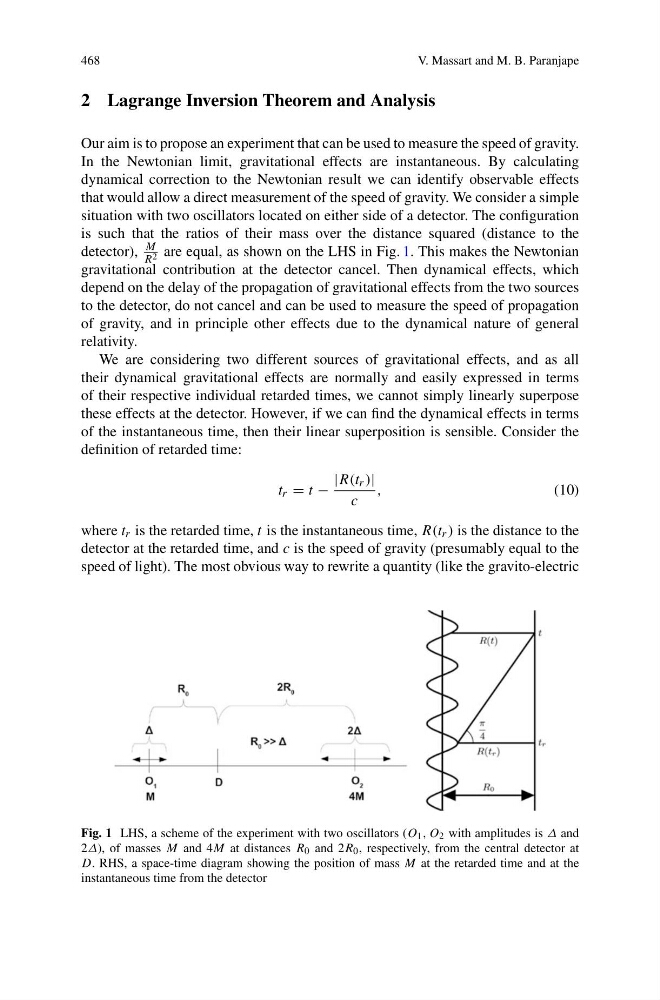
Our aim is to propose an experiment that can be used to measure the speed of gravity.
In the Newtonian limit, gravitational effects are instantaneous. By calculating
dynamical correction to the Newtonian result we can identify observable effects
that would allow a direct measurement of the speed of gravity. We consider a simple
situation with two oscillators located on either side of a detector. The configuration
is such that the ratios of their mass over the distance squared (distance to the
detector),
M
R 2 are equal, as shown on the LHS in Fig. 1. This makes the Newtonian
gravitational contribution at the detector cancel. Then dynamical effects, which
depend on the delay of the propagation of gravitational effects from the two sources
to the detector, do not cancel and can be used to measure the speed of propagation
of gravity, and in principle other effects due to the dynamical nature of general
relativity.
We are considering two different sources of gravitational effects, and as all
their dynamical gravitational effects are normally and easily expressed in terms
of their respective individual retarded times, we cannot simply linearly superpose
these effects at the detector. However, if we can find the dynamical effects in terms
of the instantaneous time, then their linear superposition is sensible. Consider the
definition of retarded time:
t r = t −
|R(t r )|
c
,
(10)
where t r is the retarded time, t is the instantaneous time, R(t r ) is the distance to the
detector at the retarded time, and c is the speed of gravity (presumably equal to the
speed of light). The most obvious way to rewrite a quantity (like the gravito-electric
Fig. 1 LHS, a scheme of the experiment with two oscillators (O 1 , O 2 with amplitudes is Δ and
2Δ), of masses M and 4M at distances R 0 and 2R 0 , respectively, from the central detector at
D. RHS, a space-time diagram showing the position of mass M at the retarded time and at the
instantaneous time from the detector
V. Massart and M. B. Paranjape
2 Lagrange Inversion Theorem and Analysis
Our aim is to propose an experiment that can be used to measure the speed of gravity.
In the Newtonian limit, gravitational effects are instantaneous. By calculating
dynamical correction to the Newtonian result we can identify observable effects
that would allow a direct measurement of the speed of gravity. We consider a simple
situation with two oscillators located on either side of a detector. The configuration
is such that the ratios of their mass over the distance squared (distance to the
detector),
M
R 2 are equal, as shown on the LHS in Fig. 1. This makes the Newtonian
gravitational contribution at the detector cancel. Then dynamical effects, which
depend on the delay of the propagation of gravitational effects from the two sources
to the detector, do not cancel and can be used to measure the speed of propagation
of gravity, and in principle other effects due to the dynamical nature of general
relativity.
We are considering two different sources of gravitational effects, and as all
their dynamical gravitational effects are normally and easily expressed in terms
of their respective individual retarded times, we cannot simply linearly superpose
these effects at the detector. However, if we can find the dynamical effects in terms
of the instantaneous time, then their linear superposition is sensible. Consider the
definition of retarded time:
t r = t −
|R(t r )|
c
,
(10)
where t r is the retarded time, t is the instantaneous time, R(t r ) is the distance to the
detector at the retarded time, and c is the speed of gravity (presumably equal to the
speed of light). The most obvious way to rewrite a quantity (like the gravito-electric
Fig. 1 LHS, a scheme of the experiment with two oscillators (O 1 , O 2 with amplitudes is Δ and
2Δ), of masses M and 4M at distances R 0 and 2R 0 , respectively, from the central detector at
D. RHS, a space-time diagram showing the position of mass M at the retarded time and at the
instantaneous time from the detector