

Aberration in Gravito-Electromagnetism
467
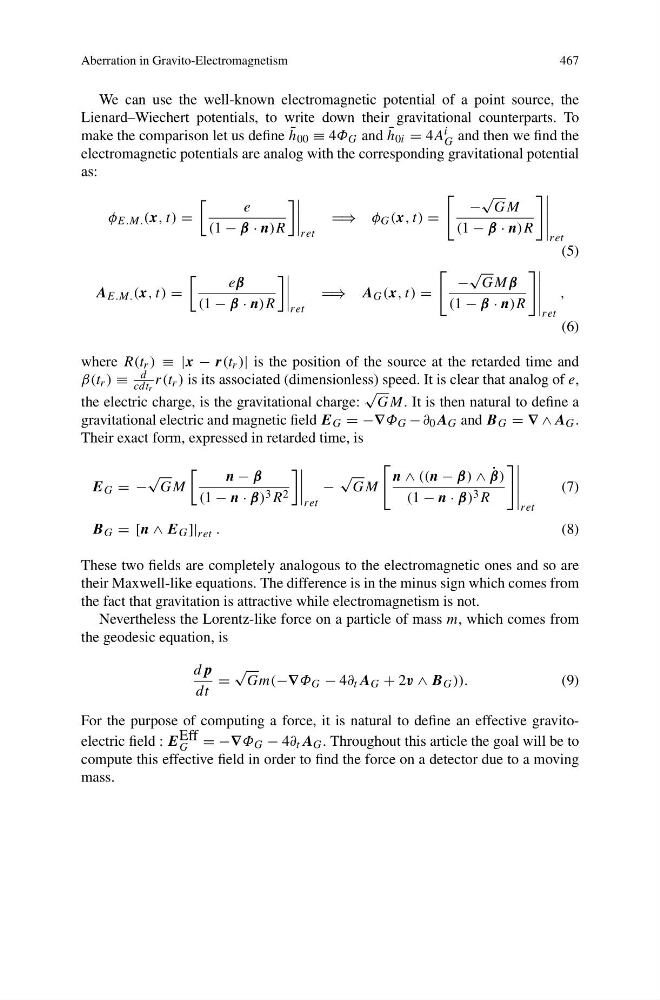
We can use the well-known electromagnetic potential of a point source, the
Lienard–Wiechert potentials, to write down their gravitational counterparts. To
make the comparison let us define ¯
h 00 ≡ 4Φ G and ¯
h 0i = 4A i
G and then we find the
electromagnetic potentials are analog with the corresponding gravitational potential
as:
φ E.M. (x, t) =
e
(1 − β · n)R
ret
⇒ φ G (x, t) =
−
√
GM
(1 − β · n)R
ret
(5)
A E.M. (x, t) =
eβ
(1 − β · n)R
ret
⇒ A G (x, t) =
−
√
GMβ
(1 − β · n)R
ret
,
(6)
where R(t r ) ≡ |x − r(t r )| is the position of the source at the retarded time and
β(t r ) ≡
d
cdt r
r(t r ) is its associated (dimensionless) speed. It is clear that analog of e,
the electric charge, is the gravitational charge:
√
GM. It is then natural to define a
gravitational electric and magnetic field E G = −∇Φ G − ∂ 0 A G and B G = ∇ ∧ A G .
Their exact form, expressed in retarded time, is
E G = −
√
GM
n − β
(1 − n · β) 3 R 2
ret
−
√
GM
n ∧ ((n − β) ∧ ˙
β)
(1 − n · β) 3 R
ret
(7)
B G = [n ∧ E G ]| ret .
(8)
These two fields are completely analogous to the electromagnetic ones and so are
their Maxwell-like equations. The difference is in the minus sign which comes from
the fact that gravitation is attractive while electromagnetism is not.
Nevertheless the Lorentz-like force on a particle of mass m, which comes from
the geodesic equation, is
dp
dt
=
√
Gm(−∇Φ G − 4∂ t A G + 2v ∧ B G )).
(9)
For the purpose of computing a force, it is natural to define an effective gravitoelectric field : E Eff
G = −∇Φ G − 4∂ t A G . Throughout this article the goal will be to
compute this effective field in order to find the force on a detector due to a moving
mass.
467
We can use the well-known electromagnetic potential of a point source, the
Lienard–Wiechert potentials, to write down their gravitational counterparts. To
make the comparison let us define ¯
h 00 ≡ 4Φ G and ¯
h 0i = 4A i
G and then we find the
electromagnetic potentials are analog with the corresponding gravitational potential
as:
φ E.M. (x, t) =
e
(1 − β · n)R
ret
⇒ φ G (x, t) =
−
√
GM
(1 − β · n)R
ret
(5)
A E.M. (x, t) =
eβ
(1 − β · n)R
ret
⇒ A G (x, t) =
−
√
GMβ
(1 − β · n)R
ret
,
(6)
where R(t r ) ≡ |x − r(t r )| is the position of the source at the retarded time and
β(t r ) ≡
d
cdt r
r(t r ) is its associated (dimensionless) speed. It is clear that analog of e,
the electric charge, is the gravitational charge:
√
GM. It is then natural to define a
gravitational electric and magnetic field E G = −∇Φ G − ∂ 0 A G and B G = ∇ ∧ A G .
Their exact form, expressed in retarded time, is
E G = −
√
GM
n − β
(1 − n · β) 3 R 2
ret
−
√
GM
n ∧ ((n − β) ∧ ˙
β)
(1 − n · β) 3 R
ret
(7)
B G = [n ∧ E G ]| ret .
(8)
These two fields are completely analogous to the electromagnetic ones and so are
their Maxwell-like equations. The difference is in the minus sign which comes from
the fact that gravitation is attractive while electromagnetism is not.
Nevertheless the Lorentz-like force on a particle of mass m, which comes from
the geodesic equation, is
dp
dt
=
√
Gm(−∇Φ G − 4∂ t A G + 2v ∧ B G )).
(9)
For the purpose of computing a force, it is natural to define an effective gravitoelectric field : E Eff
G = −∇Φ G − 4∂ t A G . Throughout this article the goal will be to
compute this effective field in order to find the force on a detector due to a moving
mass.