

Intensity Mapping: A New Window into the Cosmos
463
h
Ω m
n s
Ω b
σ 8
γ
0.1
1
10
100
b/
/
σ
h
Ω m
n s
Ω b
σ 8
f NL
500
1000
2000
5000
0.1
1
10
100
max
b σ
500
1000
2000
5000
max
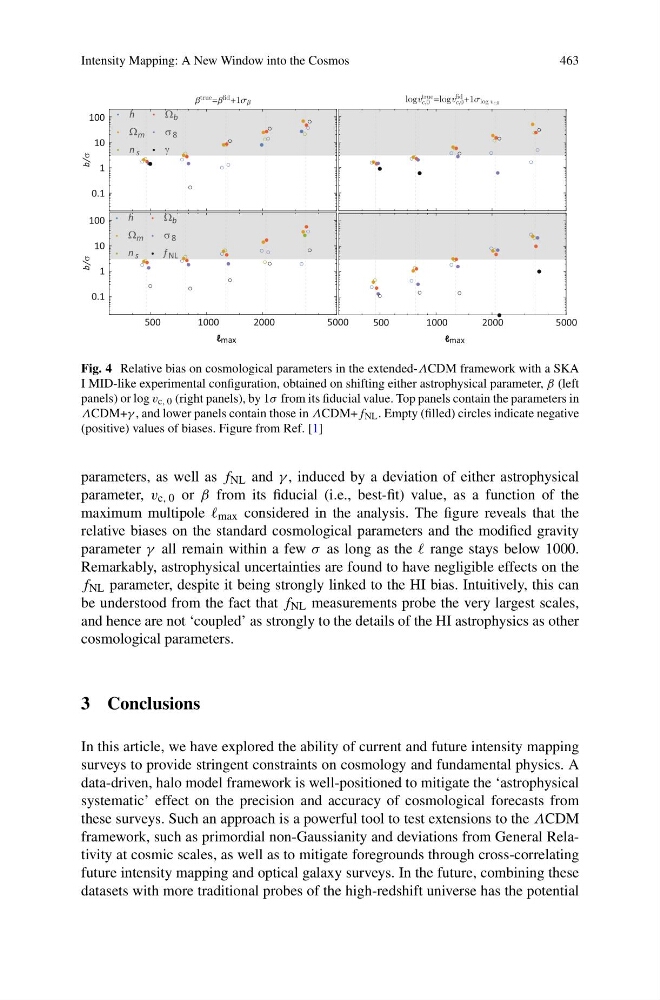
Fig. 4 Relative bias on cosmological parameters in the extended-ΛCDM framework with a SKA
I MID-like experimental configuration, obtained on shifting either astrophysical parameter, β (left
panels) or log v c, 0 (right panels), by 1σ from its fiducial value. Top panels contain the parameters in
ΛCDM+γ , and lower panels contain those in ΛCDM+f NL . Empty (filled) circles indicate negative
(positive) values of biases. Figure from Ref. [1]
parameters, as well as f NL and γ , induced by a deviation of either astrophysical
parameter, v c, 0 or β from its fiducial (i.e., best-fit) value, as a function of the
maximum multipole max considered in the analysis. The figure reveals that the
relative biases on the standard cosmological parameters and the modified gravity
parameter γ all remain within a few σ as long as the range stays below 1000.
Remarkably, astrophysical uncertainties are found to have negligible effects on the
f NL parameter, despite it being strongly linked to the HI bias. Intuitively, this can
be understood from the fact that f NL measurements probe the very largest scales,
and hence are not ‘coupled’ as strongly to the details of the HI astrophysics as other
cosmological parameters.
3 Conclusions
In this article, we have explored the ability of current and future intensity mapping
surveys to provide stringent constraints on cosmology and fundamental physics. A
data-driven, halo model framework is well-positioned to mitigate the ‘astrophysical
systematic’ effect on the precision and accuracy of cosmological forecasts from
these surveys. Such an approach is a powerful tool to test extensions to the ΛCDM
framework, such as primordial non-Gaussianity and deviations from General Relativity at cosmic scales, as well as to mitigate foregrounds through cross-correlating
future intensity mapping and optical galaxy surveys. In the future, combining these
datasets with more traditional probes of the high-redshift universe has the potential
463
h
Ω m
n s
Ω b
σ 8
γ
0.1
1
10
100
b/
/
σ
h
Ω m
n s
Ω b
σ 8
f NL
500
1000
2000
5000
0.1
1
10
100
max
b σ
500
1000
2000
5000
max
Fig. 4 Relative bias on cosmological parameters in the extended-ΛCDM framework with a SKA
I MID-like experimental configuration, obtained on shifting either astrophysical parameter, β (left
panels) or log v c, 0 (right panels), by 1σ from its fiducial value. Top panels contain the parameters in
ΛCDM+γ , and lower panels contain those in ΛCDM+f NL . Empty (filled) circles indicate negative
(positive) values of biases. Figure from Ref. [1]
parameters, as well as f NL and γ , induced by a deviation of either astrophysical
parameter, v c, 0 or β from its fiducial (i.e., best-fit) value, as a function of the
maximum multipole max considered in the analysis. The figure reveals that the
relative biases on the standard cosmological parameters and the modified gravity
parameter γ all remain within a few σ as long as the range stays below 1000.
Remarkably, astrophysical uncertainties are found to have negligible effects on the
f NL parameter, despite it being strongly linked to the HI bias. Intuitively, this can
be understood from the fact that f NL measurements probe the very largest scales,
and hence are not ‘coupled’ as strongly to the details of the HI astrophysics as other
cosmological parameters.
3 Conclusions
In this article, we have explored the ability of current and future intensity mapping
surveys to provide stringent constraints on cosmology and fundamental physics. A
data-driven, halo model framework is well-positioned to mitigate the ‘astrophysical
systematic’ effect on the precision and accuracy of cosmological forecasts from
these surveys. Such an approach is a powerful tool to test extensions to the ΛCDM
framework, such as primordial non-Gaussianity and deviations from General Relativity at cosmic scales, as well as to mitigate foregrounds through cross-correlating
future intensity mapping and optical galaxy surveys. In the future, combining these
datasets with more traditional probes of the high-redshift universe has the potential