

462
H. Padmanabhan
h Ω m n s Ω b σ 8
0.0
0.1
0.2
0.3
0.4
σ
A /A
Fixed astrophysics
With astrophysical prior
v c,0
β
Q
Fixed cosmology
With astrophysical prior
Original astro prior
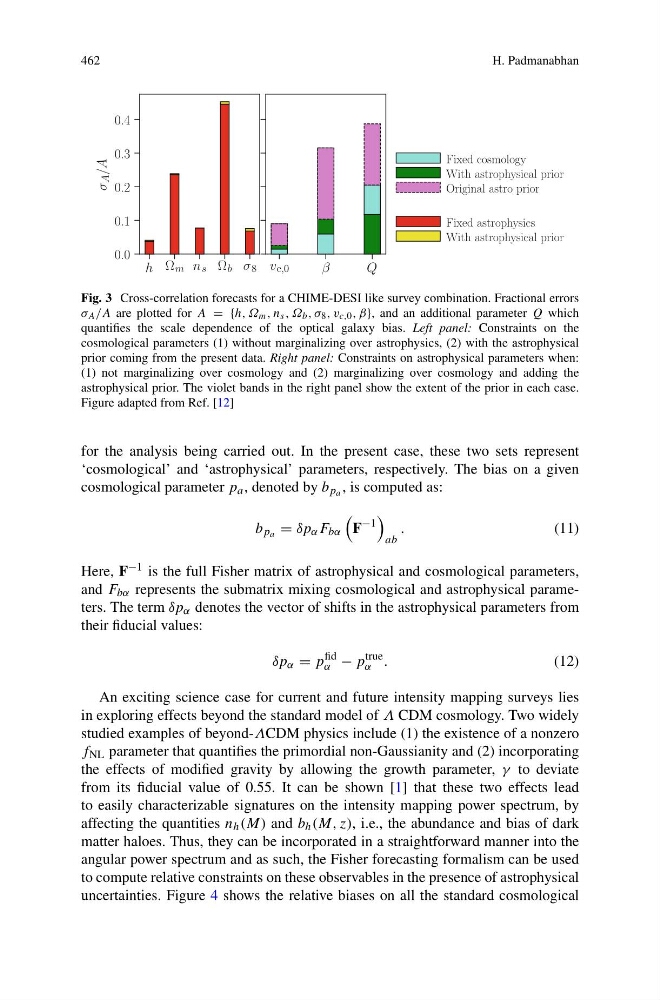
Fig. 3 Cross-correlation forecasts for a CHIME-DESI like survey combination. Fractional errors
σ A /A are plotted for A = {h, Ω m , n s , Ω b , σ 8 , v c,0 , β}, and an additional parameter Q which
quantifies the scale dependence of the optical galaxy bias. Left panel: Constraints on the
cosmological parameters (1) without marginalizing over astrophysics, (2) with the astrophysical
prior coming from the present data. Right panel: Constraints on astrophysical parameters when:
(1) not marginalizing over cosmology and (2) marginalizing over cosmology and adding the
astrophysical prior. The violet bands in the right panel show the extent of the prior in each case.
Figure adapted from Ref. [12]
for the analysis being carried out. In the present case, these two sets represent
‘cosmological’ and ‘astrophysical’ parameters, respectively. The bias on a given
cosmological parameter p a , denoted by b p a , is computed as:
b p a = δp α F bα
F
−1
ab
.
(11)
Here, F −1 is the full Fisher matrix of astrophysical and cosmological parameters,
and F bα represents the submatrix mixing cosmological and astrophysical parameters. The term δp α denotes the vector of shifts in the astrophysical parameters from
their fiducial values:
δp α = p
fid
α − p
true
α .
(12)
An exciting science case for current and future intensity mapping surveys lies
in exploring effects beyond the standard model of Λ CDM cosmology. Two widely
studied examples of beyond-ΛCDM physics include (1) the existence of a nonzero
f NL parameter that quantifies the primordial non-Gaussianity and (2) incorporating
the effects of modified gravity by allowing the growth parameter, γ to deviate
from its fiducial value of 0.55. It can be shown [1] that these two effects lead
to easily characterizable signatures on the intensity mapping power spectrum, by
affecting the quantities n h (M) and b h (M, z), i.e., the abundance and bias of dark
matter haloes. Thus, they can be incorporated in a straightforward manner into the
angular power spectrum and as such, the Fisher forecasting formalism can be used
to compute relative constraints on these observables in the presence of astrophysical
uncertainties. Figure 4 shows the relative biases on all the standard cosmological
H. Padmanabhan
h Ω m n s Ω b σ 8
0.0
0.1
0.2
0.3
0.4
σ
A /A
Fixed astrophysics
With astrophysical prior
v c,0
β
Q
Fixed cosmology
With astrophysical prior
Original astro prior
Fig. 3 Cross-correlation forecasts for a CHIME-DESI like survey combination. Fractional errors
σ A /A are plotted for A = {h, Ω m , n s , Ω b , σ 8 , v c,0 , β}, and an additional parameter Q which
quantifies the scale dependence of the optical galaxy bias. Left panel: Constraints on the
cosmological parameters (1) without marginalizing over astrophysics, (2) with the astrophysical
prior coming from the present data. Right panel: Constraints on astrophysical parameters when:
(1) not marginalizing over cosmology and (2) marginalizing over cosmology and adding the
astrophysical prior. The violet bands in the right panel show the extent of the prior in each case.
Figure adapted from Ref. [12]
for the analysis being carried out. In the present case, these two sets represent
‘cosmological’ and ‘astrophysical’ parameters, respectively. The bias on a given
cosmological parameter p a , denoted by b p a , is computed as:
b p a = δp α F bα
F
−1
ab
.
(11)
Here, F −1 is the full Fisher matrix of astrophysical and cosmological parameters,
and F bα represents the submatrix mixing cosmological and astrophysical parameters. The term δp α denotes the vector of shifts in the astrophysical parameters from
their fiducial values:
δp α = p
fid
α − p
true
α .
(12)
An exciting science case for current and future intensity mapping surveys lies
in exploring effects beyond the standard model of Λ CDM cosmology. Two widely
studied examples of beyond-ΛCDM physics include (1) the existence of a nonzero
f NL parameter that quantifies the primordial non-Gaussianity and (2) incorporating
the effects of modified gravity by allowing the growth parameter, γ to deviate
from its fiducial value of 0.55. It can be shown [1] that these two effects lead
to easily characterizable signatures on the intensity mapping power spectrum, by
affecting the quantities n h (M) and b h (M, z), i.e., the abundance and bias of dark
matter haloes. Thus, they can be incorporated in a straightforward manner into the
angular power spectrum and as such, the Fisher forecasting formalism can be used
to compute relative constraints on these observables in the presence of astrophysical
uncertainties. Figure 4 shows the relative biases on all the standard cosmological