

460
H. Padmanabhan
enables a tomographic analysis of clustering in multiple redshift bins without the
assumption of an underlying cosmological model (e.g., [15]). The expression for
C HI
(z) can be constructed using the Limber approximation (accurate to within 1%
for scales above ∼ 10; e.g., Ref. [5]), using the angular window function, W HI (z)
of the survey, as:
C
HI
(z) =
1
c
dz
W HI (z) 2 H (z)
R(z) 2
P HI [/R(z), z],
(8)
where H (z) is the Hubble parameter at redshift z, and R(z) is the comoving
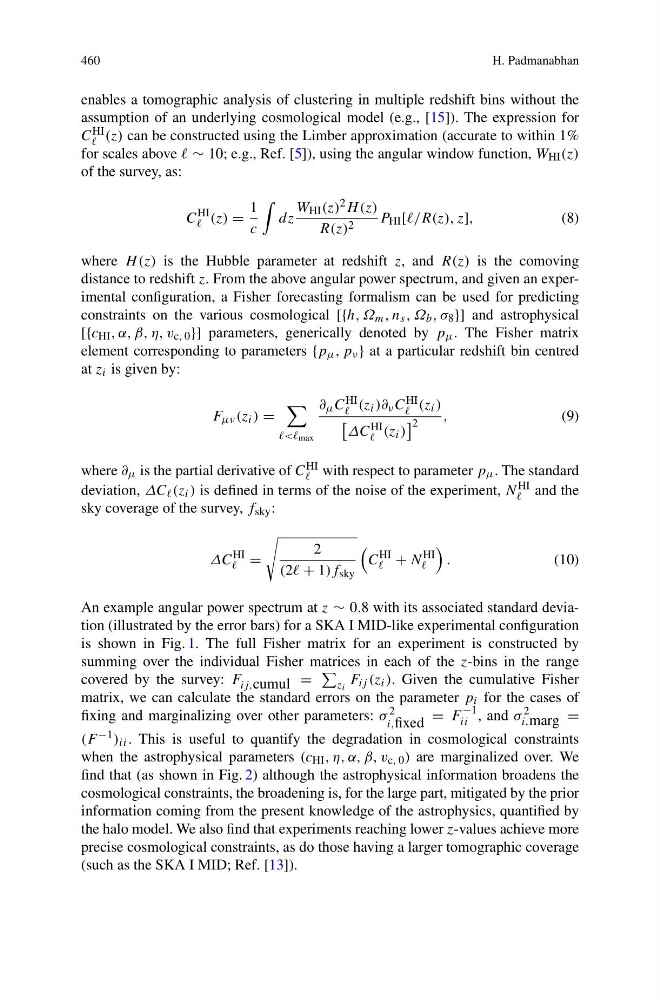
distance to redshift z. From the above angular power spectrum, and given an experimental configuration, a Fisher forecasting formalism can be used for predicting
constraints on the various cosmological [{h, Ω m , n s , Ω b , σ 8 }] and astrophysical
[{c HI , α, β, η, v c, 0 }] parameters, generically denoted by p μ . The Fisher matrix
element corresponding to parameters {p μ , p ν } at a particular redshift bin centred
at z i is given by:
F μν (z i ) =
<< max
∂ μ C HI
(z i )∂ ν C HI
(z i )
ΔC HI
(z i )
2
,
(9)
where ∂ μ is the partial derivative of C HI
with respect to parameter p μ . The standard
deviation, ΔC (z i ) is defined in terms of the noise of the experiment, N HI
and the
sky coverage of the survey, f sky :
ΔC
HI
=
2
(2 + 1)f sky
C
HI
+ N
HI
.
(10)
An example angular power spectrum at z ∼ 0.8 with its associated standard deviation (illustrated by the error bars) for a SKA I MID-like experimental configuration
is shown in Fig. 1. The full Fisher matrix for an experiment is constructed by
summing over the individual Fisher matrices in each of the z-bins in the range
covered by the survey: F ij,cumul =
z i
F ij (z i ). Given the cumulative Fisher
matrix, we can calculate the standard errors on the parameter p i for the cases of
fixing and marginalizing over other parameters: σ 2
i,fixed
= F
−1
ii , and σ 2
i,marg =
(F −1 ) ii . This is useful to quantify the degradation in cosmological constraints
when the astrophysical parameters (c HI , η, α, β, v c, 0 ) are marginalized over. We
find that (as shown in Fig. 2) although the astrophysical information broadens the
cosmological constraints, the broadening is, for the large part, mitigated by the prior
information coming from the present knowledge of the astrophysics, quantified by
the halo model. We also find that experiments reaching lower z-values achieve more
precise cosmological constraints, as do those having a larger tomographic coverage
(such as the SKA I MID; Ref. [13]).
H. Padmanabhan
enables a tomographic analysis of clustering in multiple redshift bins without the
assumption of an underlying cosmological model (e.g., [15]). The expression for
C HI
(z) can be constructed using the Limber approximation (accurate to within 1%
for scales above ∼ 10; e.g., Ref. [5]), using the angular window function, W HI (z)
of the survey, as:
C
HI
(z) =
1
c
dz
W HI (z) 2 H (z)
R(z) 2
P HI [/R(z), z],
(8)
where H (z) is the Hubble parameter at redshift z, and R(z) is the comoving
distance to redshift z. From the above angular power spectrum, and given an experimental configuration, a Fisher forecasting formalism can be used for predicting
constraints on the various cosmological [{h, Ω m , n s , Ω b , σ 8 }] and astrophysical
[{c HI , α, β, η, v c, 0 }] parameters, generically denoted by p μ . The Fisher matrix
element corresponding to parameters {p μ , p ν } at a particular redshift bin centred
at z i is given by:
F μν (z i ) =
<< max
∂ μ C HI
(z i )∂ ν C HI
(z i )
ΔC HI
(z i )
2
,
(9)
where ∂ μ is the partial derivative of C HI
with respect to parameter p μ . The standard
deviation, ΔC (z i ) is defined in terms of the noise of the experiment, N HI
and the
sky coverage of the survey, f sky :
ΔC
HI
=
2
(2 + 1)f sky
C
HI
+ N
HI
.
(10)
An example angular power spectrum at z ∼ 0.8 with its associated standard deviation (illustrated by the error bars) for a SKA I MID-like experimental configuration
is shown in Fig. 1. The full Fisher matrix for an experiment is constructed by
summing over the individual Fisher matrices in each of the z-bins in the range
covered by the survey: F ij,cumul =
z i
F ij (z i ). Given the cumulative Fisher
matrix, we can calculate the standard errors on the parameter p i for the cases of
fixing and marginalizing over other parameters: σ 2
i,fixed
= F
−1
ii , and σ 2
i,marg =
(F −1 ) ii . This is useful to quantify the degradation in cosmological constraints
when the astrophysical parameters (c HI , η, α, β, v c, 0 ) are marginalized over. We
find that (as shown in Fig. 2) although the astrophysical information broadens the
cosmological constraints, the broadening is, for the large part, mitigated by the prior
information coming from the present knowledge of the astrophysics, quantified by
the halo model. We also find that experiments reaching lower z-values achieve more
precise cosmological constraints, as do those having a larger tomographic coverage
(such as the SKA I MID; Ref. [13]).