

Intensity Mapping: A New Window into the Cosmos
459
with free parameters (1) α, the fraction of HI relative to cosmic f H, c , (2) β, the
logarithmic slope of the HI-halo mass relation and (3) v c, 0 , the lower virial velocity
cutoff below which haloes preferentially do not host HI. Similarly, the small-scale
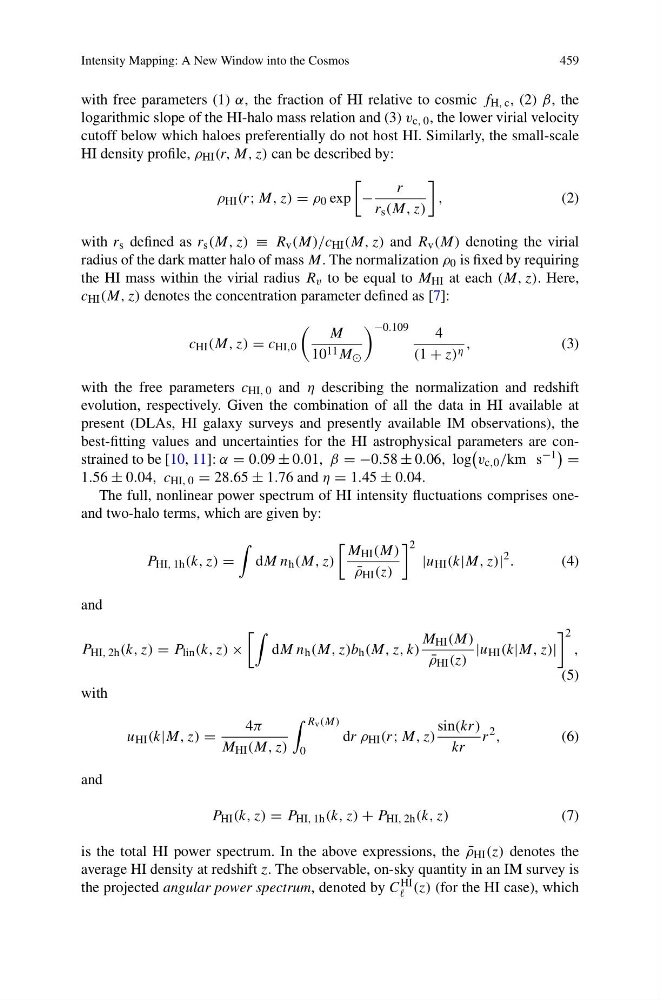
HI density profile, ρ HI (r, M, z) can be described by:
ρ HI (r; M, z) = ρ 0 exp
−
r
r s (M, z)
,
(2)
with r s defined as r s (M, z) ≡ R v (M)/c HI (M, z) and R v (M) denoting the virial
radius of the dark matter halo of mass M. The normalization ρ 0 is fixed by requiring
the HI mass within the virial radius R v to be equal to M HI at each (M, z). Here,
c HI (M, z) denotes the concentration parameter defined as [7]:
c HI (M, z) = c HI,0
M
10 11 M
−0.109
4
(1 + z) η ,
(3)
with the free parameters c HI, 0 and η describing the normalization and redshift
evolution, respectively. Given the combination of all the data in HI available at
present (DLAs, HI galaxy surveys and presently available IM observations), the
best-fitting values and uncertainties for the HI astrophysical parameters are constrained to be [10, 11]: α = 0.09 ± 0.01, β = −0.58 ± 0.06, log
v c,0 /km s
−1
=
1.56 ± 0.04, c HI, 0 = 28.65 ± 1.76 and η = 1.45 ± 0.04.
The full, nonlinear power spectrum of HI intensity fluctuations comprises oneand two-halo terms, which are given by:
P HI, 1h (k, z) =
dM n h (M, z)
M HI (M)
¯
ρ HI (z)
2
|u HI (k|M, z)|
2 .
(4)
and
P HI, 2h (k, z) = P lin (k, z) ×
dM n h (M, z)b h (M, z, k)
M HI (M)
¯
ρ HI (z)
|u HI (k|M, z)|
2
,
(5)
with
u HI (k|M, z) =
4π
M HI (M, z)
R v (M)
0
dr ρ HI (r; M, z)
sin(kr)
kr
r
2 ,
(6)
and
P HI (k, z) = P HI, 1h (k, z) + P HI, 2h (k, z)
(7)
is the total HI power spectrum. In the above expressions, the ¯
ρ HI (z) denotes the
average HI density at redshift z. The observable, on-sky quantity in an IM survey is
the projected angular power spectrum, denoted by C HI
(z) (for the HI case), which
459
with free parameters (1) α, the fraction of HI relative to cosmic f H, c , (2) β, the
logarithmic slope of the HI-halo mass relation and (3) v c, 0 , the lower virial velocity
cutoff below which haloes preferentially do not host HI. Similarly, the small-scale
HI density profile, ρ HI (r, M, z) can be described by:
ρ HI (r; M, z) = ρ 0 exp
−
r
r s (M, z)
,
(2)
with r s defined as r s (M, z) ≡ R v (M)/c HI (M, z) and R v (M) denoting the virial
radius of the dark matter halo of mass M. The normalization ρ 0 is fixed by requiring
the HI mass within the virial radius R v to be equal to M HI at each (M, z). Here,
c HI (M, z) denotes the concentration parameter defined as [7]:
c HI (M, z) = c HI,0
M
10 11 M
−0.109
4
(1 + z) η ,
(3)
with the free parameters c HI, 0 and η describing the normalization and redshift
evolution, respectively. Given the combination of all the data in HI available at
present (DLAs, HI galaxy surveys and presently available IM observations), the
best-fitting values and uncertainties for the HI astrophysical parameters are constrained to be [10, 11]: α = 0.09 ± 0.01, β = −0.58 ± 0.06, log
v c,0 /km s
−1
=
1.56 ± 0.04, c HI, 0 = 28.65 ± 1.76 and η = 1.45 ± 0.04.
The full, nonlinear power spectrum of HI intensity fluctuations comprises oneand two-halo terms, which are given by:
P HI, 1h (k, z) =
dM n h (M, z)
M HI (M)
¯
ρ HI (z)
2
|u HI (k|M, z)|
2 .
(4)
and
P HI, 2h (k, z) = P lin (k, z) ×
dM n h (M, z)b h (M, z, k)
M HI (M)
¯
ρ HI (z)
|u HI (k|M, z)|
2
,
(5)
with
u HI (k|M, z) =
4π
M HI (M, z)
R v (M)
0
dr ρ HI (r; M, z)
sin(kr)
kr
r
2 ,
(6)
and
P HI (k, z) = P HI, 1h (k, z) + P HI, 2h (k, z)
(7)
is the total HI power spectrum. In the above expressions, the ¯
ρ HI (z) denotes the
average HI density at redshift z. The observable, on-sky quantity in an IM survey is
the projected angular power spectrum, denoted by C HI
(z) (for the HI case), which