

424
C. Cosme
abundance, the dark scalar’s mass, and its lifetime. Fixing the present dark matter
abundance, we get a relation between g and λ φ (Eq. (14)), implying that m φ and
τ φ depend exclusively on the Higgs-portal coupling. Hence, the prediction for the
magnitude of the 3.5 keV line in different astrophysical objects is quite remarkable
and, as far as we are aware, it has not been achieved by other scenarios, where the
dark matter’s mass and lifetime can be tuned by different free parameters.
4.2 Invisible Higgs Decays into Dark Scalars
One way to probe the Higgs-portal scalar field dark matter is to look for invisible
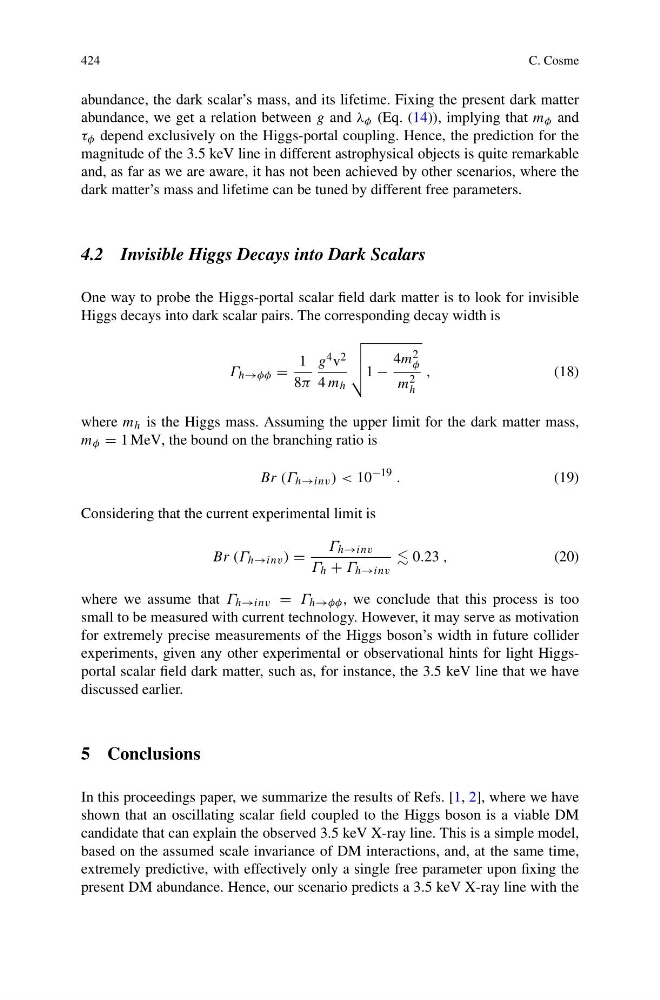
Higgs decays into dark scalar pairs. The corresponding decay width is
Γ h→φφ =
1
8π
g 4 v 2
4 m h
1 −
4m 2
φ
m 2
h
,
(18)
where m h is the Higgs mass. Assuming the upper limit for the dark matter mass,
m φ = 1 MeV, the bound on the branching ratio is
Br (Γ h→inv ) < 10
−19 .
(19)
Considering that the current experimental limit is
Br (Γ h→inv ) =
Γ h→inv
Γ h + Γ h→inv
0.23 ,
(20)
where we assume that Γ h→inv = Γ h→φφ , we conclude that this process is too
small to be measured with current technology. However, it may serve as motivation
for extremely precise measurements of the Higgs boson’s width in future collider
experiments, given any other experimental or observational hints for light Higgsportal scalar field dark matter, such as, for instance, the 3.5 keV line that we have
discussed earlier.
5 Conclusions
In this proceedings paper, we summarize the results of Refs. [1, 2], where we have
shown that an oscillating scalar field coupled to the Higgs boson is a viable DM
candidate that can explain the observed 3.5 keV X-ray line. This is a simple model,
based on the assumed scale invariance of DM interactions, and, at the same time,
extremely predictive, with effectively only a single free parameter upon fixing the
present DM abundance. Hence, our scenario predicts a 3.5 keV X-ray line with the
C. Cosme
abundance, the dark scalar’s mass, and its lifetime. Fixing the present dark matter
abundance, we get a relation between g and λ φ (Eq. (14)), implying that m φ and
τ φ depend exclusively on the Higgs-portal coupling. Hence, the prediction for the
magnitude of the 3.5 keV line in different astrophysical objects is quite remarkable
and, as far as we are aware, it has not been achieved by other scenarios, where the
dark matter’s mass and lifetime can be tuned by different free parameters.
4.2 Invisible Higgs Decays into Dark Scalars
One way to probe the Higgs-portal scalar field dark matter is to look for invisible
Higgs decays into dark scalar pairs. The corresponding decay width is
Γ h→φφ =
1
8π
g 4 v 2
4 m h
1 −
4m 2
φ
m 2
h
,
(18)
where m h is the Higgs mass. Assuming the upper limit for the dark matter mass,
m φ = 1 MeV, the bound on the branching ratio is
Br (Γ h→inv ) < 10
−19 .
(19)
Considering that the current experimental limit is
Br (Γ h→inv ) =
Γ h→inv
Γ h + Γ h→inv
0.23 ,
(20)
where we assume that Γ h→inv = Γ h→φφ , we conclude that this process is too
small to be measured with current technology. However, it may serve as motivation
for extremely precise measurements of the Higgs boson’s width in future collider
experiments, given any other experimental or observational hints for light Higgsportal scalar field dark matter, such as, for instance, the 3.5 keV line that we have
discussed earlier.
5 Conclusions
In this proceedings paper, we summarize the results of Refs. [1, 2], where we have
shown that an oscillating scalar field coupled to the Higgs boson is a viable DM
candidate that can explain the observed 3.5 keV X-ray line. This is a simple model,
based on the assumed scale invariance of DM interactions, and, at the same time,
extremely predictive, with effectively only a single free parameter upon fixing the
present DM abundance. Hence, our scenario predicts a 3.5 keV X-ray line with the