

Scale-Invariant Scalar Field Dark Matter Through the Higgs-Portal
423
Hence, although the lifetime is much larger than the age of the Universe, it can
lead to an observable monochromatic line in the spectrum of galaxies and galaxy
clusters.
Recently, the XMM-Newton X-ray observatory detected a line at 3.5 keV in the
Galactic Center, Andromeda, and Perseus cluster [4–7]. The nature of this line
has arisen some interest in the scientific community, leading to several interesting
proposals in the literature, in particular, the possibility of it resulting from DM
decay or annihilation [7–12]. In fact, the analysis in Refs. [6, 13] has shown that the
intensity of the line observed in the astrophysical systems mentioned above could
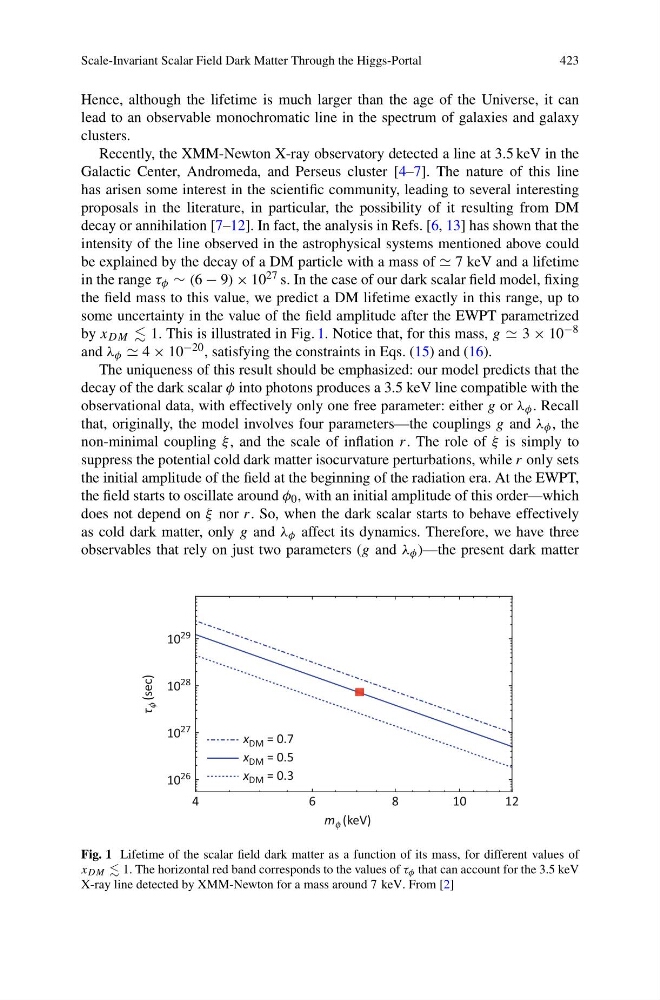
be explained by the decay of a DM particle with a mass of 7 keV and a lifetime
in the range τ φ ∼ (6 − 9) × 10 27 s. In the case of our dark scalar field model, fixing
the field mass to this value, we predict a DM lifetime exactly in this range, up to
some uncertainty in the value of the field amplitude after the EWPT parametrized
by x DM 1. This is illustrated in Fig. 1. Notice that, for this mass, g 3 × 10 −8
and λ φ 4 × 10 −20 , satisfying the constraints in Eqs. (15) and (16).
The uniqueness of this result should be emphasized: our model predicts that the
decay of the dark scalar φ into photons produces a 3.5 keV line compatible with the
observational data, with effectively only one free parameter: either g or λ φ . Recall
that, originally, the model involves four parameters—the couplings g and λ φ , the
non-minimal coupling ξ , and the scale of inflation r. The role of ξ is simply to
suppress the potential cold dark matter isocurvature perturbations, while r only sets
the initial amplitude of the field at the beginning of the radiation era. At the EWPT,
the field starts to oscillate around φ 0 , with an initial amplitude of this order—which
does not depend on ξ nor r. So, when the dark scalar starts to behave effectively
as cold dark matter, only g and λ φ affect its dynamics. Therefore, we have three
observables that rely on just two parameters (g and λ φ )—the present dark matter
x DM = 0.7
x DM = 0.5
x DM = 0.3
4
6
8
10
12
10
26
10
27
10
28
10
29
m f (keV)
τ
f (sec)
Fig. 1 Lifetime of the scalar field dark matter as a function of its mass, for different values of
x DM 1. The horizontal red band corresponds to the values of τ φ that can account for the 3.5 keV
X-ray line detected by XMM-Newton for a mass around 7 keV. From [2]
423
Hence, although the lifetime is much larger than the age of the Universe, it can
lead to an observable monochromatic line in the spectrum of galaxies and galaxy
clusters.
Recently, the XMM-Newton X-ray observatory detected a line at 3.5 keV in the
Galactic Center, Andromeda, and Perseus cluster [4–7]. The nature of this line
has arisen some interest in the scientific community, leading to several interesting
proposals in the literature, in particular, the possibility of it resulting from DM
decay or annihilation [7–12]. In fact, the analysis in Refs. [6, 13] has shown that the
intensity of the line observed in the astrophysical systems mentioned above could
be explained by the decay of a DM particle with a mass of 7 keV and a lifetime
in the range τ φ ∼ (6 − 9) × 10 27 s. In the case of our dark scalar field model, fixing
the field mass to this value, we predict a DM lifetime exactly in this range, up to
some uncertainty in the value of the field amplitude after the EWPT parametrized
by x DM 1. This is illustrated in Fig. 1. Notice that, for this mass, g 3 × 10 −8
and λ φ 4 × 10 −20 , satisfying the constraints in Eqs. (15) and (16).
The uniqueness of this result should be emphasized: our model predicts that the
decay of the dark scalar φ into photons produces a 3.5 keV line compatible with the
observational data, with effectively only one free parameter: either g or λ φ . Recall
that, originally, the model involves four parameters—the couplings g and λ φ , the
non-minimal coupling ξ , and the scale of inflation r. The role of ξ is simply to
suppress the potential cold dark matter isocurvature perturbations, while r only sets
the initial amplitude of the field at the beginning of the radiation era. At the EWPT,
the field starts to oscillate around φ 0 , with an initial amplitude of this order—which
does not depend on ξ nor r. So, when the dark scalar starts to behave effectively
as cold dark matter, only g and λ φ affect its dynamics. Therefore, we have three
observables that rely on just two parameters (g and λ φ )—the present dark matter
x DM = 0.7
x DM = 0.5
x DM = 0.3
4
6
8
10
12
10
26
10
27
10
28
10
29
m f (keV)
τ
f (sec)
Fig. 1 Lifetime of the scalar field dark matter as a function of its mass, for different values of
x DM 1. The horizontal red band corresponds to the values of τ φ that can account for the 3.5 keV
X-ray line detected by XMM-Newton for a mass around 7 keV. From [2]