

Scale-Invariant Scalar Field Dark Matter Through the Higgs-Portal
419
2.1 Inflation
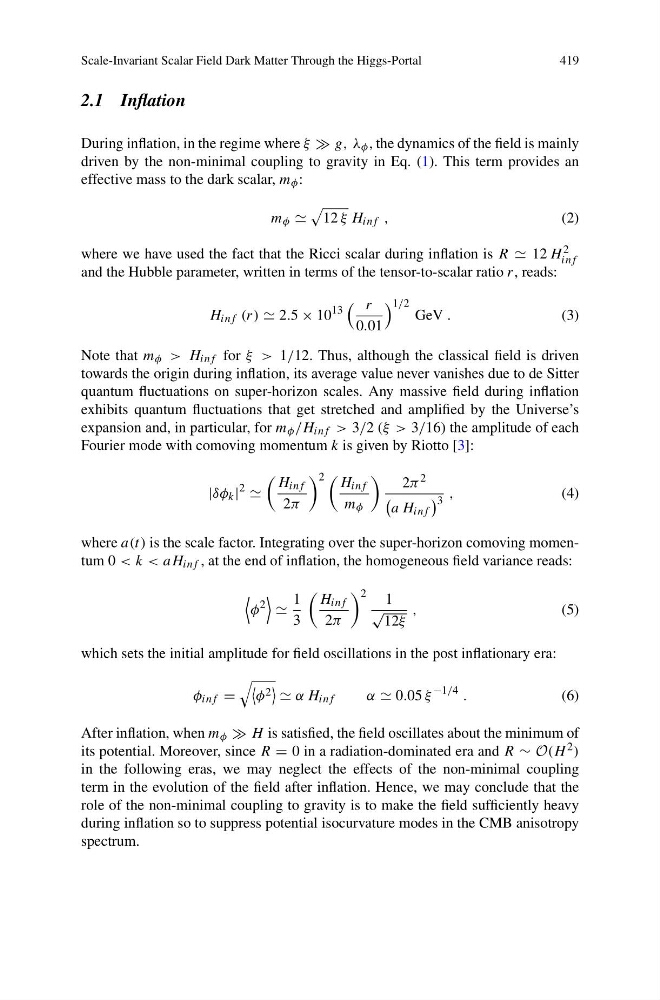
During inflation, in the regime where ξ g, λ φ , the dynamics of the field is mainly
driven by the non-minimal coupling to gravity in Eq. (1). This term provides an
effective mass to the dark scalar, m φ :
m φ
12 ξ H inf ,
(2)
where we have used the fact that the Ricci scalar during inflation is R 12 H 2
inf
and the Hubble parameter, written in terms of the tensor-to-scalar ratio r, reads:
H inf (r) 2.5 × 10
13
r
0.01
1/2
GeV .
(3)
Note that m φ > H inf for ξ > 1/12. Thus, although the classical field is driven
towards the origin during inflation, its average value never vanishes due to de Sitter
quantum fluctuations on super-horizon scales. Any massive field during inflation
exhibits quantum fluctuations that get stretched and amplified by the Universe’s
expansion and, in particular, for m φ /H inf > 3/2 (ξ > 3/16) the amplitude of each
Fourier mode with comoving momentum k is given by Riotto [3]:
|δφ k |
2
H inf
2π
2 H inf
m φ
2π 2
a H inf
3 ,
(4)
where a(t) is the scale factor. Integrating over the super-horizon comoving momentum 0 < k < aH inf , at the end of inflation, the homogeneous field variance reads:
φ
2
1
3
H inf
2π
2 1
√
12ξ
,
(5)
which sets the initial amplitude for field oscillations in the post inflationary era:
φ inf =
φ 2
α H inf
α 0.05 ξ
−1/4 .
(6)
After inflation, when m φ H is satisfied, the field oscillates about the minimum of
its potential. Moreover, since R = 0 in a radiation-dominated era and R ∼ O(H 2 )
in the following eras, we may neglect the effects of the non-minimal coupling
term in the evolution of the field after inflation. Hence, we may conclude that the
role of the non-minimal coupling to gravity is to make the field sufficiently heavy
during inflation so to suppress potential isocurvature modes in the CMB anisotropy
spectrum.
419
2.1 Inflation
During inflation, in the regime where ξ g, λ φ , the dynamics of the field is mainly
driven by the non-minimal coupling to gravity in Eq. (1). This term provides an
effective mass to the dark scalar, m φ :
m φ
12 ξ H inf ,
(2)
where we have used the fact that the Ricci scalar during inflation is R 12 H 2
inf
and the Hubble parameter, written in terms of the tensor-to-scalar ratio r, reads:
H inf (r) 2.5 × 10
13
r
0.01
1/2
GeV .
(3)
Note that m φ > H inf for ξ > 1/12. Thus, although the classical field is driven
towards the origin during inflation, its average value never vanishes due to de Sitter
quantum fluctuations on super-horizon scales. Any massive field during inflation
exhibits quantum fluctuations that get stretched and amplified by the Universe’s
expansion and, in particular, for m φ /H inf > 3/2 (ξ > 3/16) the amplitude of each
Fourier mode with comoving momentum k is given by Riotto [3]:
|δφ k |
2
H inf
2π
2 H inf
m φ
2π 2
a H inf
3 ,
(4)
where a(t) is the scale factor. Integrating over the super-horizon comoving momentum 0 < k < aH inf , at the end of inflation, the homogeneous field variance reads:
φ
2
1
3
H inf
2π
2 1
√
12ξ
,
(5)
which sets the initial amplitude for field oscillations in the post inflationary era:
φ inf =
φ 2
α H inf
α 0.05 ξ
−1/4 .
(6)
After inflation, when m φ H is satisfied, the field oscillates about the minimum of
its potential. Moreover, since R = 0 in a radiation-dominated era and R ∼ O(H 2 )
in the following eras, we may neglect the effects of the non-minimal coupling
term in the evolution of the field after inflation. Hence, we may conclude that the
role of the non-minimal coupling to gravity is to make the field sufficiently heavy
during inflation so to suppress potential isocurvature modes in the CMB anisotropy
spectrum.