

418
C. Cosme
far and the absence of new particles at the LHC motivates looking for alternatives
to the WIMP paradigm.
In this work, we introduce an oscillating scalar field coupled to the Higgs as
a dark matter candidate. Even though the Higgs-portal for dark matter has been
explored in the context of thermal dark matter candidates (WIMPs), there are
few proposals in the literature that investigate the case of a scalar field which is
oscillating in the minimum of its quadratic potential, behaving like non-relativistic
matter. Thus, we focus on a model where the oscillating scalar field dark matter
obtains its mass only through the Higgs mechanism, i.e., through scale-invariant
Higgs-portal interactions. We assume an underlying scale invariance of the theory,
spontaneously broken by some mechanism that generates the Planck and the
electroweak scales in the Lagrangian, but which forbids a bare mass term for the
dark scalar. The scale invariance is maintained in the dark sector and, therefore,
the dark scalar only gets mass after the electroweak phase transition (EWPT).
Additionally, the model has a U(1) gauge symmetry which ensures the dark matter
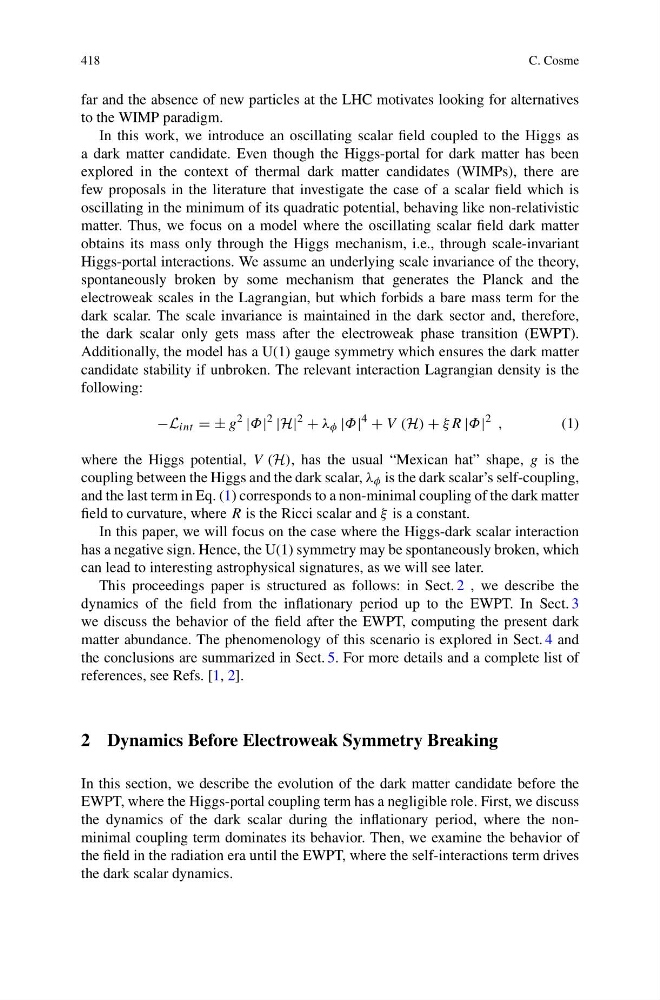
candidate stability if unbroken. The relevant interaction Lagrangian density is the
following:
−L int = ± g
2
|Φ|
2
|H|
2
+ λ φ |Φ|
4
+ V (H) + ξR |Φ|
2 ,
(1)
where the Higgs potential, V (H), has the usual “Mexican hat” shape, g is the
coupling between the Higgs and the dark scalar, λ φ is the dark scalar’s self-coupling,
and the last term in Eq. (1) corresponds to a non-minimal coupling of the dark matter
field to curvature, where R is the Ricci scalar and ξ is a constant.
In this paper, we will focus on the case where the Higgs-dark scalar interaction
has a negative sign. Hence, the U(1) symmetry may be spontaneously broken, which
can lead to interesting astrophysical signatures, as we will see later.
This proceedings paper is structured as follows: in Sect. 2 , we describe the
dynamics of the field from the inflationary period up to the EWPT. In Sect. 3
we discuss the behavior of the field after the EWPT, computing the present dark
matter abundance. The phenomenology of this scenario is explored in Sect. 4 and
the conclusions are summarized in Sect. 5. For more details and a complete list of
references, see Refs. [1, 2].
2 Dynamics Before Electroweak Symmetry Breaking
In this section, we describe the evolution of the dark matter candidate before the
EWPT, where the Higgs-portal coupling term has a negligible role. First, we discuss
the dynamics of the dark scalar during the inflationary period, where the nonminimal coupling term dominates its behavior. Then, we examine the behavior of
the field in the radiation era until the EWPT, where the self-interactions term drives
the dark scalar dynamics.
C. Cosme
far and the absence of new particles at the LHC motivates looking for alternatives
to the WIMP paradigm.
In this work, we introduce an oscillating scalar field coupled to the Higgs as
a dark matter candidate. Even though the Higgs-portal for dark matter has been
explored in the context of thermal dark matter candidates (WIMPs), there are
few proposals in the literature that investigate the case of a scalar field which is
oscillating in the minimum of its quadratic potential, behaving like non-relativistic
matter. Thus, we focus on a model where the oscillating scalar field dark matter
obtains its mass only through the Higgs mechanism, i.e., through scale-invariant
Higgs-portal interactions. We assume an underlying scale invariance of the theory,
spontaneously broken by some mechanism that generates the Planck and the
electroweak scales in the Lagrangian, but which forbids a bare mass term for the
dark scalar. The scale invariance is maintained in the dark sector and, therefore,
the dark scalar only gets mass after the electroweak phase transition (EWPT).
Additionally, the model has a U(1) gauge symmetry which ensures the dark matter
candidate stability if unbroken. The relevant interaction Lagrangian density is the
following:
−L int = ± g
2
|Φ|
2
|H|
2
+ λ φ |Φ|
4
+ V (H) + ξR |Φ|
2 ,
(1)
where the Higgs potential, V (H), has the usual “Mexican hat” shape, g is the
coupling between the Higgs and the dark scalar, λ φ is the dark scalar’s self-coupling,
and the last term in Eq. (1) corresponds to a non-minimal coupling of the dark matter
field to curvature, where R is the Ricci scalar and ξ is a constant.
In this paper, we will focus on the case where the Higgs-dark scalar interaction
has a negative sign. Hence, the U(1) symmetry may be spontaneously broken, which
can lead to interesting astrophysical signatures, as we will see later.
This proceedings paper is structured as follows: in Sect. 2 , we describe the
dynamics of the field from the inflationary period up to the EWPT. In Sect. 3
we discuss the behavior of the field after the EWPT, computing the present dark
matter abundance. The phenomenology of this scenario is explored in Sect. 4 and
the conclusions are summarized in Sect. 5. For more details and a complete list of
references, see Refs. [1, 2].
2 Dynamics Before Electroweak Symmetry Breaking
In this section, we describe the evolution of the dark matter candidate before the
EWPT, where the Higgs-portal coupling term has a negligible role. First, we discuss
the dynamics of the dark scalar during the inflationary period, where the nonminimal coupling term dominates its behavior. Then, we examine the behavior of
the field in the radiation era until the EWPT, where the self-interactions term drives
the dark scalar dynamics.