

Features of Discrete Integrability
25
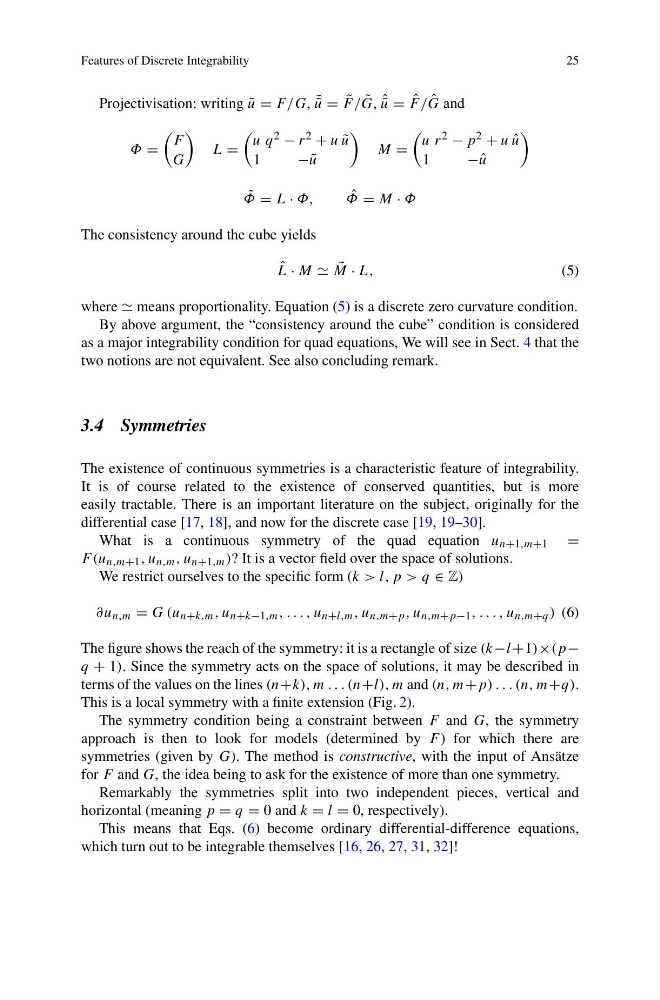
Projectivisation: writing ¯
u = F /G, ˜ ¯
u = ˜
F / ˜
G, ˆ ¯
u = ˆ
F / ˆ
G and
Φ =
F
G
L =
u q 2 − r 2 + u ˜
u
1
− ˜
u
M =
u r 2 − p 2 + u ˆ
u
1
− ˆ
u
˜
Φ = L · Φ,
ˆ
Φ = M · Φ
The consistency around the cube yields
ˆ
L · M ˜
M · L,
(5)
where means proportionality. Equation (5) is a discrete zero curvature condition.
By above argument, the “consistency around the cube” condition is considered
as a major integrability condition for quad equations, We will see in Sect. 4 that the
two notions are not equivalent. See also concluding remark.
3.4 Symmetries
The existence of continuous symmetries is a characteristic feature of integrability.
It is of course related to the existence of conserved quantities, but is more
easily tractable. There is an important literature on the subject, originally for the
differential case [17, 18], and now for the discrete case [19, 19–30].
What is a continuous symmetry of the quad equation u n+1,m+1 =
F (u n,m+1 , u n,m , u n+1,m )? It is a vector field over the space of solutions.
We restrict ourselves to the specific form (k > l, p > q ∈ Z)
∂u n,m = G (u n+k,m , u n+k−1,m , . . . , u n+l,m , u n,m+p , u n,m+p−1 , . . . , u n,m+q ) (6)
The figure shows the reach of the symmetry: it is a rectangle of size (k−l +1)×(p−
q + 1). Since the symmetry acts on the space of solutions, it may be described in
terms of the values on the lines (n+k), m . . . (n+l), m and (n, m+p) . . . (n, m+q).
This is a local symmetry with a finite extension (Fig. 2).
The symmetry condition being a constraint between F and G, the symmetry
approach is then to look for models (determined by F ) for which there are
symmetries (given by G). The method is constructive, with the input of Ansätze
for F and G, the idea being to ask for the existence of more than one symmetry.
Remarkably the symmetries split into two independent pieces, vertical and
horizontal (meaning p = q = 0 and k = l = 0, respectively).
This means that Eqs. (6) become ordinary differential-difference equations,
which turn out to be integrable themselves [16, 26, 27, 31, 32]!
25
Projectivisation: writing ¯
u = F /G, ˜ ¯
u = ˜
F / ˜
G, ˆ ¯
u = ˆ
F / ˆ
G and
Φ =
F
G
L =
u q 2 − r 2 + u ˜
u
1
− ˜
u
M =
u r 2 − p 2 + u ˆ
u
1
− ˆ
u
˜
Φ = L · Φ,
ˆ
Φ = M · Φ
The consistency around the cube yields
ˆ
L · M ˜
M · L,
(5)
where means proportionality. Equation (5) is a discrete zero curvature condition.
By above argument, the “consistency around the cube” condition is considered
as a major integrability condition for quad equations, We will see in Sect. 4 that the
two notions are not equivalent. See also concluding remark.
3.4 Symmetries
The existence of continuous symmetries is a characteristic feature of integrability.
It is of course related to the existence of conserved quantities, but is more
easily tractable. There is an important literature on the subject, originally for the
differential case [17, 18], and now for the discrete case [19, 19–30].
What is a continuous symmetry of the quad equation u n+1,m+1 =
F (u n,m+1 , u n,m , u n+1,m )? It is a vector field over the space of solutions.
We restrict ourselves to the specific form (k > l, p > q ∈ Z)
∂u n,m = G (u n+k,m , u n+k−1,m , . . . , u n+l,m , u n,m+p , u n,m+p−1 , . . . , u n,m+q ) (6)
The figure shows the reach of the symmetry: it is a rectangle of size (k−l +1)×(p−
q + 1). Since the symmetry acts on the space of solutions, it may be described in
terms of the values on the lines (n+k), m . . . (n+l), m and (n, m+p) . . . (n, m+q).
This is a local symmetry with a finite extension (Fig. 2).
The symmetry condition being a constraint between F and G, the symmetry
approach is then to look for models (determined by F ) for which there are
symmetries (given by G). The method is constructive, with the input of Ansätze
for F and G, the idea being to ask for the existence of more than one symmetry.
Remarkably the symmetries split into two independent pieces, vertical and
horizontal (meaning p = q = 0 and k = l = 0, respectively).
This means that Eqs. (6) become ordinary differential-difference equations,
which turn out to be integrable themselves [16, 26, 27, 31, 32]!