

24
C. M. Viallet
equation (1). Discrete quad equations have soliton type solutions, and Lax pairs can
be used to produce explicit solutions [10].
3.2 Consistency Around the Cube (CAC)
Consider the archetypal case of discrete potential KdV:
( ˆ
u − ˜
u)(u − ˆ ˜
u) = p
2
− q
2
(3)
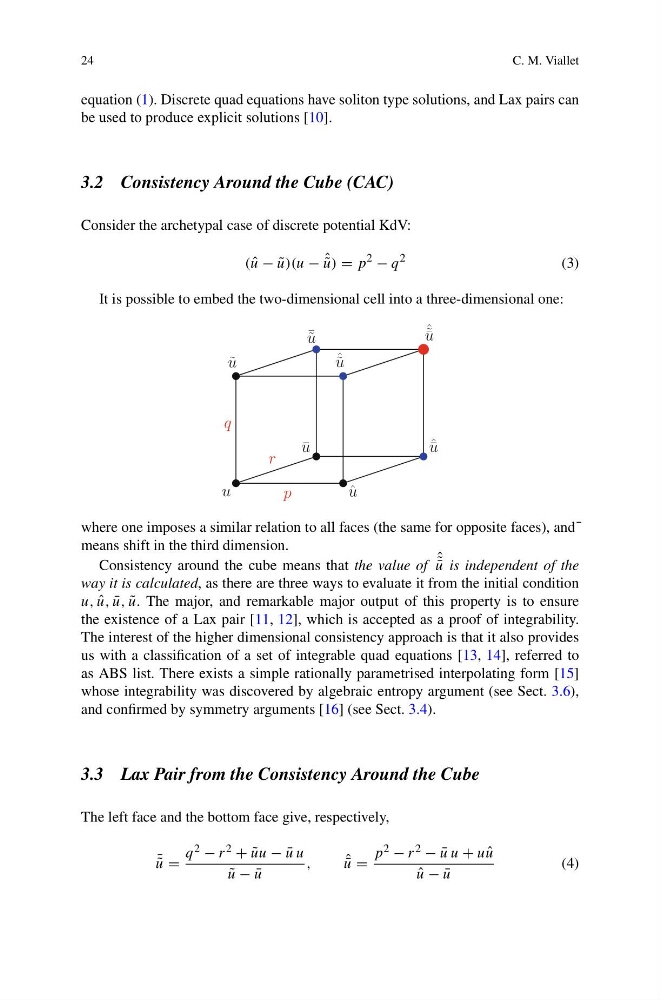
It is possible to embed the two-dimensional cell into a three-dimensional one:
p
q
r
u
ˆ
u
¯ ˜
u
ˆ ˜ ¯
u
˜
u
¯
u
ˆ ¯
u
ˆ ˜
u
where one imposes a similar relation to all faces (the same for opposite faces), and¯
means shift in the third dimension.
Consistency around the cube means that the value of ˆ ˜ ¯
u is independent of the
way it is calculated, as there are three ways to evaluate it from the initial condition
u, ˆ
u, ¯
u, ˜
u. The major, and remarkable major output of this property is to ensure
the existence of a Lax pair [11, 12], which is accepted as a proof of integrability.
The interest of the higher dimensional consistency approach is that it also provides
us with a classification of a set of integrable quad equations [13, 14], referred to
as ABS list. There exists a simple rationally parametrised interpolating form [15]
whose integrability was discovered by algebraic entropy argument (see Sect. 3.6),
and confirmed by symmetry arguments [16] (see Sect. 3.4).
3.3 Lax Pair from the Consistency Around the Cube
The left face and the bottom face give, respectively,
¯ ˜
u =
q 2 − r 2 + ˜
uu − ¯
u u
˜
u − ¯
u
,
ˆ ¯
u =
p 2 − r 2 − ¯
u u + u ˆ
u
ˆ
u − ¯
u
(4)
C. M. Viallet
equation (1). Discrete quad equations have soliton type solutions, and Lax pairs can
be used to produce explicit solutions [10].
3.2 Consistency Around the Cube (CAC)
Consider the archetypal case of discrete potential KdV:
( ˆ
u − ˜
u)(u − ˆ ˜
u) = p
2
− q
2
(3)
It is possible to embed the two-dimensional cell into a three-dimensional one:
p
q
r
u
ˆ
u
¯ ˜
u
ˆ ˜ ¯
u
˜
u
¯
u
ˆ ¯
u
ˆ ˜
u
where one imposes a similar relation to all faces (the same for opposite faces), and¯
means shift in the third dimension.
Consistency around the cube means that the value of ˆ ˜ ¯
u is independent of the
way it is calculated, as there are three ways to evaluate it from the initial condition
u, ˆ
u, ¯
u, ˜
u. The major, and remarkable major output of this property is to ensure
the existence of a Lax pair [11, 12], which is accepted as a proof of integrability.
The interest of the higher dimensional consistency approach is that it also provides
us with a classification of a set of integrable quad equations [13, 14], referred to
as ABS list. There exists a simple rationally parametrised interpolating form [15]
whose integrability was discovered by algebraic entropy argument (see Sect. 3.6),
and confirmed by symmetry arguments [16] (see Sect. 3.4).
3.3 Lax Pair from the Consistency Around the Cube
The left face and the bottom face give, respectively,
¯ ˜
u =
q 2 − r 2 + ˜
uu − ¯
u u
˜
u − ¯
u
,
ˆ ¯
u =
p 2 − r 2 − ¯
u u + u ˆ
u
ˆ
u − ¯
u
(4)