

Probes in AdS 3 Quantum Gravity
401
just correspond to different pairings of eigenvalues that are degenerate. For this
reason, all these cases are captured by (32): any pairing λ i = λ j with i = j
implies the extremality bound Q 3
(2) = 27/64Q 2
(3) . 6 At least for N = 2, 3, a nontrivial Jordan decomposition implies zero temperature and vice versa. And from
the heuristic argument in Sect. 4.1, we expect this to always be the case.
2. Other Jordan classes: For λ ≡ λ 1 = λ 2 = 0, a φ has only two linearly
independently eigenvectors. If take first λ 2 = 0 and then λ 1 = 0, the holonomy
of a φ belongs to a different Jordan class where there is only one eigenvector; this
case corresponds to extremal BTZ within sl(3) ⊕ sl(3) Chern–Simons theory.
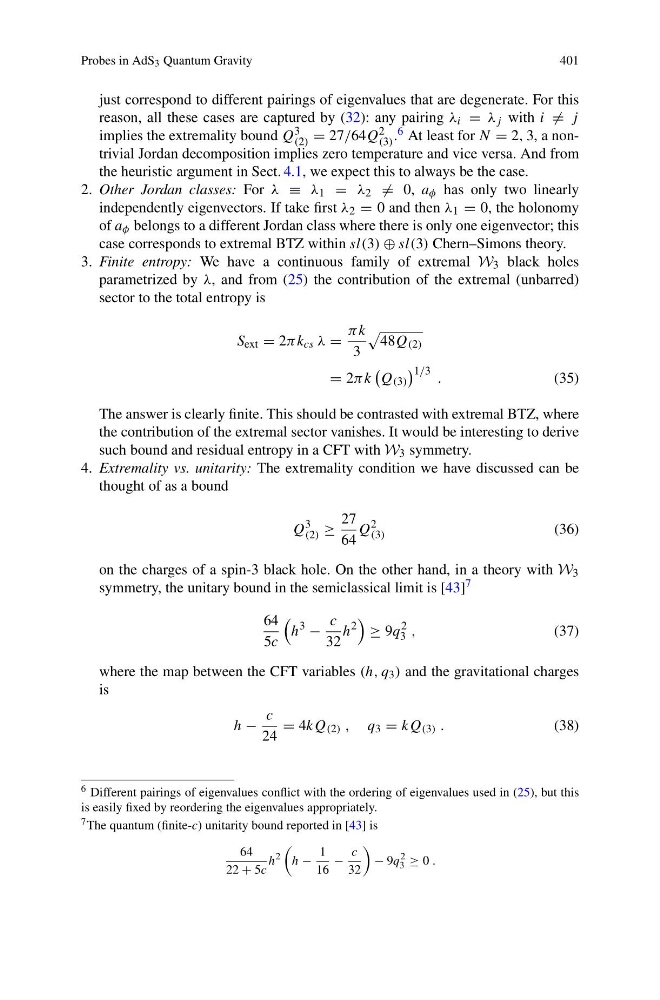
3. Finite entropy: We have a continuous family of extremal W 3 black holes
parametrized by λ, and from (25) the contribution of the extremal (unbarred)
sector to the total entropy is
S ext = 2πk cs λ =
πk
3
48Q (2)
= 2πk
Q (3)
1/3 .
(35)
The answer is clearly finite. This should be contrasted with extremal BTZ, where
the contribution of the extremal sector vanishes. It would be interesting to derive
such bound and residual entropy in a CFT with W 3 symmetry.
4. Extremality vs. unitarity: The extremality condition we have discussed can be
thought of as a bound
Q
3
(2) ≥
27
64
Q
2
(3)
(36)
on the charges of a spin-3 black hole. On the other hand, in a theory with W 3
symmetry, the unitary bound in the semiclassical limit is [43] 7
64
5c
h
3
−
c
32
h
2
≥ 9q
2
3 ,
(37)
where the map between the CFT variables (h, q 3 ) and the gravitational charges
is
h −
c
24
= 4kQ (2) , q 3 = kQ (3) .
(38)
6 Different pairings of eigenvalues conflict with the ordering of eigenvalues used in (25), but this
is easily fixed by reordering the eigenvalues appropriately.
7 The quantum (finite-c) unitarity bound reported in [43] is
64
22 + 5c
h
2
h −
1
16
−
c
32
− 9q
2
3 ≥ 0 .
401
just correspond to different pairings of eigenvalues that are degenerate. For this
reason, all these cases are captured by (32): any pairing λ i = λ j with i = j
implies the extremality bound Q 3
(2) = 27/64Q 2
(3) . 6 At least for N = 2, 3, a nontrivial Jordan decomposition implies zero temperature and vice versa. And from
the heuristic argument in Sect. 4.1, we expect this to always be the case.
2. Other Jordan classes: For λ ≡ λ 1 = λ 2 = 0, a φ has only two linearly
independently eigenvectors. If take first λ 2 = 0 and then λ 1 = 0, the holonomy
of a φ belongs to a different Jordan class where there is only one eigenvector; this
case corresponds to extremal BTZ within sl(3) ⊕ sl(3) Chern–Simons theory.
3. Finite entropy: We have a continuous family of extremal W 3 black holes
parametrized by λ, and from (25) the contribution of the extremal (unbarred)
sector to the total entropy is
S ext = 2πk cs λ =
πk
3
48Q (2)
= 2πk
Q (3)
1/3 .
(35)
The answer is clearly finite. This should be contrasted with extremal BTZ, where
the contribution of the extremal sector vanishes. It would be interesting to derive
such bound and residual entropy in a CFT with W 3 symmetry.
4. Extremality vs. unitarity: The extremality condition we have discussed can be
thought of as a bound
Q
3
(2) ≥
27
64
Q
2
(3)
(36)
on the charges of a spin-3 black hole. On the other hand, in a theory with W 3
symmetry, the unitary bound in the semiclassical limit is [43] 7
64
5c
h
3
−
c
32
h
2
≥ 9q
2
3 ,
(37)
where the map between the CFT variables (h, q 3 ) and the gravitational charges
is
h −
c
24
= 4kQ (2) , q 3 = kQ (3) .
(38)
6 Different pairings of eigenvalues conflict with the ordering of eigenvalues used in (25), but this
is easily fixed by reordering the eigenvalues appropriately.
7 The quantum (finite-c) unitarity bound reported in [43] is
64
22 + 5c
h
2
h −
1
16
−
c
32
− 9q
2
3 ≥ 0 .