

400
A. Castro
τ = i
2λ 2
1 + 2λ 1 λ 2 − λ 2
2
(λ 1 − λ 2 ) (2λ 1 + λ 2 ) (λ 1 + 2λ 2 )
,
(28)
α 3 = − 6i
λ 2
(λ 1 − λ 2 ) (2λ 1 + λ 2 ) (λ 1 + 2λ 2 )
,
(29)
and
μ 3 = 6
1 + Ω
λ 2
2λ 2
1 + 2λ 1 λ 2 − λ 2
2
,
(30)
¯
μ 3 = − 6
1 − Ω
¯
λ 2
2 ¯
λ 2
1 + 2 ¯
λ 1 ¯
λ 2 − ¯
λ 2
2
.
(31)
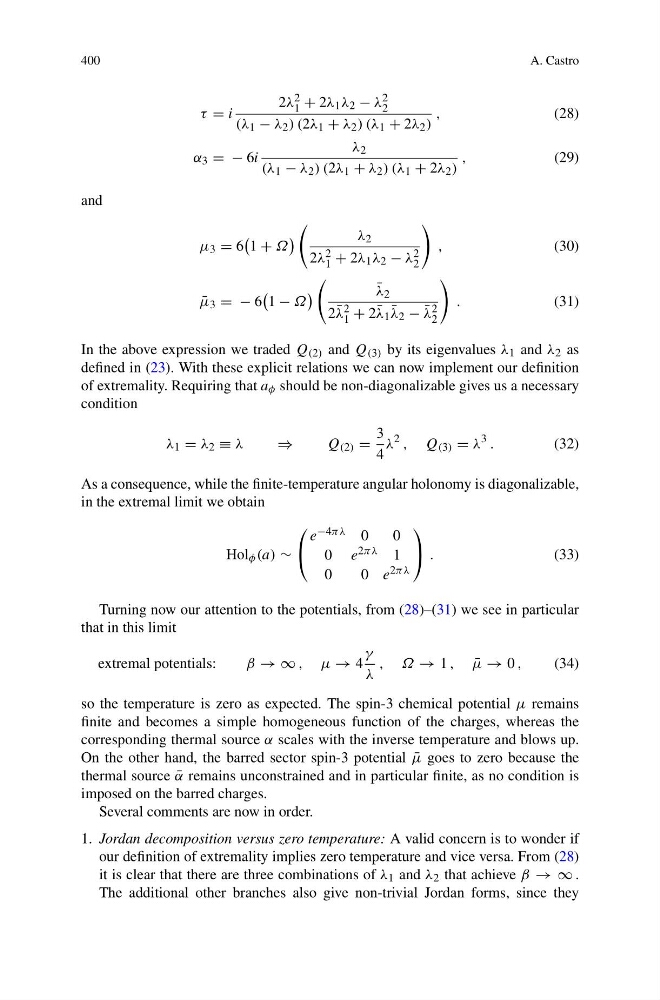
In the above expression we traded Q (2) and Q (3) by its eigenvalues λ 1 and λ 2 as
defined in (23). With these explicit relations we can now implement our definition
of extremality. Requiring that a φ should be non-diagonalizable gives us a necessary
condition
λ 1 = λ 2 ≡ λ
⇒
Q (2) =
3
4
λ
2 , Q (3) = λ
3 .
(32)
As a consequence, while the finite-temperature angular holonomy is diagonalizable,
in the extremal limit we obtain
Hol φ (a) ∼
⎛
⎝
e −4πλ 0
0
0 e 2πλ 1
0
0 e 2πλ
⎞
⎠ .
(33)
Turning now our attention to the potentials, from (28)–(31) we see in particular
that in this limit
extremal potentials:
β → ∞ , μ → 4
γ
λ
, Ω → 1 , ¯
μ → 0 ,
(34)
so the temperature is zero as expected. The spin-3 chemical potential μ remains
finite and becomes a simple homogeneous function of the charges, whereas the
corresponding thermal source α scales with the inverse temperature and blows up.
On the other hand, the barred sector spin-3 potential ¯
μ goes to zero because the
thermal source ¯
α remains unconstrained and in particular finite, as no condition is
imposed on the barred charges.
Several comments are now in order.
1. Jordan decomposition versus zero temperature: A valid concern is to wonder if
our definition of extremality implies zero temperature and vice versa. From (28)
it is clear that there are three combinations of λ 1 and λ 2 that achieve β → ∞ .
The additional other branches also give non-trivial Jordan forms, since they
A. Castro
τ = i
2λ 2
1 + 2λ 1 λ 2 − λ 2
2
(λ 1 − λ 2 ) (2λ 1 + λ 2 ) (λ 1 + 2λ 2 )
,
(28)
α 3 = − 6i
λ 2
(λ 1 − λ 2 ) (2λ 1 + λ 2 ) (λ 1 + 2λ 2 )
,
(29)
and
μ 3 = 6
1 + Ω
λ 2
2λ 2
1 + 2λ 1 λ 2 − λ 2
2
,
(30)
¯
μ 3 = − 6
1 − Ω
¯
λ 2
2 ¯
λ 2
1 + 2 ¯
λ 1 ¯
λ 2 − ¯
λ 2
2
.
(31)
In the above expression we traded Q (2) and Q (3) by its eigenvalues λ 1 and λ 2 as
defined in (23). With these explicit relations we can now implement our definition
of extremality. Requiring that a φ should be non-diagonalizable gives us a necessary
condition
λ 1 = λ 2 ≡ λ
⇒
Q (2) =
3
4
λ
2 , Q (3) = λ
3 .
(32)
As a consequence, while the finite-temperature angular holonomy is diagonalizable,
in the extremal limit we obtain
Hol φ (a) ∼
⎛
⎝
e −4πλ 0
0
0 e 2πλ 1
0
0 e 2πλ
⎞
⎠ .
(33)
Turning now our attention to the potentials, from (28)–(31) we see in particular
that in this limit
extremal potentials:
β → ∞ , μ → 4
γ
λ
, Ω → 1 , ¯
μ → 0 ,
(34)
so the temperature is zero as expected. The spin-3 chemical potential μ remains
finite and becomes a simple homogeneous function of the charges, whereas the
corresponding thermal source α scales with the inverse temperature and blows up.
On the other hand, the barred sector spin-3 potential ¯
μ goes to zero because the
thermal source ¯
α remains unconstrained and in particular finite, as no condition is
imposed on the barred charges.
Several comments are now in order.
1. Jordan decomposition versus zero temperature: A valid concern is to wonder if
our definition of extremality implies zero temperature and vice versa. From (28)
it is clear that there are three combinations of λ 1 and λ 2 that achieve β → ∞ .
The additional other branches also give non-trivial Jordan forms, since they