

Probes in AdS 3 Quantum Gravity
397
For this prescription, again (Q (2) , Q (3) ) are the zero modes of the currents in W 3 .
The quantitative difference between the holomorphic and canonical definitions lies
in the spatial components of the connection; both a c and a h have the same time
component.
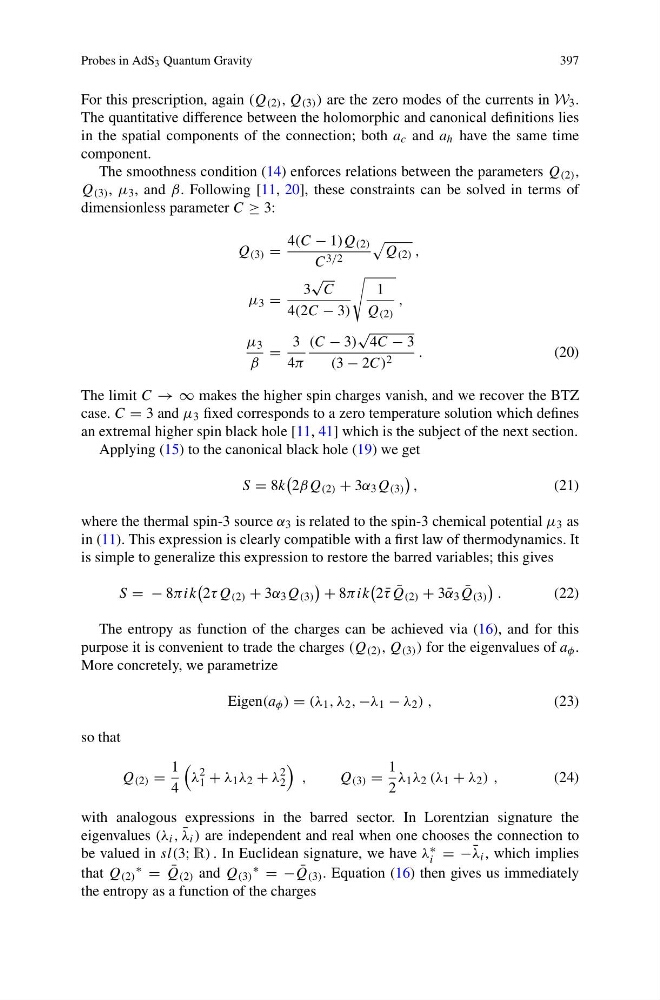
The smoothness condition (14) enforces relations between the parameters Q (2) ,
Q (3) , μ 3 , and β. Following [11, 20], these constraints can be solved in terms of
dimensionless parameter C ≥ 3:
Q (3) =
4(C − 1)Q (2)
C 3/2
Q (2) ,
μ 3 =
3
√
C
4(2C − 3)
1
Q (2)
,
μ 3
β
=
3
4π
(C − 3)
√
4C − 3
(3 − 2C) 2
.
(20)
The limit C → ∞ makes the higher spin charges vanish, and we recover the BTZ
case. C = 3 and μ 3 fixed corresponds to a zero temperature solution which defines
an extremal higher spin black hole [11, 41] which is the subject of the next section.
Applying (15) to the canonical black hole (19) we get
S = 8k
2βQ (2) + 3α 3 Q (3)
,
(21)
where the thermal spin-3 source α 3 is related to the spin-3 chemical potential μ 3 as
in (11). This expression is clearly compatible with a first law of thermodynamics. It
is simple to generalize this expression to restore the barred variables; this gives
S = − 8πik
2τ Q (2) + 3α 3 Q (3)
+ 8πik
2 ¯
τ ¯
Q (2) + 3 ¯
α 3 ¯
Q (3)
.
(22)
The entropy as function of the charges can be achieved via (16), and for this
purpose it is convenient to trade the charges (Q (2) , Q (3) ) for the eigenvalues of a φ .
More concretely, we parametrize
Eigen(a φ ) = (λ 1 , λ 2 , −λ 1 − λ 2 ) ,
(23)
so that
Q (2) =
1
4
λ
2
1 + λ 1 λ 2 + λ
2
2
,
Q (3) =
1
2
λ 1 λ 2 (λ 1 + λ 2 ) ,
(24)
with analogous expressions in the barred sector. In Lorentzian signature the
eigenvalues (λ i , ¯
λ i ) are independent and real when one chooses the connection to
be valued in sl(3; R) . In Euclidean signature, we have λ ∗
i = − ¯
λ i , which implies
that Q (2)
∗ = ¯
Q (2) and Q (3)
∗ = − ¯
Q (3) . Equation (16) then gives us immediately
the entropy as a function of the charges
397
For this prescription, again (Q (2) , Q (3) ) are the zero modes of the currents in W 3 .
The quantitative difference between the holomorphic and canonical definitions lies
in the spatial components of the connection; both a c and a h have the same time
component.
The smoothness condition (14) enforces relations between the parameters Q (2) ,
Q (3) , μ 3 , and β. Following [11, 20], these constraints can be solved in terms of
dimensionless parameter C ≥ 3:
Q (3) =
4(C − 1)Q (2)
C 3/2
Q (2) ,
μ 3 =
3
√
C
4(2C − 3)
1
Q (2)
,
μ 3
β
=
3
4π
(C − 3)
√
4C − 3
(3 − 2C) 2
.
(20)
The limit C → ∞ makes the higher spin charges vanish, and we recover the BTZ
case. C = 3 and μ 3 fixed corresponds to a zero temperature solution which defines
an extremal higher spin black hole [11, 41] which is the subject of the next section.
Applying (15) to the canonical black hole (19) we get
S = 8k
2βQ (2) + 3α 3 Q (3)
,
(21)
where the thermal spin-3 source α 3 is related to the spin-3 chemical potential μ 3 as
in (11). This expression is clearly compatible with a first law of thermodynamics. It
is simple to generalize this expression to restore the barred variables; this gives
S = − 8πik
2τ Q (2) + 3α 3 Q (3)
+ 8πik
2 ¯
τ ¯
Q (2) + 3 ¯
α 3 ¯
Q (3)
.
(22)
The entropy as function of the charges can be achieved via (16), and for this
purpose it is convenient to trade the charges (Q (2) , Q (3) ) for the eigenvalues of a φ .
More concretely, we parametrize
Eigen(a φ ) = (λ 1 , λ 2 , −λ 1 − λ 2 ) ,
(23)
so that
Q (2) =
1
4
λ
2
1 + λ 1 λ 2 + λ
2
2
,
Q (3) =
1
2
λ 1 λ 2 (λ 1 + λ 2 ) ,
(24)
with analogous expressions in the barred sector. In Lorentzian signature the
eigenvalues (λ i , ¯
λ i ) are independent and real when one chooses the connection to
be valued in sl(3; R) . In Euclidean signature, we have λ ∗
i = − ¯
λ i , which implies
that Q (2)
∗ = ¯
Q (2) and Q (3)
∗ = − ¯
Q (3) . Equation (16) then gives us immediately
the entropy as a function of the charges