

396
A. Castro
finds that (15) can be written equivalently as [21]
S = 2πkTr
λ φ − ¯
λ φ
L 0
,
(16)
where λ φ and ¯
λ φ are diagonal matrices containing the eigenvalues of the angular component of the connection (9), which carries the values of the charges
(Q (s) , ¯
Q (s) ).
3.1 Example
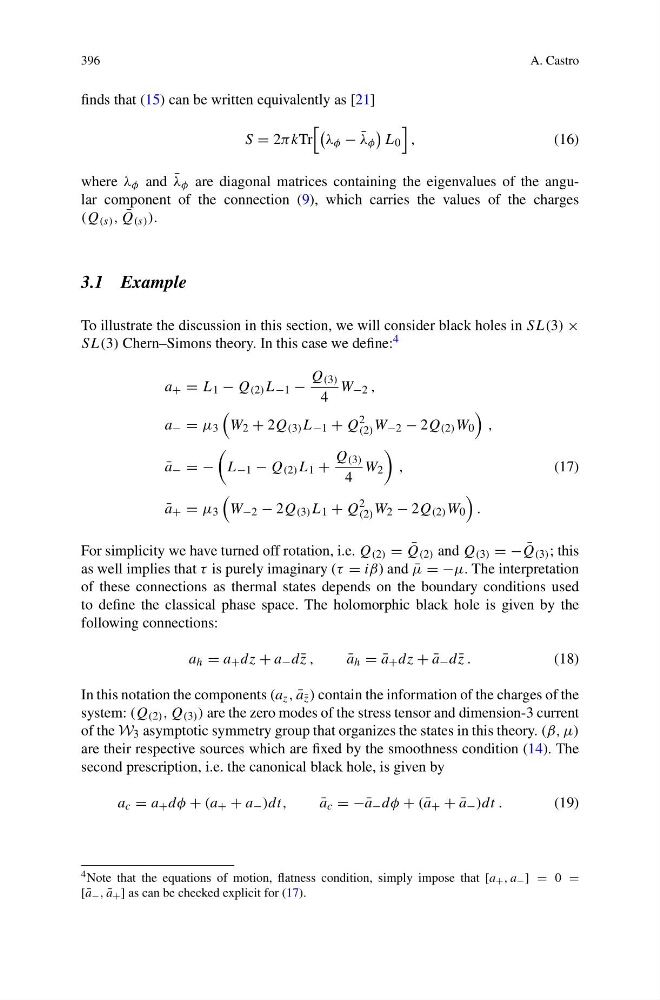
To illustrate the discussion in this section, we will consider black holes in SL(3) ×
SL(3) Chern–Simons theory. In this case we define: 4
a + = L 1 − Q (2) L −1 −
Q (3)
4
W −2 ,
a − = μ 3
W 2 + 2Q (3) L −1 + Q
2
(2) W −2 − 2Q (2) W 0
,
¯
a − = −
L −1 − Q (2) L 1 +
Q (3)
4
W 2
,
(17)
¯
a + = μ 3
W −2 − 2Q (3) L 1 + Q
2
(2) W 2 − 2Q (2) W 0
.
For simplicity we have turned off rotation, i.e. Q (2) = ¯
Q (2) and Q (3) = − ¯
Q (3) ; this
as well implies that τ is purely imaginary (τ = iβ) and ¯
μ = −μ. The interpretation
of these connections as thermal states depends on the boundary conditions used
to define the classical phase space. The holomorphic black hole is given by the
following connections:
a h = a + dz + a − d ¯
z ,
¯
a h = ¯
a + dz + ¯
a − d ¯
z .
(18)
In this notation the components (a z , ¯
a ¯
z ) contain the information of the charges of the
system: (Q (2) , Q (3) ) are the zero modes of the stress tensor and dimension-3 current
of the W 3 asymptotic symmetry group that organizes the states in this theory. (β, μ)
are their respective sources which are fixed by the smoothness condition (14). The
second prescription, i.e. the canonical black hole, is given by
a c = a + dφ + (a + + a − )dt,
¯
a c = −¯ a − dφ + ( ¯
a + + ¯
a − )dt .
(19)
4 Note that the equations of motion, flatness condition, simply impose that [a + , a − ] = 0 =
[ ¯
a − , ¯
a + ] as can be checked explicit for (17).
A. Castro
finds that (15) can be written equivalently as [21]
S = 2πkTr
λ φ − ¯
λ φ
L 0
,
(16)
where λ φ and ¯
λ φ are diagonal matrices containing the eigenvalues of the angular component of the connection (9), which carries the values of the charges
(Q (s) , ¯
Q (s) ).
3.1 Example
To illustrate the discussion in this section, we will consider black holes in SL(3) ×
SL(3) Chern–Simons theory. In this case we define: 4
a + = L 1 − Q (2) L −1 −
Q (3)
4
W −2 ,
a − = μ 3
W 2 + 2Q (3) L −1 + Q
2
(2) W −2 − 2Q (2) W 0
,
¯
a − = −
L −1 − Q (2) L 1 +
Q (3)
4
W 2
,
(17)
¯
a + = μ 3
W −2 − 2Q (3) L 1 + Q
2
(2) W 2 − 2Q (2) W 0
.
For simplicity we have turned off rotation, i.e. Q (2) = ¯
Q (2) and Q (3) = − ¯
Q (3) ; this
as well implies that τ is purely imaginary (τ = iβ) and ¯
μ = −μ. The interpretation
of these connections as thermal states depends on the boundary conditions used
to define the classical phase space. The holomorphic black hole is given by the
following connections:
a h = a + dz + a − d ¯
z ,
¯
a h = ¯
a + dz + ¯
a − d ¯
z .
(18)
In this notation the components (a z , ¯
a ¯
z ) contain the information of the charges of the
system: (Q (2) , Q (3) ) are the zero modes of the stress tensor and dimension-3 current
of the W 3 asymptotic symmetry group that organizes the states in this theory. (β, μ)
are their respective sources which are fixed by the smoothness condition (14). The
second prescription, i.e. the canonical black hole, is given by
a c = a + dφ + (a + + a − )dt,
¯
a c = −¯ a − dφ + ( ¯
a + + ¯
a − )dt .
(19)
4 Note that the equations of motion, flatness condition, simply impose that [a + , a − ] = 0 =
[ ¯
a − , ¯
a + ] as can be checked explicit for (17).