

Soft Degrees of Freedom, Gibbons–Hawking Contribution and Entropy from. . .
375
conditions. We then take Dirichlet conditions for A a as well since this guarantees
well-defined Poisson brackets and a standard quantization in terms of the Fourier
coefficients of sine functions. The requirement that B 3 = ∂ 1 A 2 − ∂ 2 A 1 should also
satisfy Dirichlet conditions then holds automatically.
There remains the boundary conditions on (A 3 , π 3 ) and, in the case of BRST
quantization, on (A 0 , π 0 ) as well as the ghost variables (η, P), ( ¯
C, ρ). A natural
choice is Neumann conditions for (A 3 , π 3 ), and Dirichlet for all others in the case of
BRST quantization. This choice implies that the divergence
∇ · ·
π satisfies Dirichlet
conditions. The constraint
∇ · ·
π = 0 in the space between the conductors can then be
implemented by variation in the action principle (9) through a field A 0 that satisfies
Dirichlet conditions as well. Proper gauge transformations are defined by gauge
parameters that satisfy Dirichlet conditions, which implies the same conditions for
the ghost variables. In the context of BRST quantization, this choice guarantees that
the quartet mechanism for (A 0 , π 0 ), (
A L ,
π L ) and ghost pairs will be effective.
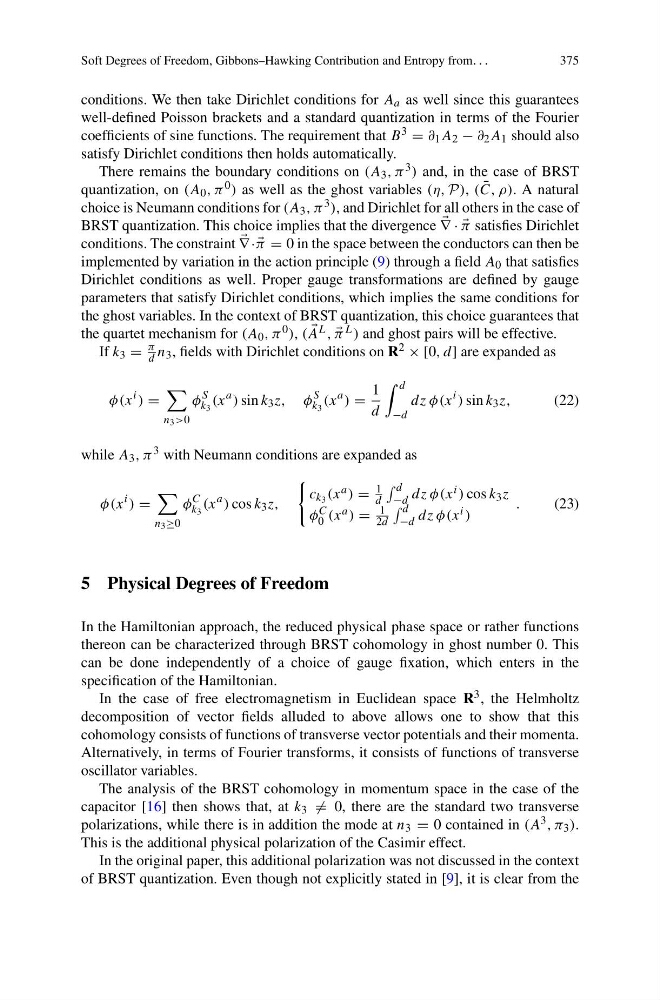
If k 3 =
π
d n 3 , fields with Dirichlet conditions on R 2 × [0, d] are expanded as
φ(x
i ) =
n 3 >0
φ
S
k 3
(x
a ) sin k 3 z, φ
S
k 3
(x
a ) =
1
d
d
−d
dz φ(x
i ) sin k 3 z,
(22)
while A 3 , π 3 with Neumann conditions are expanded as
φ(x
i ) =
n 3 ≥0
φ
C
k 3
(x
a ) cos k 3 z,
c k 3 (x a ) =
1
d
d
−d dz φ(x i ) cos k 3 z
φ C
0 (x a ) =
1
2d
d
−d dz φ(x i )
.
(23)
5 Physical Degrees of Freedom
In the Hamiltonian approach, the reduced physical phase space or rather functions
thereon can be characterized through BRST cohomology in ghost number 0. This
can be done independently of a choice of gauge fixation, which enters in the
specification of the Hamiltonian.
In the case of free electromagnetism in Euclidean space R 3 , the Helmholtz
decomposition of vector fields alluded to above allows one to show that this
cohomology consists of functions of transverse vector potentials and their momenta.
Alternatively, in terms of Fourier transforms, it consists of functions of transverse
oscillator variables.
The analysis of the BRST cohomology in momentum space in the case of the
capacitor [16] then shows that, at k 3 = 0, there are the standard two transverse
polarizations, while there is in addition the mode at n 3 = 0 contained in (A 3 , π 3 ).
This is the additional physical polarization of the Casimir effect.
In the original paper, this additional polarization was not discussed in the context
of BRST quantization. Even though not explicitly stated in [9], it is clear from the
375
conditions. We then take Dirichlet conditions for A a as well since this guarantees
well-defined Poisson brackets and a standard quantization in terms of the Fourier
coefficients of sine functions. The requirement that B 3 = ∂ 1 A 2 − ∂ 2 A 1 should also
satisfy Dirichlet conditions then holds automatically.
There remains the boundary conditions on (A 3 , π 3 ) and, in the case of BRST
quantization, on (A 0 , π 0 ) as well as the ghost variables (η, P), ( ¯
C, ρ). A natural
choice is Neumann conditions for (A 3 , π 3 ), and Dirichlet for all others in the case of
BRST quantization. This choice implies that the divergence
∇ · ·
π satisfies Dirichlet
conditions. The constraint
∇ · ·
π = 0 in the space between the conductors can then be
implemented by variation in the action principle (9) through a field A 0 that satisfies
Dirichlet conditions as well. Proper gauge transformations are defined by gauge
parameters that satisfy Dirichlet conditions, which implies the same conditions for
the ghost variables. In the context of BRST quantization, this choice guarantees that
the quartet mechanism for (A 0 , π 0 ), (
A L ,
π L ) and ghost pairs will be effective.
If k 3 =
π
d n 3 , fields with Dirichlet conditions on R 2 × [0, d] are expanded as
φ(x
i ) =
n 3 >0
φ
S
k 3
(x
a ) sin k 3 z, φ
S
k 3
(x
a ) =
1
d
d
−d
dz φ(x
i ) sin k 3 z,
(22)
while A 3 , π 3 with Neumann conditions are expanded as
φ(x
i ) =
n 3 ≥0
φ
C
k 3
(x
a ) cos k 3 z,
c k 3 (x a ) =
1
d
d
−d dz φ(x i ) cos k 3 z
φ C
0 (x a ) =
1
2d
d
−d dz φ(x i )
.
(23)
5 Physical Degrees of Freedom
In the Hamiltonian approach, the reduced physical phase space or rather functions
thereon can be characterized through BRST cohomology in ghost number 0. This
can be done independently of a choice of gauge fixation, which enters in the
specification of the Hamiltonian.
In the case of free electromagnetism in Euclidean space R 3 , the Helmholtz
decomposition of vector fields alluded to above allows one to show that this
cohomology consists of functions of transverse vector potentials and their momenta.
Alternatively, in terms of Fourier transforms, it consists of functions of transverse
oscillator variables.
The analysis of the BRST cohomology in momentum space in the case of the
capacitor [16] then shows that, at k 3 = 0, there are the standard two transverse
polarizations, while there is in addition the mode at n 3 = 0 contained in (A 3 , π 3 ).
This is the additional physical polarization of the Casimir effect.
In the original paper, this additional polarization was not discussed in the context
of BRST quantization. Even though not explicitly stated in [9], it is clear from the