

372
G. Barnich and M. Bonte
Q N =
1
2
C (ΔV )
2
× N =
1
2
CV 2
N
.
(4)
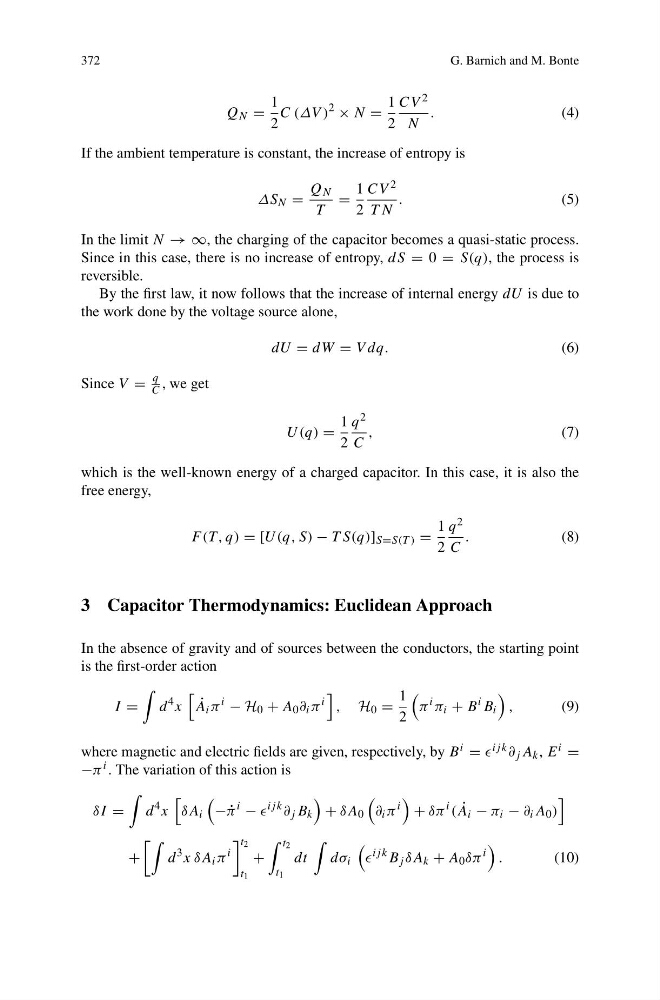
If the ambient temperature is constant, the increase of entropy is
ΔS N =
Q N
T
=
1
2
CV 2
T N
.
(5)
In the limit N → ∞, the charging of the capacitor becomes a quasi-static process.
Since in this case, there is no increase of entropy, dS = 0 = S(q), the process is
reversible.
By the first law, it now follows that the increase of internal energy dU is due to
the work done by the voltage source alone,
dU = dW = V dq.
(6)
Since V =
q
C , we get
U(q) =
1
2
q 2
C
,
(7)
which is the well-known energy of a charged capacitor. In this case, it is also the
free energy,
F (T , q) = [U(q, S) − T S(q)] S=S(T ) =
1
2
q 2
C
.
(8)
3 Capacitor Thermodynamics: Euclidean Approach
In the absence of gravity and of sources between the conductors, the starting point
is the first-order action
I =
d
4 x
˙
A i π
i
− H 0 + A 0 ∂ i π
i
, H 0 =
1
2
π
i π i + B
i B i
,
(9)
where magnetic and electric fields are given, respectively, by B i = ij k ∂ j A k , E i =
−π i . The variation of this action is
δI =
d
4 x
δA i
− ˙
π
i
−
ij k ∂ j B k
+ δA 0
∂ i π
i
+ δπ
i ( ˙
A i − π i − ∂ i A 0 )
+
d
3 x δA i π
i
t 2
t 1
+
t 2
t 1
dt
dσ i
ij k B j δA k + A 0 δπ
i
.
(10)
G. Barnich and M. Bonte
Q N =
1
2
C (ΔV )
2
× N =
1
2
CV 2
N
.
(4)
If the ambient temperature is constant, the increase of entropy is
ΔS N =
Q N
T
=
1
2
CV 2
T N
.
(5)
In the limit N → ∞, the charging of the capacitor becomes a quasi-static process.
Since in this case, there is no increase of entropy, dS = 0 = S(q), the process is
reversible.
By the first law, it now follows that the increase of internal energy dU is due to
the work done by the voltage source alone,
dU = dW = V dq.
(6)
Since V =
q
C , we get
U(q) =
1
2
q 2
C
,
(7)
which is the well-known energy of a charged capacitor. In this case, it is also the
free energy,
F (T , q) = [U(q, S) − T S(q)] S=S(T ) =
1
2
q 2
C
.
(8)
3 Capacitor Thermodynamics: Euclidean Approach
In the absence of gravity and of sources between the conductors, the starting point
is the first-order action
I =
d
4 x
˙
A i π
i
− H 0 + A 0 ∂ i π
i
, H 0 =
1
2
π
i π i + B
i B i
,
(9)
where magnetic and electric fields are given, respectively, by B i = ij k ∂ j A k , E i =
−π i . The variation of this action is
δI =
d
4 x
δA i
− ˙
π
i
−
ij k ∂ j B k
+ δA 0
∂ i π
i
+ δπ
i ( ˙
A i − π i − ∂ i A 0 )
+
d
3 x δA i π
i
t 2
t 1
+
t 2
t 1
dt
dσ i
ij k B j δA k + A 0 δπ
i
.
(10)