

Spin Chains of Haldane–Shastry Type: A Bird’s Eye View
19
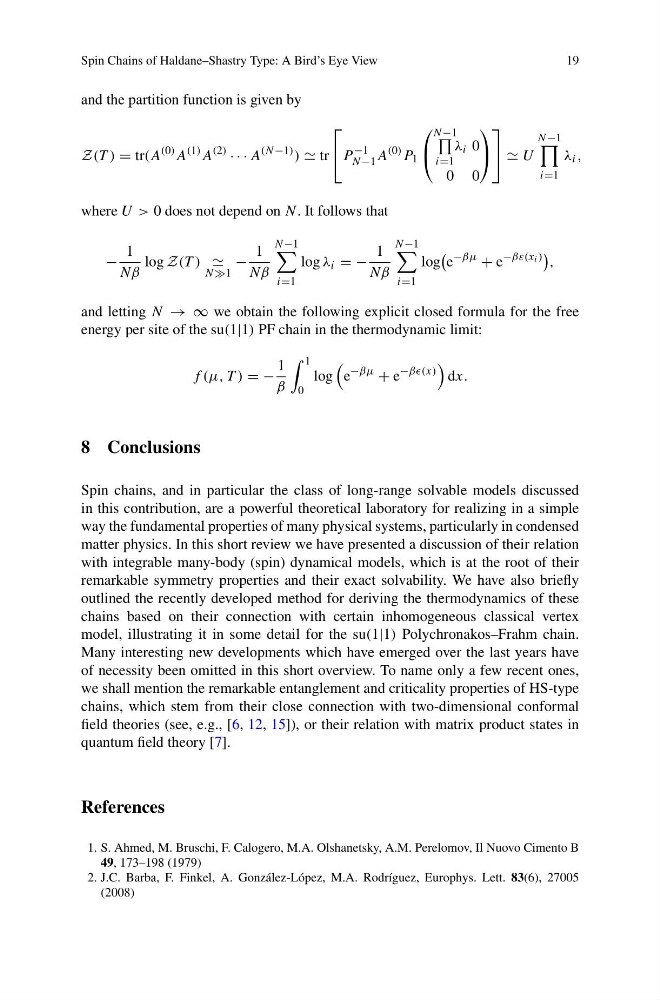
and the partition function is given by
Z(T ) = tr(A
(0) A
(1) A
(2)
· · · A
(N −1) ) tr
⎡
⎣ P
−1
N −1 A
(0) P 1
⎛
⎝
N −1
i=1
λ i 0
0 0
⎞
⎠
⎤
⎦ U
N −1
i=1
λ i ,
where U > 0 does not depend on N . It follows that
−
1
Nβ
log Z(T )
N
−
1
Nβ
N −1
i=1
log λ i = −
1
Nβ
N −1
i=1
log
e
−βμ
+ e
−βε(x i )
,
and letting N → ∞ we obtain the following explicit closed formula for the free
energy per site of the su(1|1) PF chain in the thermodynamic limit:
f (μ, T ) = −
1
β
1
0
log
e
−βμ
+ e
−ββ(x)
dx.
8 Conclusions
Spin chains, and in particular the class of long-range solvable models discussed
in this contribution, are a powerful theoretical laboratory for realizing in a simple
way the fundamental properties of many physical systems, particularly in condensed
matter physics. In this short review we have presented a discussion of their relation
with integrable many-body (spin) dynamical models, which is at the root of their
remarkable symmetry properties and their exact solvability. We have also briefly
outlined the recently developed method for deriving the thermodynamics of these
chains based on their connection with certain inhomogeneous classical vertex
model, illustrating it in some detail for the su(1|1) Polychronakos–Frahm chain.
Many interesting new developments which have emerged over the last years have
of necessity been omitted in this short overview. To name only a few recent ones,
we shall mention the remarkable entanglement and criticality properties of HS-type
chains, which stem from their close connection with two-dimensional conformal
field theories (see, e.g., [6, 12, 15]), or their relation with matrix product states in
quantum field theory [7].
References
1. S. Ahmed, M. Bruschi, F. Calogero, M.A. Olshanetsky, A.M. Perelomov, Il Nuovo Cimento B
49, 173–198 (1979)
2. J.C. Barba, F. Finkel, A. González-López, M.A. Rodríguez, Europhys. Lett. 83(6), 27005
(2008)
19
and the partition function is given by
Z(T ) = tr(A
(0) A
(1) A
(2)
· · · A
(N −1) ) tr
⎡
⎣ P
−1
N −1 A
(0) P 1
⎛
⎝
N −1
i=1
λ i 0
0 0
⎞
⎠
⎤
⎦ U
N −1
i=1
λ i ,
where U > 0 does not depend on N . It follows that
−
1
Nβ
log Z(T )
N
−
1
Nβ
N −1
i=1
log λ i = −
1
Nβ
N −1
i=1
log
e
−βμ
+ e
−βε(x i )
,
and letting N → ∞ we obtain the following explicit closed formula for the free
energy per site of the su(1|1) PF chain in the thermodynamic limit:
f (μ, T ) = −
1
β
1
0
log
e
−βμ
+ e
−ββ(x)
dx.
8 Conclusions
Spin chains, and in particular the class of long-range solvable models discussed
in this contribution, are a powerful theoretical laboratory for realizing in a simple
way the fundamental properties of many physical systems, particularly in condensed
matter physics. In this short review we have presented a discussion of their relation
with integrable many-body (spin) dynamical models, which is at the root of their
remarkable symmetry properties and their exact solvability. We have also briefly
outlined the recently developed method for deriving the thermodynamics of these
chains based on their connection with certain inhomogeneous classical vertex
model, illustrating it in some detail for the su(1|1) Polychronakos–Frahm chain.
Many interesting new developments which have emerged over the last years have
of necessity been omitted in this short overview. To name only a few recent ones,
we shall mention the remarkable entanglement and criticality properties of HS-type
chains, which stem from their close connection with two-dimensional conformal
field theories (see, e.g., [6, 12, 15]), or their relation with matrix product states in
quantum field theory [7].
References
1. S. Ahmed, M. Bruschi, F. Calogero, M.A. Olshanetsky, A.M. Perelomov, Il Nuovo Cimento B
49, 173–198 (1979)
2. J.C. Barba, F. Finkel, A. González-López, M.A. Rodríguez, Europhys. Lett. 83(6), 27005
(2008)