

344
R. Boyack and J. Maciejko
Table 1 Large-N f critical
exponents for the chiral O(2)
QED 3 -GN model
η φ
1/ν
ν
Δ Ψ Ψ Δ iΨ Γ 3 Γ 5 Ψ
N f = 4 1.473 0.3245 3.081 1.662 2.675
N f = 6 1.315 0.5497 1.819 1.775 2.450
N f = 8 1.236 0.6623 1.510 1.831 2.338
Table 2 Large-N f and QMC critical exponents for the chiral O(2) GN model
η φ
η φ (QMC)
1/ν
ν
ν (QMC)
Δ Ψ Ψ
Δ iΨ Γ 3 Γ 5 Ψ
N f = 2
0.9166
0.71(3)
1.209
0.8270
1.06(5)
1.865
2.270
N f = 3
0.9329
0.78(2)
1.033
0.9681
1.07(4)
1.910
2.180
N f = 4
0.9454
0.80(4)
0.9848
1.015
1.11(3)
1.932
2.135
N f = 5
0.9542
0.85(4)
0.9686
1.032
1.07(2)
1.946
2.108
N f = 6
0.9607
0.87(4)
0.9632
1.038
1.06(3)
1.955
2.090
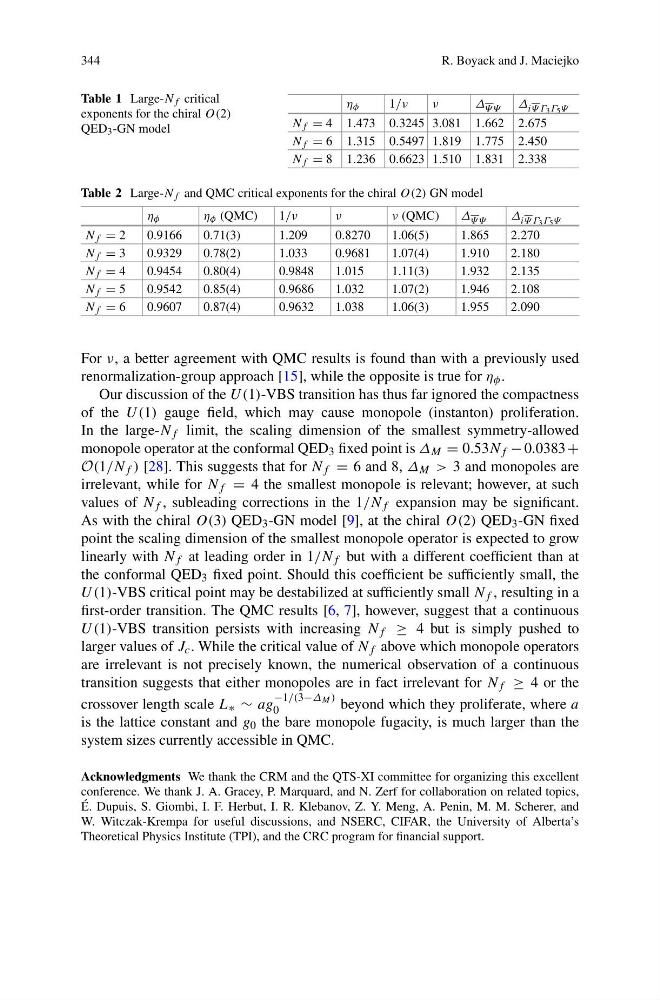
For ν, a better agreement with QMC results is found than with a previously used
renormalization-group approach [15], while the opposite is true for η φ .
Our discussion of the U(1)-VBS transition has thus far ignored the compactness
of the U(1) gauge field, which may cause monopole (instanton) proliferation.
In the large-N f limit, the scaling dimension of the smallest symmetry-allowed
monopole operator at the conformal QED 3 fixed point is Δ M = 0.53N f − 0.0383 +
O(1/N f ) [28]. This suggests that for N f = 6 and 8, Δ M > 3 and monopoles are
irrelevant, while for N f = 4 the smallest monopole is relevant; however, at such
values of N f , subleading corrections in the 1/N f expansion may be significant.
As with the chiral O(3) QED 3 -GN model [9], at the chiral O(2) QED 3 -GN fixed
point the scaling dimension of the smallest monopole operator is expected to grow
linearly with N f at leading order in 1/N f but with a different coefficient than at
the conformal QED 3 fixed point. Should this coefficient be sufficiently small, the
U(1)-VBS critical point may be destabilized at sufficiently small N f , resulting in a
first-order transition. The QMC results [6, 7], however, suggest that a continuous
U(1)-VBS transition persists with increasing N f ≥ 4 but is simply pushed to
larger values of J c . While the critical value of N f above which monopole operators
are irrelevant is not precisely known, the numerical observation of a continuous
transition suggests that either monopoles are in fact irrelevant for N f ≥ 4 or the
crossover length scale L ∗ ∼ ag
−1/(3−Δ M )
0
beyond which they proliferate, where a
is the lattice constant and g 0 the bare monopole fugacity, is much larger than the
system sizes currently accessible in QMC.
Acknowledgments We thank the CRM and the QTS-XI committee for organizing this excellent
conference. We thank J. A. Gracey, P. Marquard, and N. Zerf for collaboration on related topics,
É. Dupuis, S. Giombi, I. F. Herbut, I. R. Klebanov, Z. Y. Meng, A. Penin, M. M. Scherer, and
W. Witczak-Krempa for useful discussions, and NSERC, CIFAR, the University of Alberta’s
Theoretical Physics Institute (TPI), and the CRC program for financial support.
R. Boyack and J. Maciejko
Table 1 Large-N f critical
exponents for the chiral O(2)
QED 3 -GN model
η φ
1/ν
ν
Δ Ψ Ψ Δ iΨ Γ 3 Γ 5 Ψ
N f = 4 1.473 0.3245 3.081 1.662 2.675
N f = 6 1.315 0.5497 1.819 1.775 2.450
N f = 8 1.236 0.6623 1.510 1.831 2.338
Table 2 Large-N f and QMC critical exponents for the chiral O(2) GN model
η φ
η φ (QMC)
1/ν
ν
ν (QMC)
Δ Ψ Ψ
Δ iΨ Γ 3 Γ 5 Ψ
N f = 2
0.9166
0.71(3)
1.209
0.8270
1.06(5)
1.865
2.270
N f = 3
0.9329
0.78(2)
1.033
0.9681
1.07(4)
1.910
2.180
N f = 4
0.9454
0.80(4)
0.9848
1.015
1.11(3)
1.932
2.135
N f = 5
0.9542
0.85(4)
0.9686
1.032
1.07(2)
1.946
2.108
N f = 6
0.9607
0.87(4)
0.9632
1.038
1.06(3)
1.955
2.090
For ν, a better agreement with QMC results is found than with a previously used
renormalization-group approach [15], while the opposite is true for η φ .
Our discussion of the U(1)-VBS transition has thus far ignored the compactness
of the U(1) gauge field, which may cause monopole (instanton) proliferation.
In the large-N f limit, the scaling dimension of the smallest symmetry-allowed
monopole operator at the conformal QED 3 fixed point is Δ M = 0.53N f − 0.0383 +
O(1/N f ) [28]. This suggests that for N f = 6 and 8, Δ M > 3 and monopoles are
irrelevant, while for N f = 4 the smallest monopole is relevant; however, at such
values of N f , subleading corrections in the 1/N f expansion may be significant.
As with the chiral O(3) QED 3 -GN model [9], at the chiral O(2) QED 3 -GN fixed
point the scaling dimension of the smallest monopole operator is expected to grow
linearly with N f at leading order in 1/N f but with a different coefficient than at
the conformal QED 3 fixed point. Should this coefficient be sufficiently small, the
U(1)-VBS critical point may be destabilized at sufficiently small N f , resulting in a
first-order transition. The QMC results [6, 7], however, suggest that a continuous
U(1)-VBS transition persists with increasing N f ≥ 4 but is simply pushed to
larger values of J c . While the critical value of N f above which monopole operators
are irrelevant is not precisely known, the numerical observation of a continuous
transition suggests that either monopoles are in fact irrelevant for N f ≥ 4 or the
crossover length scale L ∗ ∼ ag
−1/(3−Δ M )
0
beyond which they proliferate, where a
is the lattice constant and g 0 the bare monopole fugacity, is much larger than the
system sizes currently accessible in QMC.
Acknowledgments We thank the CRM and the QTS-XI committee for organizing this excellent
conference. We thank J. A. Gracey, P. Marquard, and N. Zerf for collaboration on related topics,
É. Dupuis, S. Giombi, I. F. Herbut, I. R. Klebanov, Z. Y. Meng, A. Penin, M. M. Scherer, and
W. Witczak-Krempa for useful discussions, and NSERC, CIFAR, the University of Alberta’s
Theoretical Physics Institute (TPI), and the CRC program for financial support.