

Critical Exponents for the Valence-Bond-Solid Transition in Lattice Quantum. . .
343
columnar VBS order in the x and y directions, respectively. Here S A (r) =
αβ c
†
rα T
αβ
A c rβ denotes the SU (N f ) spin operator, where T A , A = 1, . . . , N 2
f − 1
is a Hermitian generator of the SU (N f ) Lie algebra. The corresponding thermodynamic susceptibility χ VBS (q) ∼ |q| 2Δ φ −3 ∼ |q| −(2−η φ ) , which can be computed
in QMC, diverges as q → 0, signaling the onset of VBS order. In the U(1)
phase itself, which is a critical phase, other gauge-invariant observables such as
the staggered density operator O CDW (r) = (−1) x+y
α c
†
rα c rα , the staggered
SU (N f ) spin O A (r) = (−1) x+y S A (r), and a quantum anomalous Hall mass
operator O QAH (r) defined in Ref. [10] also exhibit universal power-law correlations
characterized by (non-diverging) susceptibilities χ O (q) ∼ |q| 2Δ O −3 [8], which are
also in principle accessible in QMC. Such susceptibilities remain power law at the
U(1)-VBS critical point, but with different exponents characterizing the conformal
field theory associated with the chiral O(2) QED 3 -GN fixed point as opposed to that
of the pure-QED 3 fixed point. Detecting a change in these exponents numerically
upon approach to the critical point J → J −
c would be a signature of the new
universality class discussed in the present paper.
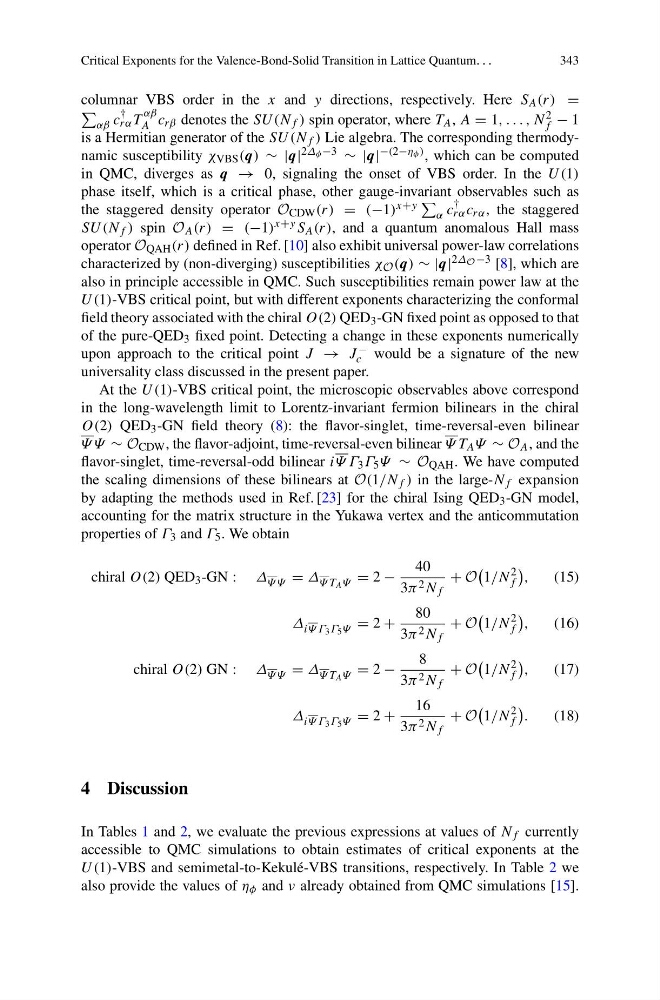
At the U(1)-VBS critical point, the microscopic observables above correspond
in the long-wavelength limit to Lorentz-invariant fermion bilinears in the chiral
O(2) QED 3 -GN field theory (8): the flavor-singlet, time-reversal-even bilinear
Ψ Ψ ∼ O CDW , the flavor-adjoint, time-reversal-even bilinear Ψ T A Ψ ∼ O A , and the
flavor-singlet, time-reversal-odd bilinear iΨ Γ 3 Γ 5 Ψ ∼ O QAH . We have computed
the scaling dimensions of these bilinears at O(1/N f ) in the large-N f expansion
by adapting the methods used in Ref. [23] for the chiral Ising QED 3 -GN model,
accounting for the matrix structure in the Yukawa vertex and the anticommutation
properties of Γ 3 and Γ 5 . We obtain
chiral O(2) QED 3 -GN : Δ Ψ Ψ = Δ Ψ T A Ψ = 2 −
40
3π 2 N f
+ O
1/N
2
f
,
(15)
Δ iΨ Γ 3 Γ 5 Ψ = 2 +
80
3π 2 N f
+ O
1/N
2
f
,
(16)
chiral O(2) GN : Δ Ψ Ψ = Δ Ψ T A Ψ = 2 −
8
3π 2 N f
+ O
1/N
2
f
,
(17)
Δ iΨ Γ 3 Γ 5 Ψ = 2 +
16
3π 2 N f
+ O
1/N
2
f
.
(18)
4 Discussion
In Tables 1 and 2, we evaluate the previous expressions at values of N f currently
accessible to QMC simulations to obtain estimates of critical exponents at the
U(1)-VBS and semimetal-to-Kekulé-VBS transitions, respectively. In Table 2 we
also provide the values of η φ and ν already obtained from QMC simulations [15].
343
columnar VBS order in the x and y directions, respectively. Here S A (r) =
αβ c
†
rα T
αβ
A c rβ denotes the SU (N f ) spin operator, where T A , A = 1, . . . , N 2
f − 1
is a Hermitian generator of the SU (N f ) Lie algebra. The corresponding thermodynamic susceptibility χ VBS (q) ∼ |q| 2Δ φ −3 ∼ |q| −(2−η φ ) , which can be computed
in QMC, diverges as q → 0, signaling the onset of VBS order. In the U(1)
phase itself, which is a critical phase, other gauge-invariant observables such as
the staggered density operator O CDW (r) = (−1) x+y
α c
†
rα c rα , the staggered
SU (N f ) spin O A (r) = (−1) x+y S A (r), and a quantum anomalous Hall mass
operator O QAH (r) defined in Ref. [10] also exhibit universal power-law correlations
characterized by (non-diverging) susceptibilities χ O (q) ∼ |q| 2Δ O −3 [8], which are
also in principle accessible in QMC. Such susceptibilities remain power law at the
U(1)-VBS critical point, but with different exponents characterizing the conformal
field theory associated with the chiral O(2) QED 3 -GN fixed point as opposed to that
of the pure-QED 3 fixed point. Detecting a change in these exponents numerically
upon approach to the critical point J → J −
c would be a signature of the new
universality class discussed in the present paper.
At the U(1)-VBS critical point, the microscopic observables above correspond
in the long-wavelength limit to Lorentz-invariant fermion bilinears in the chiral
O(2) QED 3 -GN field theory (8): the flavor-singlet, time-reversal-even bilinear
Ψ Ψ ∼ O CDW , the flavor-adjoint, time-reversal-even bilinear Ψ T A Ψ ∼ O A , and the
flavor-singlet, time-reversal-odd bilinear iΨ Γ 3 Γ 5 Ψ ∼ O QAH . We have computed
the scaling dimensions of these bilinears at O(1/N f ) in the large-N f expansion
by adapting the methods used in Ref. [23] for the chiral Ising QED 3 -GN model,
accounting for the matrix structure in the Yukawa vertex and the anticommutation
properties of Γ 3 and Γ 5 . We obtain
chiral O(2) QED 3 -GN : Δ Ψ Ψ = Δ Ψ T A Ψ = 2 −
40
3π 2 N f
+ O
1/N
2
f
,
(15)
Δ iΨ Γ 3 Γ 5 Ψ = 2 +
80
3π 2 N f
+ O
1/N
2
f
,
(16)
chiral O(2) GN : Δ Ψ Ψ = Δ Ψ T A Ψ = 2 −
8
3π 2 N f
+ O
1/N
2
f
,
(17)
Δ iΨ Γ 3 Γ 5 Ψ = 2 +
16
3π 2 N f
+ O
1/N
2
f
.
(18)
4 Discussion
In Tables 1 and 2, we evaluate the previous expressions at values of N f currently
accessible to QMC simulations to obtain estimates of critical exponents at the
U(1)-VBS and semimetal-to-Kekulé-VBS transitions, respectively. In Table 2 we
also provide the values of η φ and ν already obtained from QMC simulations [15].