

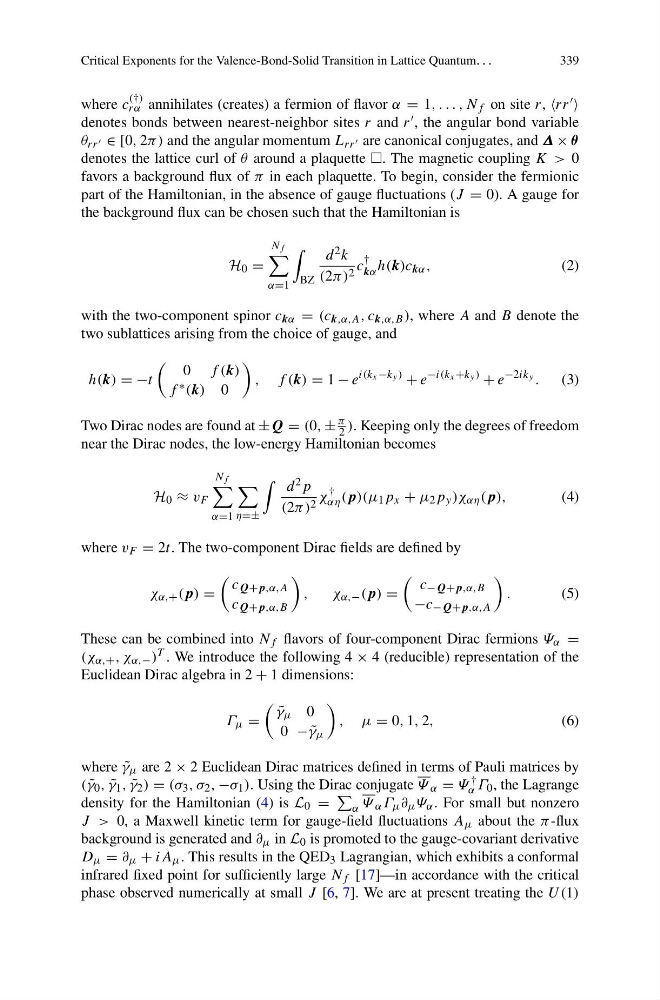
Critical Exponents for the Valence-Bond-Solid Transition in Lattice Quantum. . .
339
where c
(†)
rα annihilates (creates) a fermion of flavor α = 1, . . . , N f on site r, rr
denotes bonds between nearest-neighbor sites r and r , the angular bond variable
θ rr ∈ [0, 2π) and the angular momentum L rr are canonical conjugates, and Δ × θ
denotes the lattice curl of θ around a plaquette . The magnetic coupling K > 0
favors a background flux of π in each plaquette. To begin, consider the fermionic
part of the Hamiltonian, in the absence of gauge fluctuations (J = 0). A gauge for
the background flux can be chosen such that the Hamiltonian is
H 0 =
N f
α=1
BZ
d 2 k
(2π) 2 c
†
kα h(k)c kα ,
(2)
with the two-component spinor c kα = (c k,α,A , c k,α,B ), where A and B denote the
two sublattices arising from the choice of gauge, and
h(k) = −t
0 f (k)
f ∗ (k) 0
, f(k) = 1 − e
i(k x −k y )
+ e
−i(k x +k y )
+ e
−2ik y .
(3)
Two Dirac nodes are found at ±Q = (0, ±
π
2 ). Keeping only the degrees of freedom
near the Dirac nodes, the low-energy Hamiltonian becomes
H 0 ≈ v F
N f
α=1
η=±
d 2 p
(2π) 2 χ
†
αη (p)(μ 1 p x + μ 2 p y )χ αη (p),
(4)
where v F = 2t. The two-component Dirac fields are defined by
χ α,+ (p) =
c Q+p,α,A
c Q+p,α,B
,
χ α,− (p) =
c −Q+p,α,B
−c −Q+p,α,A
.
(5)
These can be combined into N f flavors of four-component Dirac fermions Ψ α =
(χ α,+ , χ α,− ) T . We introduce the following 4 × 4 (reducible) representation of the
Euclidean Dirac algebra in 2 + 1 dimensions:
Γ μ =
˜
γ μ 0
0 − ˜
γ μ
, μ = 0, 1, 2,
(6)
where ˜
γ μ are 2 × 2 Euclidean Dirac matrices defined in terms of Pauli matrices by
( ˜
γ 0 , ˜
γ 1 , ˜
γ 2 ) = (σ 3 , σ 2 , −σ 1 ). Using the Dirac conjugate Ψ α = Ψ †
α Γ 0 , the Lagrange
density for the Hamiltonian (4) is L 0 =
α Ψ α Γ μ ∂ μ Ψ α . For small but nonzero
J > 0, a Maxwell kinetic term for gauge-field fluctuations A μ about the π -flux
background is generated and ∂ μ in L 0 is promoted to the gauge-covariant derivative
D μ = ∂ μ + iA μ . This results in the QED 3 Lagrangian, which exhibits a conformal
infrared fixed point for sufficiently large N f [17]—in accordance with the critical
phase observed numerically at small J [6, 7]. We are at present treating the U(1)
339
where c
(†)
rα annihilates (creates) a fermion of flavor α = 1, . . . , N f on site r, rr
denotes bonds between nearest-neighbor sites r and r , the angular bond variable
θ rr ∈ [0, 2π) and the angular momentum L rr are canonical conjugates, and Δ × θ
denotes the lattice curl of θ around a plaquette . The magnetic coupling K > 0
favors a background flux of π in each plaquette. To begin, consider the fermionic
part of the Hamiltonian, in the absence of gauge fluctuations (J = 0). A gauge for
the background flux can be chosen such that the Hamiltonian is
H 0 =
N f
α=1
BZ
d 2 k
(2π) 2 c
†
kα h(k)c kα ,
(2)
with the two-component spinor c kα = (c k,α,A , c k,α,B ), where A and B denote the
two sublattices arising from the choice of gauge, and
h(k) = −t
0 f (k)
f ∗ (k) 0
, f(k) = 1 − e
i(k x −k y )
+ e
−i(k x +k y )
+ e
−2ik y .
(3)
Two Dirac nodes are found at ±Q = (0, ±
π
2 ). Keeping only the degrees of freedom
near the Dirac nodes, the low-energy Hamiltonian becomes
H 0 ≈ v F
N f
α=1
η=±
d 2 p
(2π) 2 χ
†
αη (p)(μ 1 p x + μ 2 p y )χ αη (p),
(4)
where v F = 2t. The two-component Dirac fields are defined by
χ α,+ (p) =
c Q+p,α,A
c Q+p,α,B
,
χ α,− (p) =
c −Q+p,α,B
−c −Q+p,α,A
.
(5)
These can be combined into N f flavors of four-component Dirac fermions Ψ α =
(χ α,+ , χ α,− ) T . We introduce the following 4 × 4 (reducible) representation of the
Euclidean Dirac algebra in 2 + 1 dimensions:
Γ μ =
˜
γ μ 0
0 − ˜
γ μ
, μ = 0, 1, 2,
(6)
where ˜
γ μ are 2 × 2 Euclidean Dirac matrices defined in terms of Pauli matrices by
( ˜
γ 0 , ˜
γ 1 , ˜
γ 2 ) = (σ 3 , σ 2 , −σ 1 ). Using the Dirac conjugate Ψ α = Ψ †
α Γ 0 , the Lagrange
density for the Hamiltonian (4) is L 0 =
α Ψ α Γ μ ∂ μ Ψ α . For small but nonzero
J > 0, a Maxwell kinetic term for gauge-field fluctuations A μ about the π -flux
background is generated and ∂ μ in L 0 is promoted to the gauge-covariant derivative
D μ = ∂ μ + iA μ . This results in the QED 3 Lagrangian, which exhibits a conformal
infrared fixed point for sufficiently large N f [17]—in accordance with the critical
phase observed numerically at small J [6, 7]. We are at present treating the U(1)