

338
R. Boyack and J. Maciejko
phase and a conventional phase. In the language of lattice gauge theories of
quantum antiferromagnets [3], where spin degrees of freedom fractionalize into
emergent fermions coupled to gauge fields, these correspond to transitions between
distinct deconfined phases of a lattice gauge theory or between a deconfined
phase and a confined phase, respectively. Besides their application to frustrated
magnetism and elementary particle physics, lattice gauge theories may now be
experimentally realized using ultracold atoms in optical lattices [4, 5], and thus
constitute an important class of interacting many-body systems whose phases and
phase transitions are of intrinsic interest.
Recently, sign-problem-free quantum Monte Carlo (QMC) simulations of (2+1)dimensional lattice quantum electrodynamics (QED 3 ) with an even number N f of
flavors of fermions on the square lattice [6, 7] have found evidence for a U(1)
deconfined phase with power-law correlations, and for continuous quantum phase
transitions from this phase to conventional confined phases. For N f = 2, the
putative U(1) phase is adiabatically connected to the algebraic spin liquid [8] and
the transition is towards a Néel antiferromagnet. This transition is described by the
chiral O(3) QED 3 -Gross-Neveu (GN) model, whose universal critical properties
were studied recently using both -expansion [9, 10] and large-N f techniques [10].
For N f = 4, 6, and 8, the confinement transition is found to be towards a
gapped valence-bond-solid (VBS) phase. The corresponding critical theory was
conjectured to be of the chiral O(2) QED 3 -GN type [6], but its critical properties
have thus far not been investigated. In this paper, we establish the precise form
of the critical theory, show its equivalence to the gauged Nambu–Jona-Lasinio
(NJL) model [11, 12], and determine various critical exponents using the large-N f
expansion. In both the gauged and ungauged chiral O(2) GN models, we obtain new
results for the scaling dimensions of fermion bilinears that, respectively, describe
the power-law decay of certain two-particle correlation functions at the U(1)-VBS
transition and the semimetal-to-Kekulé-VBS transition for interacting fermions on
the honeycomb lattice [13–15]. Critical exponents for the U(1)-VBS transition at
O(1/N 2
f ) in the large-N f expansion and four-loop order in the -expansion will be
reported in a future publication [16].
1 The U (1)-VBS Transition
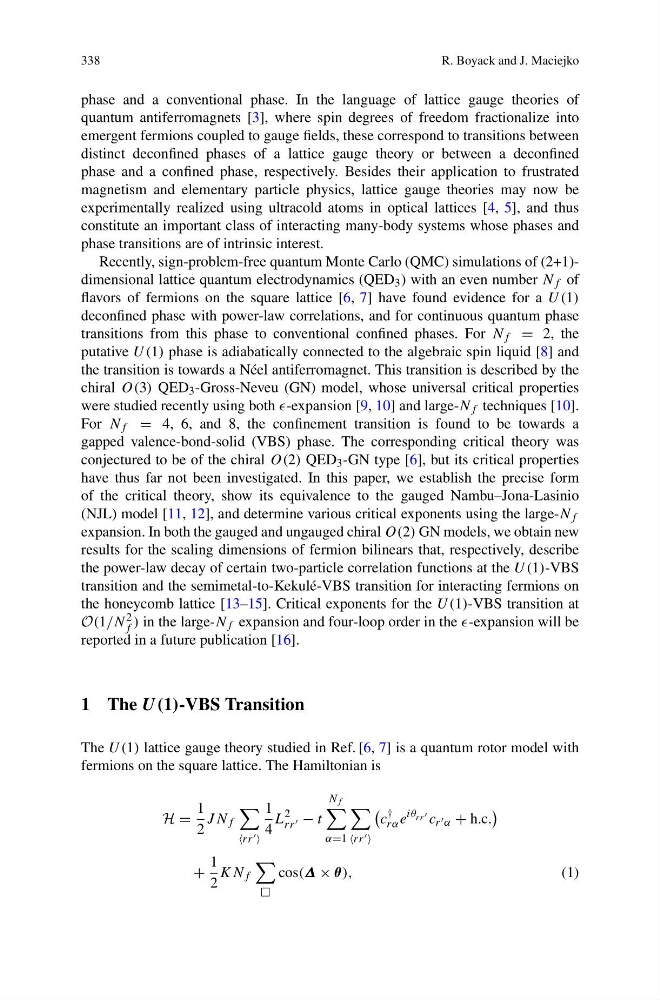
The U(1) lattice gauge theory studied in Ref. [6, 7] is a quantum rotor model with
fermions on the square lattice. The Hamiltonian is
H =
1
2
J N f
rr
1
4
L
2
rr − t
N f
α=1
rr
c
†
rα e
iθ rr c r α + h.c.
+
1
2
KN f
cos(Δ × θ ),
(1)
R. Boyack and J. Maciejko
phase and a conventional phase. In the language of lattice gauge theories of
quantum antiferromagnets [3], where spin degrees of freedom fractionalize into
emergent fermions coupled to gauge fields, these correspond to transitions between
distinct deconfined phases of a lattice gauge theory or between a deconfined
phase and a confined phase, respectively. Besides their application to frustrated
magnetism and elementary particle physics, lattice gauge theories may now be
experimentally realized using ultracold atoms in optical lattices [4, 5], and thus
constitute an important class of interacting many-body systems whose phases and
phase transitions are of intrinsic interest.
Recently, sign-problem-free quantum Monte Carlo (QMC) simulations of (2+1)dimensional lattice quantum electrodynamics (QED 3 ) with an even number N f of
flavors of fermions on the square lattice [6, 7] have found evidence for a U(1)
deconfined phase with power-law correlations, and for continuous quantum phase
transitions from this phase to conventional confined phases. For N f = 2, the
putative U(1) phase is adiabatically connected to the algebraic spin liquid [8] and
the transition is towards a Néel antiferromagnet. This transition is described by the
chiral O(3) QED 3 -Gross-Neveu (GN) model, whose universal critical properties
were studied recently using both -expansion [9, 10] and large-N f techniques [10].
For N f = 4, 6, and 8, the confinement transition is found to be towards a
gapped valence-bond-solid (VBS) phase. The corresponding critical theory was
conjectured to be of the chiral O(2) QED 3 -GN type [6], but its critical properties
have thus far not been investigated. In this paper, we establish the precise form
of the critical theory, show its equivalence to the gauged Nambu–Jona-Lasinio
(NJL) model [11, 12], and determine various critical exponents using the large-N f
expansion. In both the gauged and ungauged chiral O(2) GN models, we obtain new
results for the scaling dimensions of fermion bilinears that, respectively, describe
the power-law decay of certain two-particle correlation functions at the U(1)-VBS
transition and the semimetal-to-Kekulé-VBS transition for interacting fermions on
the honeycomb lattice [13–15]. Critical exponents for the U(1)-VBS transition at
O(1/N 2
f ) in the large-N f expansion and four-loop order in the -expansion will be
reported in a future publication [16].
1 The U (1)-VBS Transition
The U(1) lattice gauge theory studied in Ref. [6, 7] is a quantum rotor model with
fermions on the square lattice. The Hamiltonian is
H =
1
2
J N f
rr
1
4
L
2
rr − t
N f
α=1
rr
c
†
rα e
iθ rr c r α + h.c.
+
1
2
KN f
cos(Δ × θ ),
(1)