

Nonlinear Coherent States for Anisotropic 2D Dirac Materials
323
q α =
˜
α + (−1) q ˜
α ∗
2
√
2i q
1 + exp
−| ˜
α|
2
∞
n=0
√
n + 2 | ˜
α| 2n
√
n!(n + 1)!
,
(18c)
2
q α = 1 + | ˜
α|
2
+ (−1)
q ( ˜
α 2 + ˜
α ∗2 )
4
×
1 + exp
−| ˜
α|
2
∞
n=0
√
n + 3 | ˜
α| 2n
√
n!(n + 1)!
.
(18d)
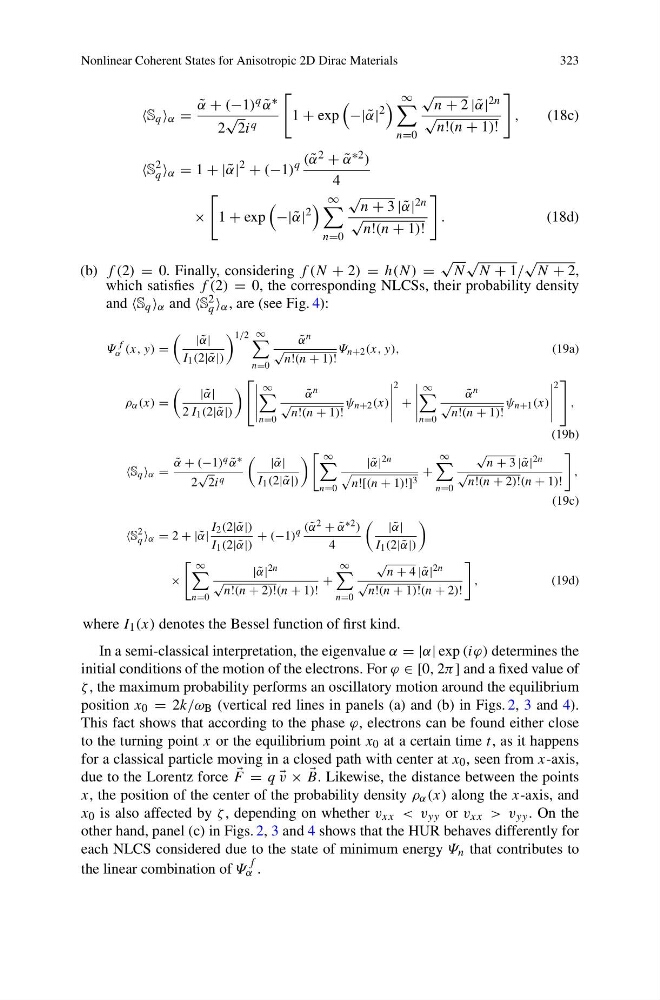
(b) f (2) = 0. Finally, considering f (N + 2) = h(N) =
√
N
√
N + 1/
√
N + 2,
which satisfies f (2) = 0, the corresponding NLCSs, their probability density
and q α and 2
q α , are (see Fig. 4):
Ψ
f
α (x, y) =
| ˜
α|
I 1 (2| ˜
α|)
1/2 ∞
n=0
˜
α n
√
n!(n + 1)!
Ψ n+2 (x, y),
(19a)
ρ α (x) =
| ˜
α|
2 I 1 (2| ˜
α|)
⎡
⎣
∞
n=0
˜
α n
√
n!(n + 1)!
ψ n+2 (x)
2
+
∞
n=0
˜
α n
√
n!(n + 1)!
ψ n+1 (x)
2
⎤
⎦ ,
(19b)
q α =
˜
α + (−1) q ˜
α ∗
2
√
2i q
| ˜
α|
I 1 (2| ˜
α|)
∞
n=0
| ˜
α| 2n
n![(n + 1)!] 3
+
∞
n=0
√
n + 3 | ˜
α| 2n
√
n!(n + 2)!(n + 1)!
,
(19c)
2
q α = 2 + | ˜
α|
I 2 (2| ˜
α|)
I 1 (2| ˜
α|)
+ (−1)
q ( ˜
α 2 + ˜
α ∗2 )
4
| ˜
α|
I 1 (2| ˜
α|)
×
∞
n=0
| ˜
α| 2n
√
n!(n + 2)!(n + 1)!
+
∞
n=0
√
n + 4 | ˜
α| 2n
√
n!(n + 1)!(n + 2)!
,
(19d)
where I 1 (x) denotes the Bessel function of first kind.
In a semi-classical interpretation, the eigenvalue α = |α| exp (iϕ) determines the
initial conditions of the motion of the electrons. For ϕ ∈ [0, 2π ] and a fixed value of
ζ , the maximum probability performs an oscillatory motion around the equilibrium
position x 0 = 2k/ω B (vertical red lines in panels (a) and (b) in Figs. 2, 3 and 4).
This fact shows that according to the phase ϕ, electrons can be found either close
to the turning point x or the equilibrium point x 0 at a certain time t, as it happens
for a classical particle moving in a closed path with center at x 0 , seen from x-axis,
due to the Lorentz force
F = q
v ×
B. Likewise, the distance between the points
x, the position of the center of the probability density ρ α (x) along the x-axis, and
x 0 is also affected by ζ , depending on whether v xx < v yy or v xx > v yy . On the
other hand, panel (c) in Figs. 2, 3 and 4 shows that the HUR behaves differently for
each NLCS considered due to the state of minimum energy Ψ n that contributes to
the linear combination of Ψ
f
α .
323
q α =
˜
α + (−1) q ˜
α ∗
2
√
2i q
1 + exp
−| ˜
α|
2
∞
n=0
√
n + 2 | ˜
α| 2n
√
n!(n + 1)!
,
(18c)
2
q α = 1 + | ˜
α|
2
+ (−1)
q ( ˜
α 2 + ˜
α ∗2 )
4
×
1 + exp
−| ˜
α|
2
∞
n=0
√
n + 3 | ˜
α| 2n
√
n!(n + 1)!
.
(18d)
(b) f (2) = 0. Finally, considering f (N + 2) = h(N) =
√
N
√
N + 1/
√
N + 2,
which satisfies f (2) = 0, the corresponding NLCSs, their probability density
and q α and 2
q α , are (see Fig. 4):
Ψ
f
α (x, y) =
| ˜
α|
I 1 (2| ˜
α|)
1/2 ∞
n=0
˜
α n
√
n!(n + 1)!
Ψ n+2 (x, y),
(19a)
ρ α (x) =
| ˜
α|
2 I 1 (2| ˜
α|)
⎡
⎣
∞
n=0
˜
α n
√
n!(n + 1)!
ψ n+2 (x)
2
+
∞
n=0
˜
α n
√
n!(n + 1)!
ψ n+1 (x)
2
⎤
⎦ ,
(19b)
q α =
˜
α + (−1) q ˜
α ∗
2
√
2i q
| ˜
α|
I 1 (2| ˜
α|)
∞
n=0
| ˜
α| 2n
n![(n + 1)!] 3
+
∞
n=0
√
n + 3 | ˜
α| 2n
√
n!(n + 2)!(n + 1)!
,
(19c)
2
q α = 2 + | ˜
α|
I 2 (2| ˜
α|)
I 1 (2| ˜
α|)
+ (−1)
q ( ˜
α 2 + ˜
α ∗2 )
4
| ˜
α|
I 1 (2| ˜
α|)
×
∞
n=0
| ˜
α| 2n
√
n!(n + 2)!(n + 1)!
+
∞
n=0
√
n + 4 | ˜
α| 2n
√
n!(n + 1)!(n + 2)!
,
(19d)
where I 1 (x) denotes the Bessel function of first kind.
In a semi-classical interpretation, the eigenvalue α = |α| exp (iϕ) determines the
initial conditions of the motion of the electrons. For ϕ ∈ [0, 2π ] and a fixed value of
ζ , the maximum probability performs an oscillatory motion around the equilibrium
position x 0 = 2k/ω B (vertical red lines in panels (a) and (b) in Figs. 2, 3 and 4).
This fact shows that according to the phase ϕ, electrons can be found either close
to the turning point x or the equilibrium point x 0 at a certain time t, as it happens
for a classical particle moving in a closed path with center at x 0 , seen from x-axis,
due to the Lorentz force
F = q
v ×
B. Likewise, the distance between the points
x, the position of the center of the probability density ρ α (x) along the x-axis, and
x 0 is also affected by ζ , depending on whether v xx < v yy or v xx > v yy . On the
other hand, panel (c) in Figs. 2, 3 and 4 shows that the HUR behaves differently for
each NLCS considered due to the state of minimum energy Ψ n that contributes to
the linear combination of Ψ
f
α .