

322
E. Díaz-Bautista et al.
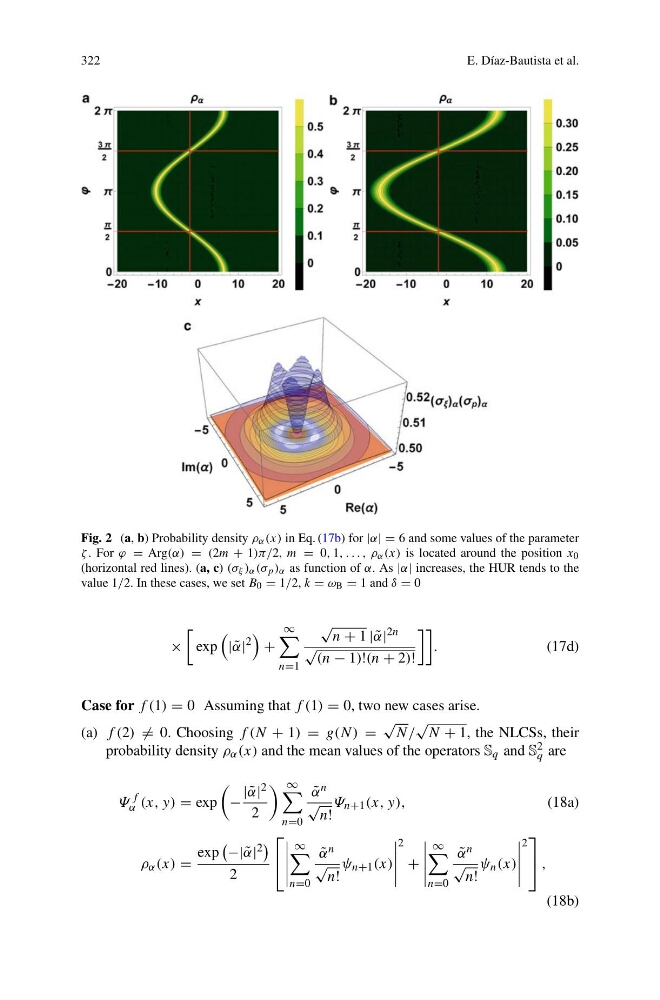
Fig. 2 (a, b) Probability density ρ α (x) in Eq. (17b) for |α| = 6 and some values of the parameter
ζ . For ϕ = Arg(α) = (2m + 1)π/2, m = 0, 1, . . . , ρ α (x) is located around the position x 0
(horizontal red lines). (a, c) (σ ξ ) α (σ p ) α as function of α. As |α| increases, the HUR tends to the
value 1/2. In these cases, we set B 0 = 1/2, k = ω B = 1 and δ = 0
×
exp
| ˜
α|
2
+
∞
n=1
√
n + 1 | ˜
α| 2n
√
(n − 1)!(n + 2)!
.
(17d)
Case for f (1) = 0 Assuming that f (1) = 0, two new cases arise.
(a) f (2) = 0. Choosing f (N + 1) = g(N) =
√
N/
√
N + 1, the NLCSs, their
probability density ρ α (x) and the mean values of the operators S q and S 2
q are
Ψ
f
α (x, y) = exp
−
| ˜
α| 2
2
∞
n=0
˜
α n
√
n!
Ψ n+1 (x, y),
(18a)
ρ α (x) =
exp
−| ˜
α| 2
2
⎡
⎣
∞
n=0
˜
α n
√
n!
ψ n+1 (x)
2
+
∞
n=0
˜
α n
√
n!
ψ n (x)
2
⎤
⎦ ,
(18b)
E. Díaz-Bautista et al.
Fig. 2 (a, b) Probability density ρ α (x) in Eq. (17b) for |α| = 6 and some values of the parameter
ζ . For ϕ = Arg(α) = (2m + 1)π/2, m = 0, 1, . . . , ρ α (x) is located around the position x 0
(horizontal red lines). (a, c) (σ ξ ) α (σ p ) α as function of α. As |α| increases, the HUR tends to the
value 1/2. In these cases, we set B 0 = 1/2, k = ω B = 1 and δ = 0
×
exp
| ˜
α|
2
+
∞
n=1
√
n + 1 | ˜
α| 2n
√
(n − 1)!(n + 2)!
.
(17d)
Case for f (1) = 0 Assuming that f (1) = 0, two new cases arise.
(a) f (2) = 0. Choosing f (N + 1) = g(N) =
√
N/
√
N + 1, the NLCSs, their
probability density ρ α (x) and the mean values of the operators S q and S 2
q are
Ψ
f
α (x, y) = exp
−
| ˜
α| 2
2
∞
n=0
˜
α n
√
n!
Ψ n+1 (x, y),
(18a)
ρ α (x) =
exp
−| ˜
α| 2
2
⎡
⎣
∞
n=0
˜
α n
√
n!
ψ n+1 (x)
2
+
∞
n=0
˜
α n
√
n!
ψ n (x)
2
⎤
⎦ ,
(18b)