

Influence of the Electron–Phonon Interaction on the Topological Phase. . .
309
k
0
E
k
− E
F
+
−
Intraband
a
b
k
0
−
+
Interband
k
0
+
−
−
+
Trivial state
k
0
+
−
−
+
Topological state
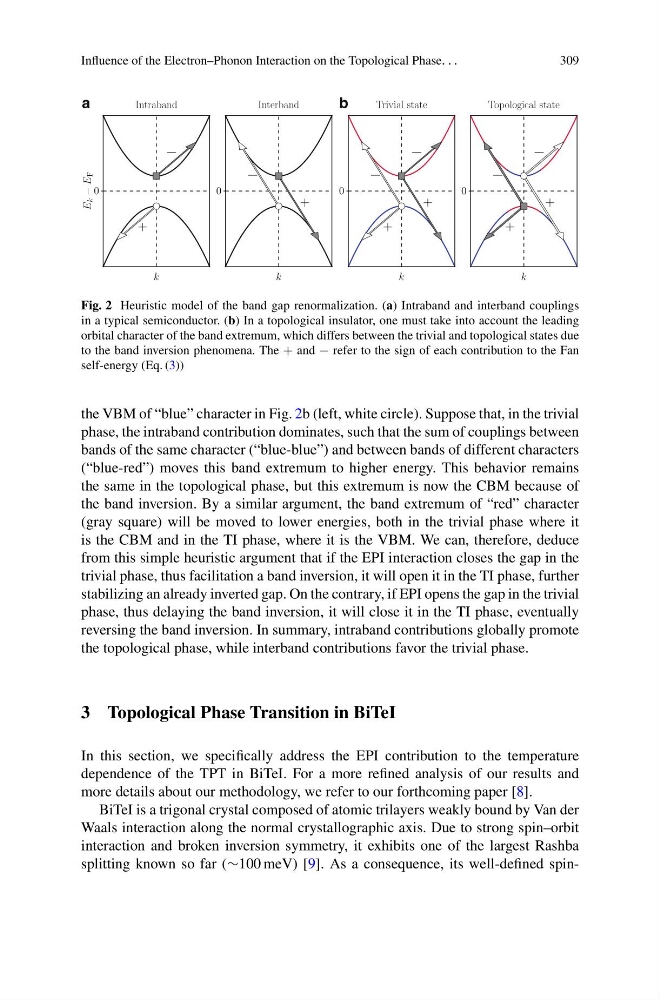
Fig. 2 Heuristic model of the band gap renormalization. (a) Intraband and interband couplings
in a typical semiconductor. (b) In a topological insulator, one must take into account the leading
orbital character of the band extremum, which differs between the trivial and topological states due
to the band inversion phenomena. The + and − refer to the sign of each contribution to the Fan
self-energy (Eq. (3))
the VBM of “blue” character in Fig. 2b (left, white circle). Suppose that, in the trivial
phase, the intraband contribution dominates, such that the sum of couplings between
bands of the same character (“blue-blue”) and between bands of different characters
(“blue-red”) moves this band extremum to higher energy. This behavior remains
the same in the topological phase, but this extremum is now the CBM because of
the band inversion. By a similar argument, the band extremum of “red” character
(gray square) will be moved to lower energies, both in the trivial phase where it
is the CBM and in the TI phase, where it is the VBM. We can, therefore, deduce
from this simple heuristic argument that if the EPI interaction closes the gap in the
trivial phase, thus facilitation a band inversion, it will open it in the TI phase, further
stabilizing an already inverted gap. On the contrary, if EPI opens the gap in the trivial
phase, thus delaying the band inversion, it will close it in the TI phase, eventually
reversing the band inversion. In summary, intraband contributions globally promote
the topological phase, while interband contributions favor the trivial phase.
3 Topological Phase Transition in BiTeI
In this section, we specifically address the EPI contribution to the temperature
dependence of the TPT in BiTeI. For a more refined analysis of our results and
more details about our methodology, we refer to our forthcoming paper [8].
BiTeI is a trigonal crystal composed of atomic trilayers weakly bound by Van der
Waals interaction along the normal crystallographic axis. Due to strong spin–orbit
interaction and broken inversion symmetry, it exhibits one of the largest Rashba
splitting known so far (∼100 meV) [9]. As a consequence, its well-defined spin-
309
k
0
E
k
− E
F
+
−
Intraband
a
b
k
0
−
+
Interband
k
0
+
−
−
+
Trivial state
k
0
+
−
−
+
Topological state
Fig. 2 Heuristic model of the band gap renormalization. (a) Intraband and interband couplings
in a typical semiconductor. (b) In a topological insulator, one must take into account the leading
orbital character of the band extremum, which differs between the trivial and topological states due
to the band inversion phenomena. The + and − refer to the sign of each contribution to the Fan
self-energy (Eq. (3))
the VBM of “blue” character in Fig. 2b (left, white circle). Suppose that, in the trivial
phase, the intraband contribution dominates, such that the sum of couplings between
bands of the same character (“blue-blue”) and between bands of different characters
(“blue-red”) moves this band extremum to higher energy. This behavior remains
the same in the topological phase, but this extremum is now the CBM because of
the band inversion. By a similar argument, the band extremum of “red” character
(gray square) will be moved to lower energies, both in the trivial phase where it
is the CBM and in the TI phase, where it is the VBM. We can, therefore, deduce
from this simple heuristic argument that if the EPI interaction closes the gap in the
trivial phase, thus facilitation a band inversion, it will open it in the TI phase, further
stabilizing an already inverted gap. On the contrary, if EPI opens the gap in the trivial
phase, thus delaying the band inversion, it will close it in the TI phase, eventually
reversing the band inversion. In summary, intraband contributions globally promote
the topological phase, while interband contributions favor the trivial phase.
3 Topological Phase Transition in BiTeI
In this section, we specifically address the EPI contribution to the temperature
dependence of the TPT in BiTeI. For a more refined analysis of our results and
more details about our methodology, we refer to our forthcoming paper [8].
BiTeI is a trigonal crystal composed of atomic trilayers weakly bound by Van der
Waals interaction along the normal crystallographic axis. Due to strong spin–orbit
interaction and broken inversion symmetry, it exhibits one of the largest Rashba
splitting known so far (∼100 meV) [9]. As a consequence, its well-defined spin-