

308
V. Brousseau-Couture and M. Côté
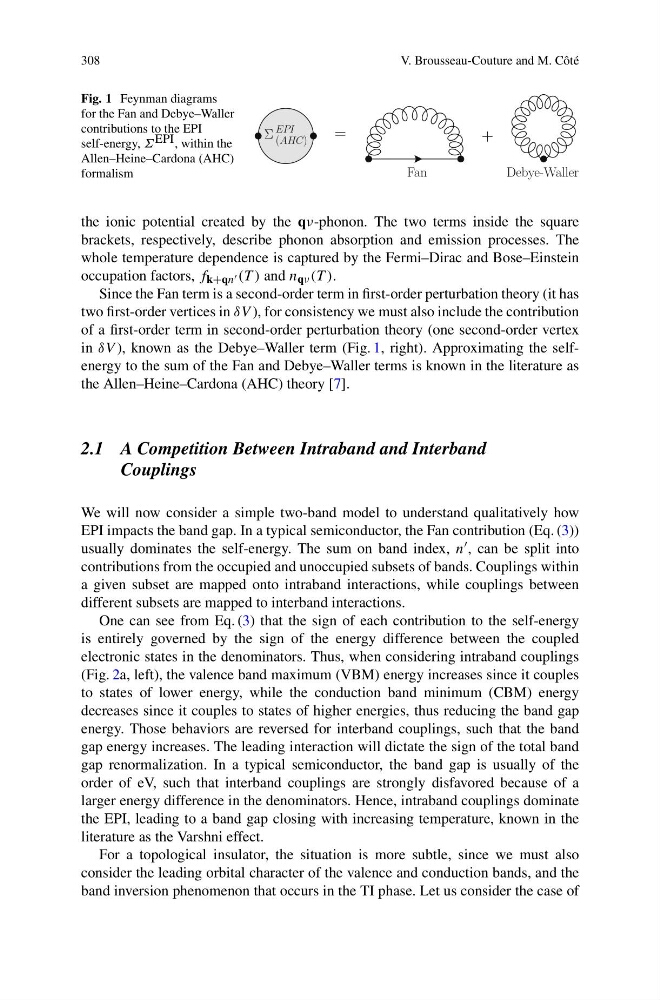
Fig. 1 Feynman diagrams
for the Fan and Debye–Waller
contributions to the EPI
self-energy, Σ EPI , within the
Allen–Heine–Cardona (AHC)
formalism
=
+
Fan
Debye-Waller
Σ
EPI
(AHC)
the ionic potential created by the qν-phonon. The two terms inside the square
brackets, respectively, describe phonon absorption and emission processes. The
whole temperature dependence is captured by the Fermi–Dirac and Bose–Einstein
occupation factors, f k+qn (T ) and n qν (T ).
Since the Fan term is a second-order term in first-order perturbation theory (it has
two first-order vertices in δV ), for consistency we must also include the contribution
of a first-order term in second-order perturbation theory (one second-order vertex
in δV ), known as the Debye–Waller term (Fig. 1, right). Approximating the selfenergy to the sum of the Fan and Debye–Waller terms is known in the literature as
the Allen–Heine–Cardona (AHC) theory [7].
2.1 A Competition Between Intraband and Interband
Couplings
We will now consider a simple two-band model to understand qualitatively how
EPI impacts the band gap. In a typical semiconductor, the Fan contribution (Eq. (3))
usually dominates the self-energy. The sum on band index, n , can be split into
contributions from the occupied and unoccupied subsets of bands. Couplings within
a given subset are mapped onto intraband interactions, while couplings between
different subsets are mapped to interband interactions.
One can see from Eq. (3) that the sign of each contribution to the self-energy
is entirely governed by the sign of the energy difference between the coupled
electronic states in the denominators. Thus, when considering intraband couplings
(Fig. 2a, left), the valence band maximum (VBM) energy increases since it couples
to states of lower energy, while the conduction band minimum (CBM) energy
decreases since it couples to states of higher energies, thus reducing the band gap
energy. Those behaviors are reversed for interband couplings, such that the band
gap energy increases. The leading interaction will dictate the sign of the total band
gap renormalization. In a typical semiconductor, the band gap is usually of the
order of eV, such that interband couplings are strongly disfavored because of a
larger energy difference in the denominators. Hence, intraband couplings dominate
the EPI, leading to a band gap closing with increasing temperature, known in the
literature as the Varshni effect.
For a topological insulator, the situation is more subtle, since we must also
consider the leading orbital character of the valence and conduction bands, and the
band inversion phenomenon that occurs in the TI phase. Let us consider the case of
V. Brousseau-Couture and M. Côté
Fig. 1 Feynman diagrams
for the Fan and Debye–Waller
contributions to the EPI
self-energy, Σ EPI , within the
Allen–Heine–Cardona (AHC)
formalism
=
+
Fan
Debye-Waller
Σ
EPI
(AHC)
the ionic potential created by the qν-phonon. The two terms inside the square
brackets, respectively, describe phonon absorption and emission processes. The
whole temperature dependence is captured by the Fermi–Dirac and Bose–Einstein
occupation factors, f k+qn (T ) and n qν (T ).
Since the Fan term is a second-order term in first-order perturbation theory (it has
two first-order vertices in δV ), for consistency we must also include the contribution
of a first-order term in second-order perturbation theory (one second-order vertex
in δV ), known as the Debye–Waller term (Fig. 1, right). Approximating the selfenergy to the sum of the Fan and Debye–Waller terms is known in the literature as
the Allen–Heine–Cardona (AHC) theory [7].
2.1 A Competition Between Intraband and Interband
Couplings
We will now consider a simple two-band model to understand qualitatively how
EPI impacts the band gap. In a typical semiconductor, the Fan contribution (Eq. (3))
usually dominates the self-energy. The sum on band index, n , can be split into
contributions from the occupied and unoccupied subsets of bands. Couplings within
a given subset are mapped onto intraband interactions, while couplings between
different subsets are mapped to interband interactions.
One can see from Eq. (3) that the sign of each contribution to the self-energy
is entirely governed by the sign of the energy difference between the coupled
electronic states in the denominators. Thus, when considering intraband couplings
(Fig. 2a, left), the valence band maximum (VBM) energy increases since it couples
to states of lower energy, while the conduction band minimum (CBM) energy
decreases since it couples to states of higher energies, thus reducing the band gap
energy. Those behaviors are reversed for interband couplings, such that the band
gap energy increases. The leading interaction will dictate the sign of the total band
gap renormalization. In a typical semiconductor, the band gap is usually of the
order of eV, such that interband couplings are strongly disfavored because of a
larger energy difference in the denominators. Hence, intraband couplings dominate
the EPI, leading to a band gap closing with increasing temperature, known in the
literature as the Varshni effect.
For a topological insulator, the situation is more subtle, since we must also
consider the leading orbital character of the valence and conduction bands, and the
band inversion phenomenon that occurs in the TI phase. Let us consider the case of