

302
K. Zelaya and V. Hussin
The latter points must be clarified in order to provide the functions (26), and any
linear combination of them, with a physical meaning.
Remarkably, such information is obtained from the point transformation itself,
because any conserved quantity is preserved [12]. Indeed, from (5) we see that the
energy eigenvalues E n = (n + 1/2) of the stationary oscillator must be preserved
since they are constant quantities. To be specific, using the relationships (11)
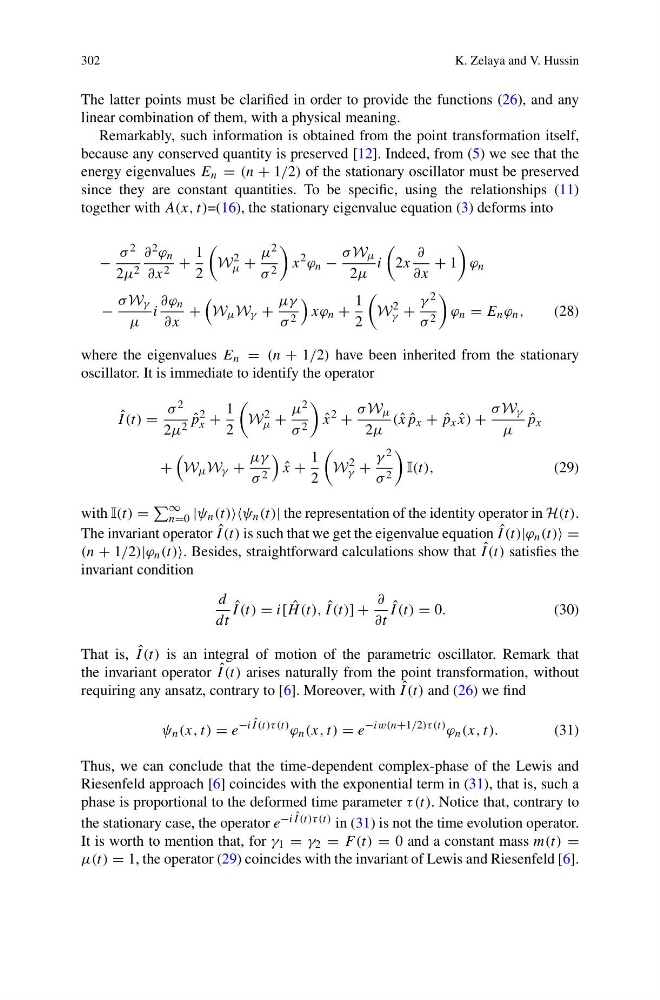
together with A(x, t)=(16), the stationary eigenvalue equation (3) deforms into
−
σ 2
2μ 2
∂ 2 ϕ n
∂x 2 +
1
2
W
2
μ +
μ 2
σ 2
x
2 ϕ n −
σ W μ
2μ
i
2x
∂
∂x
+ 1
ϕ n
−
σ W γ
μ
i
∂ϕ n
∂x
+
W μ W γ +
μγ
σ 2
xϕ n +
1
2
W
2
γ +
γ 2
σ 2
ϕ n = E n ϕ n ,
(28)
where the eigenvalues E n = (n + 1/2) have been inherited from the stationary
oscillator. It is immediate to identify the operator
ˆ
I (t) =
σ 2
2μ 2 ˆ
p
2
x +
1
2
W
2
μ +
μ 2
σ 2
ˆ
x
2
+
σ W μ
2μ
( ˆ
x ˆ
p x + ˆ
p x ˆ
x) +
σ W γ
μ
ˆ
p x
+
W μ W γ +
μγ
σ 2
ˆ
x +
1
2
W
2
γ +
γ 2
σ 2
I(t),
(29)
with I(t) =
∞
n=0 |ψ n (t) n (t)| the representation of the identity operator in H(t).
The invariant operator ˆ
I (t) is such that we get the eigenvalue equation ˆ
I (t)|ϕ n (t) =
(n + 1/2)|ϕ n (t). Besides, straightforward calculations show that ˆ
I (t) satisfies the
invariant condition
d
dt
ˆ
I (t) = i[ ˆ
H (t), ˆ
I (t)] +
∂
∂t
ˆ
I (t) = 0.
(30)
That is, ˆ
I (t) is an integral of motion of the parametric oscillator. Remark that
the invariant operator ˆ
I (t) arises naturally from the point transformation, without
requiring any ansatz, contrary to [6]. Moreover, with ˆ
I (t) and (26) we find
ψ n (x, t) = e
−i ˆ
I (t)τ (t) ϕ n (x, t) = e
−iw(n+1/2)τ (t) ϕ n (x, t).
(31)
Thus, we can conclude that the time-dependent complex-phase of the Lewis and
Riesenfeld approach [6] coincides with the exponential term in (31), that is, such a
phase is proportional to the deformed time parameter τ (t). Notice that, contrary to
the stationary case, the operator e −i ˆ
I (t)τ (t) in (31) is not the time evolution operator.
It is worth to mention that, for γ 1 = γ 2 = F (t) = 0 and a constant mass m(t) =
μ(t) = 1, the operator (29) coincides with the invariant of Lewis and Riesenfeld [6].
K. Zelaya and V. Hussin
The latter points must be clarified in order to provide the functions (26), and any
linear combination of them, with a physical meaning.
Remarkably, such information is obtained from the point transformation itself,
because any conserved quantity is preserved [12]. Indeed, from (5) we see that the
energy eigenvalues E n = (n + 1/2) of the stationary oscillator must be preserved
since they are constant quantities. To be specific, using the relationships (11)
together with A(x, t)=(16), the stationary eigenvalue equation (3) deforms into
−
σ 2
2μ 2
∂ 2 ϕ n
∂x 2 +
1
2
W
2
μ +
μ 2
σ 2
x
2 ϕ n −
σ W μ
2μ
i
2x
∂
∂x
+ 1
ϕ n
−
σ W γ
μ
i
∂ϕ n
∂x
+
W μ W γ +
μγ
σ 2
xϕ n +
1
2
W
2
γ +
γ 2
σ 2
ϕ n = E n ϕ n ,
(28)
where the eigenvalues E n = (n + 1/2) have been inherited from the stationary
oscillator. It is immediate to identify the operator
ˆ
I (t) =
σ 2
2μ 2 ˆ
p
2
x +
1
2
W
2
μ +
μ 2
σ 2
ˆ
x
2
+
σ W μ
2μ
( ˆ
x ˆ
p x + ˆ
p x ˆ
x) +
σ W γ
μ
ˆ
p x
+
W μ W γ +
μγ
σ 2
ˆ
x +
1
2
W
2
γ +
γ 2
σ 2
I(t),
(29)
with I(t) =
∞
n=0 |ψ n (t) n (t)| the representation of the identity operator in H(t).
The invariant operator ˆ
I (t) is such that we get the eigenvalue equation ˆ
I (t)|ϕ n (t) =
(n + 1/2)|ϕ n (t). Besides, straightforward calculations show that ˆ
I (t) satisfies the
invariant condition
d
dt
ˆ
I (t) = i[ ˆ
H (t), ˆ
I (t)] +
∂
∂t
ˆ
I (t) = 0.
(30)
That is, ˆ
I (t) is an integral of motion of the parametric oscillator. Remark that
the invariant operator ˆ
I (t) arises naturally from the point transformation, without
requiring any ansatz, contrary to [6]. Moreover, with ˆ
I (t) and (26) we find
ψ n (x, t) = e
−i ˆ
I (t)τ (t) ϕ n (x, t) = e
−iw(n+1/2)τ (t) ϕ n (x, t).
(31)
Thus, we can conclude that the time-dependent complex-phase of the Lewis and
Riesenfeld approach [6] coincides with the exponential term in (31), that is, such a
phase is proportional to the deformed time parameter τ (t). Notice that, contrary to
the stationary case, the operator e −i ˆ
I (t)τ (t) in (31) is not the time evolution operator.
It is worth to mention that, for γ 1 = γ 2 = F (t) = 0 and a constant mass m(t) =
μ(t) = 1, the operator (29) coincides with the invariant of Lewis and Riesenfeld [6].