

Point Transformations: Exact Solutions of the Quantum Time-Dependent Mass. . .
301
ψ(x, t) is deformed as well. To this end, let us consider a pair of arbitrary solutions
of the stationary oscillator, Ψ (1) (y, τ ) and Ψ (2) (y, τ ). Straightforward calculations
show that
(2) (τ )|Ψ (1) (τ ) =
∞
−∞
dy Ψ (2)
∗ (y, τ )Ψ (1) (y, τ )
=
∞
−∞
dx ψ (2)
∗ (x, t)ψ (1) (x, t) = =ψ (2) (t)|ψ (1) (t)
(25)
that is, the point transformation preserves the structure of the inner product.
3.1 Orthogonal Set of Solutions and the Related Spectral
Problem
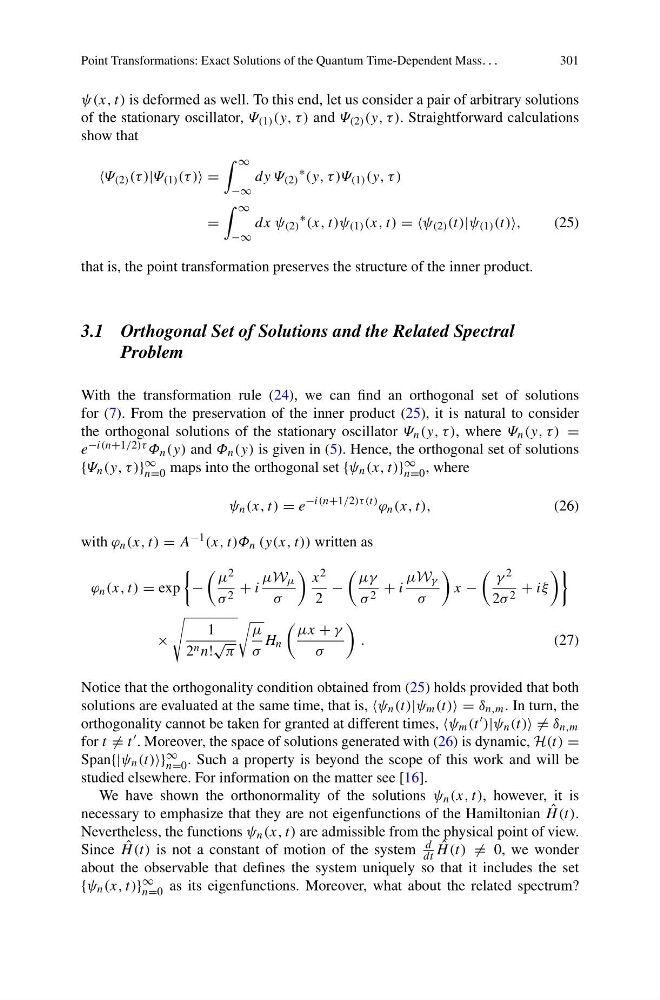
With the transformation rule (24), we can find an orthogonal set of solutions
for (7). From the preservation of the inner product (25), it is natural to consider
the orthogonal solutions of the stationary oscillator Ψ n (y, τ ), where Ψ n (y, τ ) =
e −i(n+1/2)τ Φ n (y) and Φ n (y) is given in (5). Hence, the orthogonal set of solutions
{Ψ n (y, τ )} ∞
n=0 maps into the orthogonal set {ψ n (x, t)} ∞
n=0 , where
ψ n (x, t) = e
−i(n+1/2)τ (t) ϕ n (x, t),
(26)
with ϕ n (x, t) = A −1 (x, t)Φ n (y(x, t)) written as
ϕ n (x, t) = exp
−
μ 2
σ 2 + i
μW μ
σ
x 2
2
−
μγ
σ 2 + i
μW γ
σ
x −
γ 2
2σ 2 + iξ
×
1
2 n n!
√
π
μ
σ
H n
μx + γ
σ
.
(27)
Notice that the orthogonality condition obtained from (25) holds provided that both
solutions are evaluated at the same time, that is, n (t)|ψ m (t) = δ n,m . In turn, the
orthogonality cannot be taken for granted at different times, m (t )|ψ n (t) = δ n,m
for t = t . Moreover, the space of solutions generated with (26) is dynamic, H(t) =
Span{|ψ n (t) ∞
n=0 . Such a property is beyond the scope of this work and will be
studied elsewhere. For information on the matter see [16].
We have shown the orthonormality of the solutions ψ n (x, t), however, it is
necessary to emphasize that they are not eigenfunctions of the Hamiltonian ˆ
H (t).
Nevertheless, the functions ψ n (x, t) are admissible from the physical point of view.
Since ˆ
H (t) is not a constant of motion of the system
d
dt
ˆ
H (t) = 0, we wonder
about the observable that defines the system uniquely so that it includes the set
{ψ n (x, t)} ∞
n=0 as its eigenfunctions. Moreover, what about the related spectrum?
301
ψ(x, t) is deformed as well. To this end, let us consider a pair of arbitrary solutions
of the stationary oscillator, Ψ (1) (y, τ ) and Ψ (2) (y, τ ). Straightforward calculations
show that
(2) (τ )|Ψ (1) (τ ) =
∞
−∞
dy Ψ (2)
∗ (y, τ )Ψ (1) (y, τ )
=
∞
−∞
dx ψ (2)
∗ (x, t)ψ (1) (x, t) = =ψ (2) (t)|ψ (1) (t)
(25)
that is, the point transformation preserves the structure of the inner product.
3.1 Orthogonal Set of Solutions and the Related Spectral
Problem
With the transformation rule (24), we can find an orthogonal set of solutions
for (7). From the preservation of the inner product (25), it is natural to consider
the orthogonal solutions of the stationary oscillator Ψ n (y, τ ), where Ψ n (y, τ ) =
e −i(n+1/2)τ Φ n (y) and Φ n (y) is given in (5). Hence, the orthogonal set of solutions
{Ψ n (y, τ )} ∞
n=0 maps into the orthogonal set {ψ n (x, t)} ∞
n=0 , where
ψ n (x, t) = e
−i(n+1/2)τ (t) ϕ n (x, t),
(26)
with ϕ n (x, t) = A −1 (x, t)Φ n (y(x, t)) written as
ϕ n (x, t) = exp
−
μ 2
σ 2 + i
μW μ
σ
x 2
2
−
μγ
σ 2 + i
μW γ
σ
x −
γ 2
2σ 2 + iξ
×
1
2 n n!
√
π
μ
σ
H n
μx + γ
σ
.
(27)
Notice that the orthogonality condition obtained from (25) holds provided that both
solutions are evaluated at the same time, that is, n (t)|ψ m (t) = δ n,m . In turn, the
orthogonality cannot be taken for granted at different times, m (t )|ψ n (t) = δ n,m
for t = t . Moreover, the space of solutions generated with (26) is dynamic, H(t) =
Span{|ψ n (t) ∞
n=0 . Such a property is beyond the scope of this work and will be
studied elsewhere. For information on the matter see [16].
We have shown the orthonormality of the solutions ψ n (x, t), however, it is
necessary to emphasize that they are not eigenfunctions of the Hamiltonian ˆ
H (t).
Nevertheless, the functions ψ n (x, t) are admissible from the physical point of view.
Since ˆ
H (t) is not a constant of motion of the system
d
dt
ˆ
H (t) = 0, we wonder
about the observable that defines the system uniquely so that it includes the set
{ψ n (x, t)} ∞
n=0 as its eigenfunctions. Moreover, what about the related spectrum?