

Point Transformations: Exact Solutions of the Quantum Time-Dependent Mass. . .
299
B(x, t) = i
y t
y x
−
1
2
τ t
y 2
x
2
A x
A
−
y xx
y x
,
V (x, t) = −i
A t
A
−
y t
y x
A x
A
−
1
2
τ t
y 2
x
A xx
A
−
y xx
y x
A x
A
+
τ t
2
y
2 (x, t).
(13)
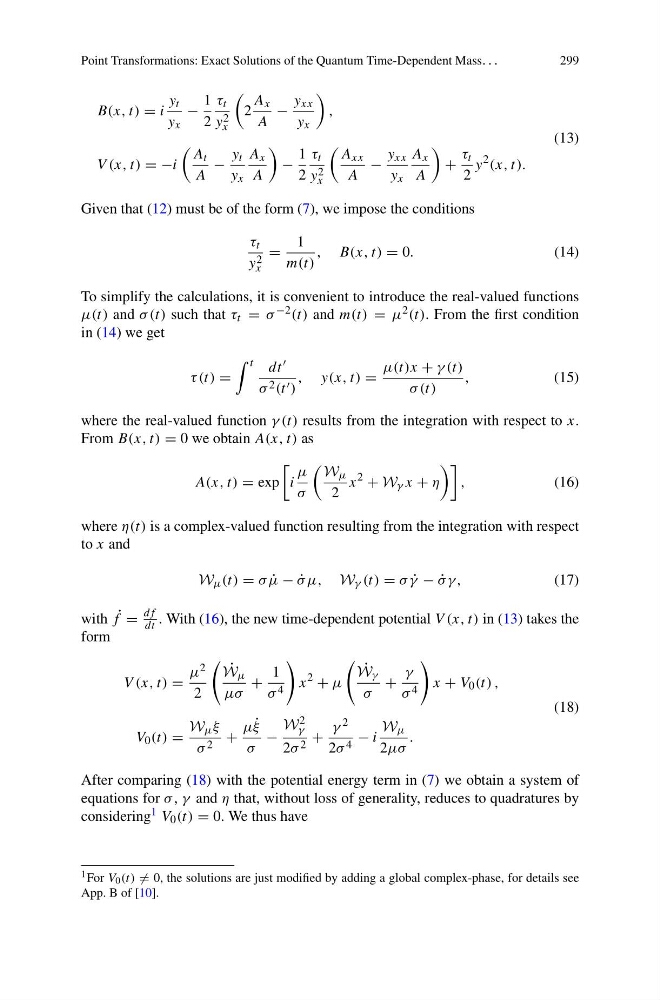
Given that (12) must be of the form (7), we impose the conditions
τ t
y 2
x
=
1
m(t)
, B(x,t) = 0.
(14)
To simplify the calculations, it is convenient to introduce the real-valued functions
μ(t) and σ (t) such that τ t = σ −2 (t) and m(t) = μ 2 (t). From the first condition
in (14) we get
τ (t) =
t dt
σ 2 (t )
, y(x,t) =
μ(t)x + γ (t)
σ (t)
,
(15)
where the real-valued function γ (t) results from the integration with respect to x.
From B(x, t) = 0 we obtain A(x, t) as
A(x, t) = exp
i
μ
σ
W μ
2
x
2
+ W γ x + η
,
(16)
where η(t) is a complex-valued function resulting from the integration with respect
to x and
W μ (t) = σ ˙
μ − ˙
σ μ, W γ (t) = σ ˙
γ − ˙
σ γ,
(17)
with ˙
f =
df
dt . With (16), the new time-dependent potential V (x, t) in (13) takes the
form
V (x, t) =
μ 2
2
˙
W μ
μσ
+
1
σ 4
x
2
+ μ
˙
W γ
σ
+
γ
σ 4
x + V 0 (t) ,
V 0 (t) =
W μ ξ
σ 2 +
μ ˙
ξ
σ
−
W 2
γ
2σ 2 +
γ 2
2σ 4 − i
W μ
2μσ
.
(18)
After comparing (18) with the potential energy term in (7) we obtain a system of
equations for σ , γ and η that, without loss of generality, reduces to quadratures by
considering 1 V 0 (t) = 0. We thus have
1 For V 0 (t) = 0, the solutions are just modified by adding a global complex-phase, for details see
App. B of [10].
299
B(x, t) = i
y t
y x
−
1
2
τ t
y 2
x
2
A x
A
−
y xx
y x
,
V (x, t) = −i
A t
A
−
y t
y x
A x
A
−
1
2
τ t
y 2
x
A xx
A
−
y xx
y x
A x
A
+
τ t
2
y
2 (x, t).
(13)
Given that (12) must be of the form (7), we impose the conditions
τ t
y 2
x
=
1
m(t)
, B(x,t) = 0.
(14)
To simplify the calculations, it is convenient to introduce the real-valued functions
μ(t) and σ (t) such that τ t = σ −2 (t) and m(t) = μ 2 (t). From the first condition
in (14) we get
τ (t) =
t dt
σ 2 (t )
, y(x,t) =
μ(t)x + γ (t)
σ (t)
,
(15)
where the real-valued function γ (t) results from the integration with respect to x.
From B(x, t) = 0 we obtain A(x, t) as
A(x, t) = exp
i
μ
σ
W μ
2
x
2
+ W γ x + η
,
(16)
where η(t) is a complex-valued function resulting from the integration with respect
to x and
W μ (t) = σ ˙
μ − ˙
σ μ, W γ (t) = σ ˙
γ − ˙
σ γ,
(17)
with ˙
f =
df
dt . With (16), the new time-dependent potential V (x, t) in (13) takes the
form
V (x, t) =
μ 2
2
˙
W μ
μσ
+
1
σ 4
x
2
+ μ
˙
W γ
σ
+
γ
σ 4
x + V 0 (t) ,
V 0 (t) =
W μ ξ
σ 2 +
μ ˙
ξ
σ
−
W 2
γ
2σ 2 +
γ 2
2σ 4 − i
W μ
2μσ
.
(18)
After comparing (18) with the potential energy term in (7) we obtain a system of
equations for σ , γ and η that, without loss of generality, reduces to quadratures by
considering 1 V 0 (t) = 0. We thus have
1 For V 0 (t) = 0, the solutions are just modified by adding a global complex-phase, for details see
App. B of [10].