

Point Transformations: Exact Solutions of the Quantum Time-Dependent Mass. . .
297
i
∂Ψ
∂τ
= −
1
2
∂ 2 Ψ
∂y 2 +
y 2
2
Ψ,
(2)
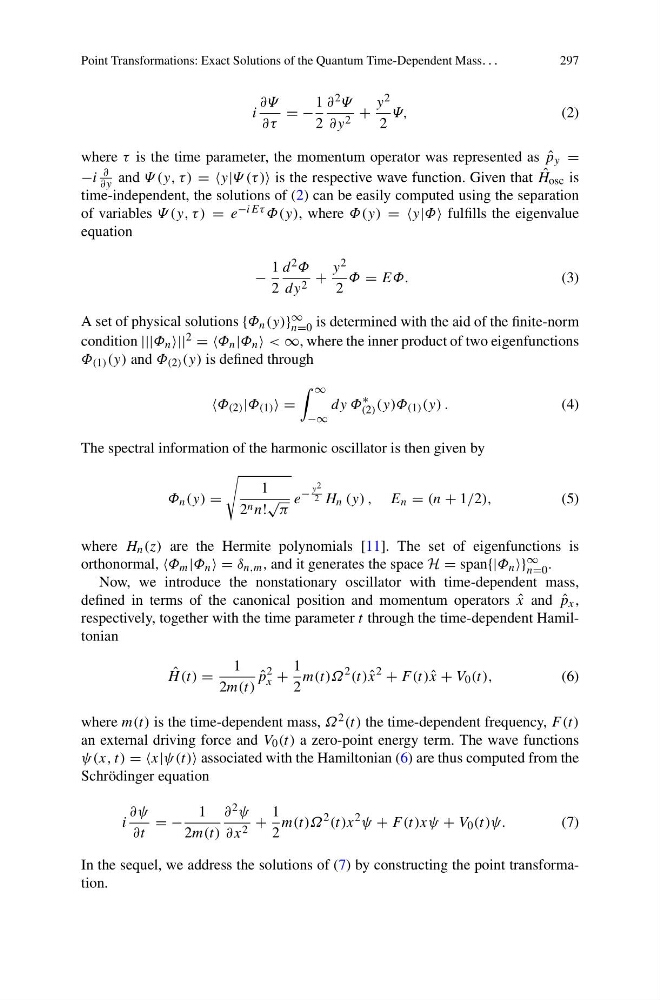
where τ is the time parameter, the momentum operator was represented as ˆ
p y =
−i
∂
∂y and Ψ (y, τ ) = =y|Ψ (τ ) is the respective wave function. Given that ˆ
H osc is
time-independent, the solutions of (2) can be easily computed using the separation
of variables Ψ (y, τ ) = e −iEτ Φ(y), where Φ(y) = =y|Φ fulfills the eigenvalue
equation
−
1
2
d 2 Φ
dy 2 +
y 2
2
Φ = EΦ.
(3)
A set of physical solutions {Φ n (y)} ∞
n=0 is determined with the aid of the finite-norm
condition |||Φ n 2 = =Φ n |Φ n < ∞, where the inner product of two eigenfunctions
Φ (1) (y) and Φ (2) (y) is defined through
(2) |Φ (1) =
∞
−∞
dy Φ
∗
(2) (y)Φ (1) (y) .
(4)
The spectral information of the harmonic oscillator is then given by
Φ n (y) =
1
2 n n!
√
π
e
−
y 2
2 H n (y) , E n = (n + 1/2),
(5)
where H n (z) are the Hermite polynomials [11]. The set of eigenfunctions is
orthonormal, m |Φ n = δ n,m , and it generates the space H = span{|Φ n ∞
n=0 .
Now, we introduce the nonstationary oscillator with time-dependent mass,
defined in terms of the canonical position and momentum operators ˆ
x and ˆ
p x ,
respectively, together with the time parameter t through the time-dependent Hamiltonian
ˆ
H (t) =
1
2m(t)
ˆ
p
2
x +
1
2
m(t)Ω
2 (t) ˆ
x
2
+ F (t) ˆ
x + V 0 (t),
(6)
where m(t) is the time-dependent mass, Ω 2 (t) the time-dependent frequency, F (t)
an external driving force and V 0 (t) a zero-point energy term. The wave functions
ψ(x, t) = =x|ψ(t) associated with the Hamiltonian (6) are thus computed from the
Schrödinger equation
i
∂ψ
∂t
= −
1
2m(t)
∂ 2 ψ
∂x 2 +
1
2
m(t)Ω
2 (t)x
2 ψ + F (t)xψ + V 0 (t)ψ.
(7)
In the sequel, we address the solutions of (7) by constructing the point transformation.
297
i
∂Ψ
∂τ
= −
1
2
∂ 2 Ψ
∂y 2 +
y 2
2
Ψ,
(2)
where τ is the time parameter, the momentum operator was represented as ˆ
p y =
−i
∂
∂y and Ψ (y, τ ) = =y|Ψ (τ ) is the respective wave function. Given that ˆ
H osc is
time-independent, the solutions of (2) can be easily computed using the separation
of variables Ψ (y, τ ) = e −iEτ Φ(y), where Φ(y) = =y|Φ fulfills the eigenvalue
equation
−
1
2
d 2 Φ
dy 2 +
y 2
2
Φ = EΦ.
(3)
A set of physical solutions {Φ n (y)} ∞
n=0 is determined with the aid of the finite-norm
condition |||Φ n 2 = =Φ n |Φ n < ∞, where the inner product of two eigenfunctions
Φ (1) (y) and Φ (2) (y) is defined through
(2) |Φ (1) =
∞
−∞
dy Φ
∗
(2) (y)Φ (1) (y) .
(4)
The spectral information of the harmonic oscillator is then given by
Φ n (y) =
1
2 n n!
√
π
e
−
y 2
2 H n (y) , E n = (n + 1/2),
(5)
where H n (z) are the Hermite polynomials [11]. The set of eigenfunctions is
orthonormal, m |Φ n = δ n,m , and it generates the space H = span{|Φ n ∞
n=0 .
Now, we introduce the nonstationary oscillator with time-dependent mass,
defined in terms of the canonical position and momentum operators ˆ
x and ˆ
p x ,
respectively, together with the time parameter t through the time-dependent Hamiltonian
ˆ
H (t) =
1
2m(t)
ˆ
p
2
x +
1
2
m(t)Ω
2 (t) ˆ
x
2
+ F (t) ˆ
x + V 0 (t),
(6)
where m(t) is the time-dependent mass, Ω 2 (t) the time-dependent frequency, F (t)
an external driving force and V 0 (t) a zero-point energy term. The wave functions
ψ(x, t) = =x|ψ(t) associated with the Hamiltonian (6) are thus computed from the
Schrödinger equation
i
∂ψ
∂t
= −
1
2m(t)
∂ 2 ψ
∂x 2 +
1
2
m(t)Ω
2 (t)x
2 ψ + F (t)xψ + V 0 (t)ψ.
(7)
In the sequel, we address the solutions of (7) by constructing the point transformation.