

280
P. Ramadevi and Zodinmawia
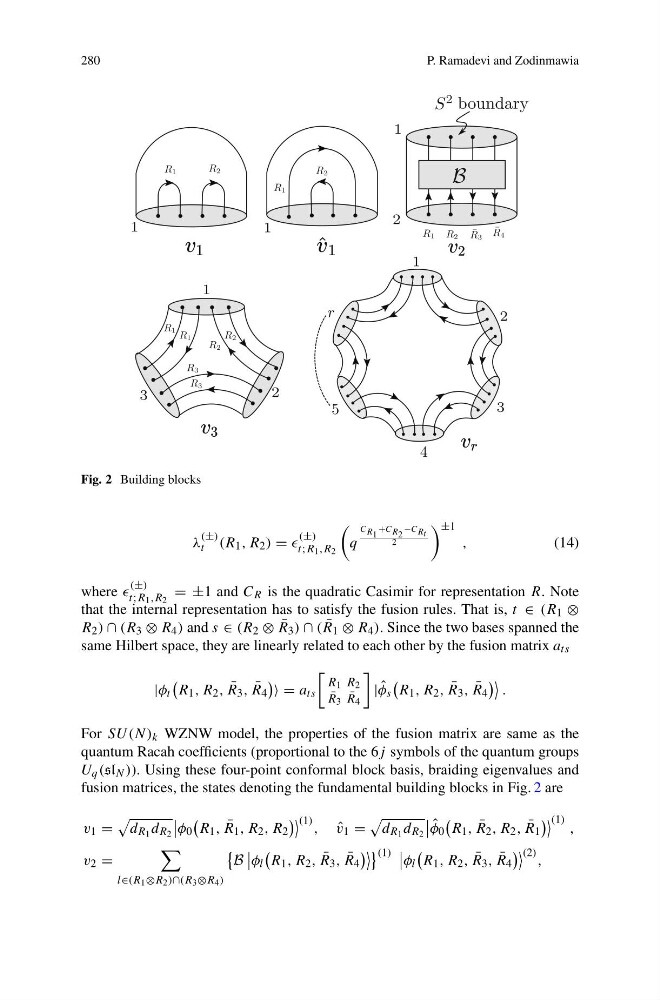
Fig. 2 Building blocks
λ
(±)
t (R 1 , R 2 ) =
(±)
t;R 1 ,R 2
q
C R 1
+C R 2
−C R t
2
±1
,
(14)
where
(±)
t;R 1 ,R 2
= ±1 and C R is the quadratic Casimir for representation R. Note
that the internal representation has to satisfy the fusion rules. That is, t ∈ (R 1 ⊗
R 2 ) ∩ (R 3 ⊗ R 4 ) and s ∈ (R 2 ⊗ ¯
R 3 ) ∩ ( ¯
R 1 ⊗ R 4 ). Since the two bases spanned the
same Hilbert space, they are linearly related to each other by the fusion matrix a ts
|φ t
R 1 , R 2 , ¯
R 3 , ¯
R 4
= a ts
R 1 R 2
¯
R 3 ¯
R 4
| ˆ
φ s
R 1 , R 2 , ¯
R 3 , ¯
R 4
.
For SU (N) k WZNW model, the properties of the fusion matrix are same as the
quantum Racah coefficients (proportional to the 6j symbols of the quantum groups
U q (sl N )). Using these four-point conformal block basis, braiding eigenvalues and
fusion matrices, the states denoting the fundamental building blocks in Fig. 2 are
v 1 =
d R 1 d R 2
φ 0
R 1 , ¯
R 1 , R 2 , R 2
(1) , ˆ
v 1 =
d R 1 d R 2
ˆ
φ 0
R 1 , ¯
R 2 , R 2 , ¯
R 1
(1) ,
v 2 =
l∈(R 1 ⊗R 2 )∩(R 3 ⊗R 4 )
B
φ l
R 1 , R 2 , ¯
R 3 , ¯
R 4
(1)
φ l
R 1 , R 2 , ¯
R 3 , ¯
R 4
(2) ,
P. Ramadevi and Zodinmawia
Fig. 2 Building blocks
λ
(±)
t (R 1 , R 2 ) =
(±)
t;R 1 ,R 2
q
C R 1
+C R 2
−C R t
2
±1
,
(14)
where
(±)
t;R 1 ,R 2
= ±1 and C R is the quadratic Casimir for representation R. Note
that the internal representation has to satisfy the fusion rules. That is, t ∈ (R 1 ⊗
R 2 ) ∩ (R 3 ⊗ R 4 ) and s ∈ (R 2 ⊗ ¯
R 3 ) ∩ ( ¯
R 1 ⊗ R 4 ). Since the two bases spanned the
same Hilbert space, they are linearly related to each other by the fusion matrix a ts
|φ t
R 1 , R 2 , ¯
R 3 , ¯
R 4
= a ts
R 1 R 2
¯
R 3 ¯
R 4
| ˆ
φ s
R 1 , R 2 , ¯
R 3 , ¯
R 4
.
For SU (N) k WZNW model, the properties of the fusion matrix are same as the
quantum Racah coefficients (proportional to the 6j symbols of the quantum groups
U q (sl N )). Using these four-point conformal block basis, braiding eigenvalues and
fusion matrices, the states denoting the fundamental building blocks in Fig. 2 are
v 1 =
d R 1 d R 2
φ 0
R 1 , ¯
R 1 , R 2 , R 2
(1) , ˆ
v 1 =
d R 1 d R 2
ˆ
φ 0
R 1 , ¯
R 2 , R 2 , ¯
R 1
(1) ,
v 2 =
l∈(R 1 ⊗R 2 )∩(R 3 ⊗R 4 )
B
φ l
R 1 , R 2 , ¯
R 3 , ¯
R 4
(1)
φ l
R 1 , R 2 , ¯
R 3 , ¯
R 4
(2) ,