

Twist Knot Invariants and Volume Conjecture
279
2 Chern–Simons Theory and Knot Invariants
In order to calculate R [K]] for a given knot, we slice the three-sphere S 3
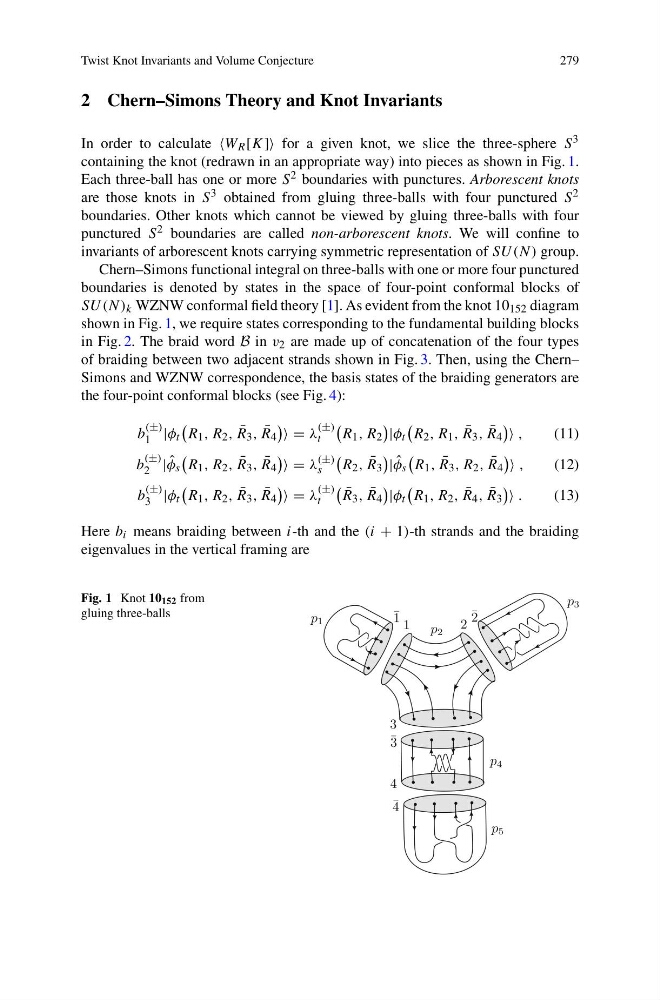
containing the knot (redrawn in an appropriate way) into pieces as shown in Fig. 1.
Each three-ball has one or more S 2 boundaries with punctures. Arborescent knots
are those knots in S 3 obtained from gluing three-balls with four punctured S 2
boundaries. Other knots which cannot be viewed by gluing three-balls with four
punctured S 2 boundaries are called non-arborescent knots. We will confine to
invariants of arborescent knots carrying symmetric representation of SU (N) group.
Chern–Simons functional integral on three-balls with one or more four punctured
boundaries is denoted by states in the space of four-point conformal blocks of
SU (N) k WZNW conformal field theory [1]. As evident from the knot 10 152 diagram
shown in Fig. 1, we require states corresponding to the fundamental building blocks
in Fig. 2. The braid word B in v 2 are made up of concatenation of the four types
of braiding between two adjacent strands shown in Fig. 3. Then, using the Chern–
Simons and WZNW correspondence, the basis states of the braiding generators are
the four-point conformal blocks (see Fig. 4):
b
(±)
1 |φ t
R 1 , R 2 , ¯
R 3 , ¯
R 4
= λ
(±)
t
R 1 , R 2
|φ t
R 2 , R 1 , ¯
R 3 , ¯
R 4
,
(11)
b
(±)
2 | ˆ
φ s
R 1 , R 2 , ¯
R 3 , ¯
R 4
= λ
(±)
s
R 2 , ¯
R 3
| ˆ
φ s
R 1 , ¯
R 3 , R 2 , ¯
R 4
,
(12)
b
(±)
3 |φ t
R 1 , R 2 , ¯
R 3 , ¯
R 4
= λ
(±)
t
¯
R 3 , ¯
R 4
|φ t
R 1 , R 2 , ¯
R 4 , ¯
R 3
.
(13)
Here b i means braiding between i-th and the (i + 1)-th strands and the braiding
eigenvalues in the vertical framing are
Fig. 1 Knot 10 152 from
gluing three-balls
279
2 Chern–Simons Theory and Knot Invariants
In order to calculate R [K]] for a given knot, we slice the three-sphere S 3
containing the knot (redrawn in an appropriate way) into pieces as shown in Fig. 1.
Each three-ball has one or more S 2 boundaries with punctures. Arborescent knots
are those knots in S 3 obtained from gluing three-balls with four punctured S 2
boundaries. Other knots which cannot be viewed by gluing three-balls with four
punctured S 2 boundaries are called non-arborescent knots. We will confine to
invariants of arborescent knots carrying symmetric representation of SU (N) group.
Chern–Simons functional integral on three-balls with one or more four punctured
boundaries is denoted by states in the space of four-point conformal blocks of
SU (N) k WZNW conformal field theory [1]. As evident from the knot 10 152 diagram
shown in Fig. 1, we require states corresponding to the fundamental building blocks
in Fig. 2. The braid word B in v 2 are made up of concatenation of the four types
of braiding between two adjacent strands shown in Fig. 3. Then, using the Chern–
Simons and WZNW correspondence, the basis states of the braiding generators are
the four-point conformal blocks (see Fig. 4):
b
(±)
1 |φ t
R 1 , R 2 , ¯
R 3 , ¯
R 4
= λ
(±)
t
R 1 , R 2
|φ t
R 2 , R 1 , ¯
R 3 , ¯
R 4
,
(11)
b
(±)
2 | ˆ
φ s
R 1 , R 2 , ¯
R 3 , ¯
R 4
= λ
(±)
s
R 2 , ¯
R 3
| ˆ
φ s
R 1 , ¯
R 3 , R 2 , ¯
R 4
,
(12)
b
(±)
3 |φ t
R 1 , R 2 , ¯
R 3 , ¯
R 4
= λ
(±)
t
¯
R 3 , ¯
R 4
|φ t
R 1 , R 2 , ¯
R 4 , ¯
R 3
.
(13)
Here b i means braiding between i-th and the (i + 1)-th strands and the braiding
eigenvalues in the vertical framing are
Fig. 1 Knot 10 152 from
gluing three-balls