

Spin Chains of Haldane–Shastry Type: A Bird’s Eye View
5
μ(x) = e
−
1
2 ω
i x 2
i
i
a ,
(2)
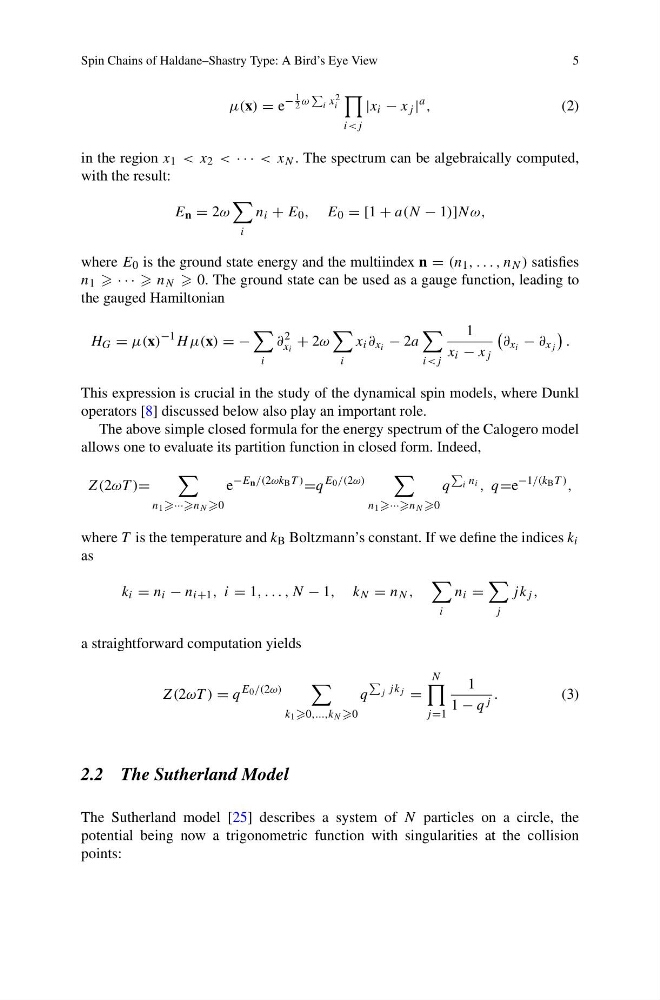
in the region x 1 < x 2 < · · · < x N . The spectrum can be algebraically computed,
with the result:
E n = 2ω
i
n i + E 0 , E 0 = [1 + a(N − 1)]Nω,
where E 0 is the ground state energy and the multiindex n = (n 1 , . . . , n N ) satisfies
n 1 · · · n N 0. The ground state can be used as a gauge function, leading to
the gauged Hamiltonian
H G = μ(x)
−1 H μ(x) = −
i
∂
2
x i
+ 2ω
i
x i ∂ x i − 2a
i
x i − x j
∂ x i − ∂ x j
.
This expression is crucial in the study of the dynamical spin models, where Dunkl
operators [8] discussed below also play an important role.
The above simple closed formula for the energy spectrum of the Calogero model
allows one to evaluate its partition function in closed form. Indeed,
Z(2ωT )=
n 1 ··· N
e
−E n /(2ωk B T )
=q
E 0 /(2ω)
n 1 ··· N
q
i n i , q=e
−1/(k B T ) ,
where T is the temperature and k B Boltzmann’s constant. If we define the indices k i
as
k i = n i − n i+1 , i = 1, . . . , N − 1, k N = n N ,
i
n i =
j
jk j ,
a straightforward computation yields
Z(2ωT ) = q
E 0 /(2ω)
k 1 N
q
j jk j =
N
j =1
1
1 − q j .
(3)
2.2 The Sutherland Model
The Sutherland model [25] describes a system of N particles on a circle, the
potential being now a trigonometric function with singularities at the collision
points:
5
μ(x) = e
−
1
2 ω
i x 2
i
i
a ,
(2)
in the region x 1 < x 2 < · · · < x N . The spectrum can be algebraically computed,
with the result:
E n = 2ω
i
n i + E 0 , E 0 = [1 + a(N − 1)]Nω,
where E 0 is the ground state energy and the multiindex n = (n 1 , . . . , n N ) satisfies
n 1 · · · n N 0. The ground state can be used as a gauge function, leading to
the gauged Hamiltonian
H G = μ(x)
−1 H μ(x) = −
i
∂
2
x i
+ 2ω
i
x i ∂ x i − 2a
i
x i − x j
∂ x i − ∂ x j
.
This expression is crucial in the study of the dynamical spin models, where Dunkl
operators [8] discussed below also play an important role.
The above simple closed formula for the energy spectrum of the Calogero model
allows one to evaluate its partition function in closed form. Indeed,
Z(2ωT )=
n 1 ··· N
e
−E n /(2ωk B T )
=q
E 0 /(2ω)
n 1 ··· N
q
i n i , q=e
−1/(k B T ) ,
where T is the temperature and k B Boltzmann’s constant. If we define the indices k i
as
k i = n i − n i+1 , i = 1, . . . , N − 1, k N = n N ,
i
n i =
j
jk j ,
a straightforward computation yields
Z(2ωT ) = q
E 0 /(2ω)
k 1 N
q
j jk j =
N
j =1
1
1 − q j .
(3)
2.2 The Sutherland Model
The Sutherland model [25] describes a system of N particles on a circle, the
potential being now a trigonometric function with singularities at the collision
points: