

W -Algebras via Lax Type Operators
193
4.3 Quantum Finite W -Algebras and (Extended) Twisted
Yangians
Let g be one of the classical Lie algebras gl N , sl N , so N or sp N , and let V = F N
be its standard representation (endowed, in the cases of so N and sp N , with a nondegenerate symmetric or skewsymmetric bilinear form, respectively). Then, the
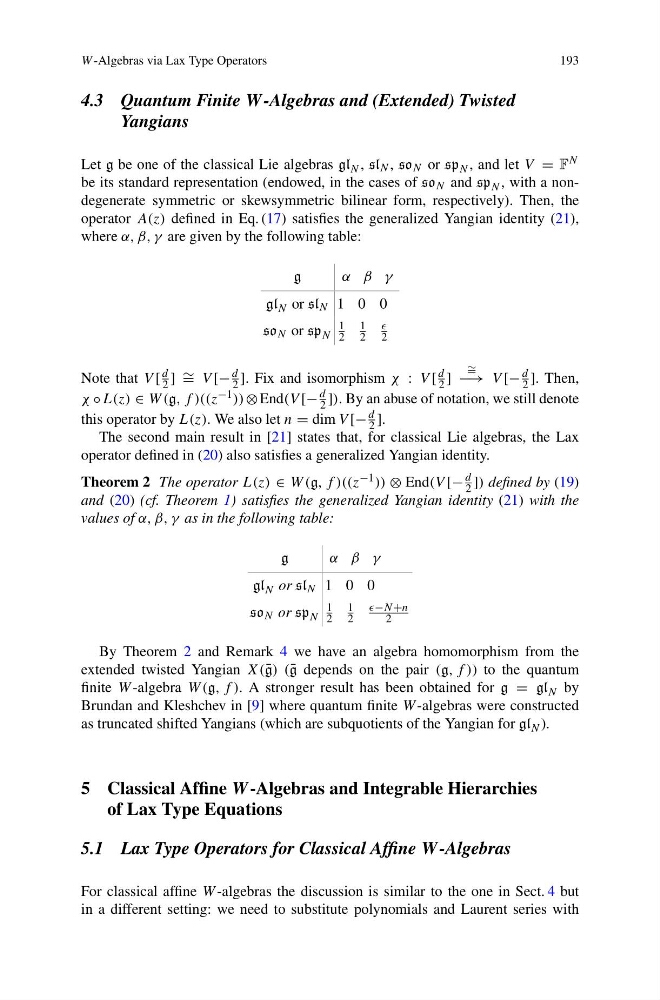
operator A(z) defined in Eq. (17) satisfies the generalized Yangian identity (21),
where α, β, γ are given by the following table:
g
α β γ
gl N or sl N 1 0 0
so N or sp N
1
2
1
2
2
Note that V [
d
2 ] ∼ = V [−
d
2 ]. Fix and isomorphism χ : V [
d
2 ]
∼ =
−→ V [−
d
2 ]. Then,
χ ◦ L(z) ∈ W (g, f )((z −1 )) ⊗ End(V [−
d
2 ]). By an abuse of notation, we still denote
this operator by L(z). We also let n = dim V [−
d
2 ].
The second main result in [21] states that, for classical Lie algebras, the Lax
operator defined in (20) also satisfies a generalized Yangian identity.
Theorem 2 The operator L(z) ∈ W (g, f )((z −1 )) ⊗ End(V [−
d
2 ]) defined by (19)
and (20) (cf. Theorem 1) satisfies the generalized Yangian identity (21) with the
values of α, β, γ as in the following table:
g
α β γ
gl N or sl N 1 0 0
so N or sp N
1
2
1
2
+n
2
By Theorem 2 and Remark 4 we have an algebra homomorphism from the
extended twisted Yangian X(¯ g) (¯ g depends on the pair (g, f )) to the quantum
finite W -algebra W (g, f ). A stronger result has been obtained for g = gl N by
Brundan and Kleshchev in [9] where quantum finite W -algebras were constructed
as truncated shifted Yangians (which are subquotients of the Yangian for gl N ).
5 Classical Affine W -Algebras and Integrable Hierarchies
of Lax Type Equations
5.1 Lax Type Operators for Classical Affine W -Algebras
For classical affine W -algebras the discussion is similar to the one in Sect. 4 but
in a different setting: we need to substitute polynomials and Laurent series with
193
4.3 Quantum Finite W -Algebras and (Extended) Twisted
Yangians
Let g be one of the classical Lie algebras gl N , sl N , so N or sp N , and let V = F N
be its standard representation (endowed, in the cases of so N and sp N , with a nondegenerate symmetric or skewsymmetric bilinear form, respectively). Then, the
operator A(z) defined in Eq. (17) satisfies the generalized Yangian identity (21),
where α, β, γ are given by the following table:
g
α β γ
gl N or sl N 1 0 0
so N or sp N
1
2
1
2
2
Note that V [
d
2 ] ∼ = V [−
d
2 ]. Fix and isomorphism χ : V [
d
2 ]
∼ =
−→ V [−
d
2 ]. Then,
χ ◦ L(z) ∈ W (g, f )((z −1 )) ⊗ End(V [−
d
2 ]). By an abuse of notation, we still denote
this operator by L(z). We also let n = dim V [−
d
2 ].
The second main result in [21] states that, for classical Lie algebras, the Lax
operator defined in (20) also satisfies a generalized Yangian identity.
Theorem 2 The operator L(z) ∈ W (g, f )((z −1 )) ⊗ End(V [−
d
2 ]) defined by (19)
and (20) (cf. Theorem 1) satisfies the generalized Yangian identity (21) with the
values of α, β, γ as in the following table:
g
α β γ
gl N or sl N 1 0 0
so N or sp N
1
2
1
2
+n
2
By Theorem 2 and Remark 4 we have an algebra homomorphism from the
extended twisted Yangian X(¯ g) (¯ g depends on the pair (g, f )) to the quantum
finite W -algebra W (g, f ). A stronger result has been obtained for g = gl N by
Brundan and Kleshchev in [9] where quantum finite W -algebras were constructed
as truncated shifted Yangians (which are subquotients of the Yangian for gl N ).
5 Classical Affine W -Algebras and Integrable Hierarchies
of Lax Type Equations
5.1 Lax Type Operators for Classical Affine W -Algebras
For classical affine W -algebras the discussion is similar to the one in Sect. 4 but
in a different setting: we need to substitute polynomials and Laurent series with