

192
D. Valeri
∈ W (g, f )((z
−1 )) ⊗ Hom
V
−
d
2
, V
d
2
.
Remark 3 For g = gl N and V = F N the standard representation, Eq. (19) may be
used to find a generating set (in the sense of PBW Theorem) for the quantum finite
W -algebra, see [22] for more details.
4.2 The Generalized Yangian Identity
Let α, β, γ ∈ F. Let R be a unital associative algebra, and let V be an N -
dimensional vector space. For β = 0, we also assume, as in Sect. 3.1, that V is
endowed with a non-degenerate bilinear form · | ·· : V × V → F which we assume
to be symmetric or skewsymmetric, and we let = +1 and −1, respectively. Again,
when denoting an element of R ⊗ End(V ) or of R ⊗ End(V ) ⊗ End(V ), we omit
the tensor product sign on the first factor, i.e. we treat elements of R as scalars.
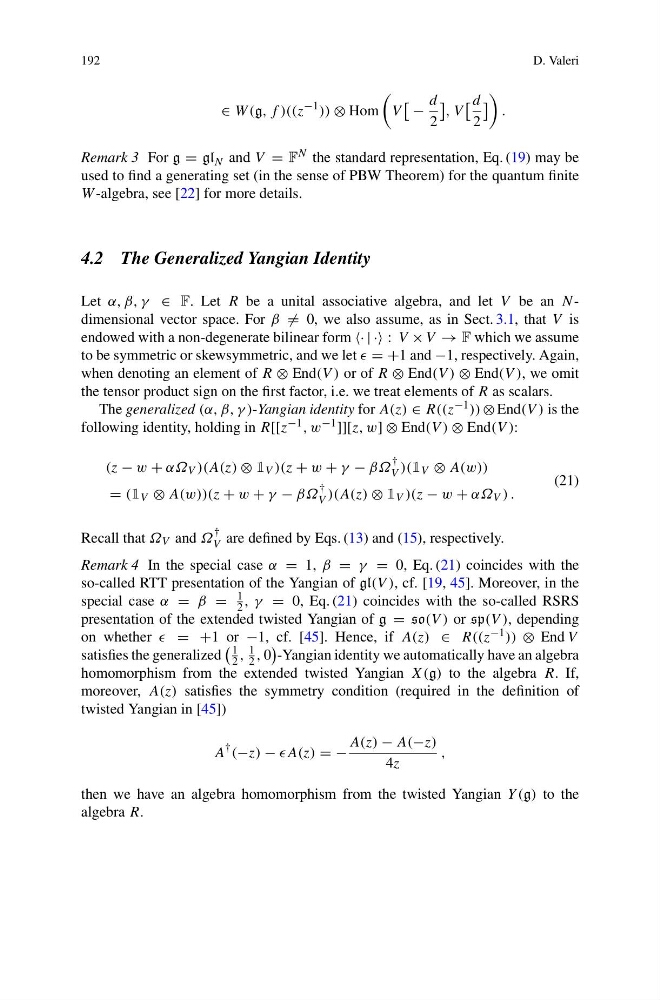
The generalized (α, β, γ )-Yangian identity for A(z) ∈ R((z −1 )) ⊗ End(V ) is the
following identity, holding in R[[z −1 , w −1 ]][z, w] ⊗ End(V ) ⊗ End(V ):
(z − w + αΩ V )(A(z) ⊗ 1 V )(z + w + γ − βΩ
†
V )(1 V ⊗ A(w))
= (1 V ⊗ A(w))(z + w + γ − βΩ
†
V )(A(z) ⊗ 1 V )(z − w + αΩ V ) .
(21)
Recall that Ω V and Ω
†
V are defined by Eqs. (13) and (15), respectively.
Remark 4 In the special case α = 1, β = γ = 0, Eq. (21) coincides with the
so-called RTT presentation of the Yangian of gl(V ), cf. [19, 45]. Moreover, in the
special case α = β =
1
2 , γ = 0, Eq. (21) coincides with the so-called RSRS
presentation of the extended twisted Yangian of g = so(V ) or sp(V ), depending
on whether = +1 or −1, cf. [45]. Hence, if A(z) ∈ R((z −1 )) ⊗ End V
satisfies the generalized
1
2 ,
1
2 , 0
-Yangian identity we automatically have an algebra
homomorphism from the extended twisted Yangian X(g) to the algebra R. If,
moreover, A(z) satisfies the symmetry condition (required in the definition of
twisted Yangian in [45])
A
† (−z) − A(z) = −
A(z) − A(−z)
4z
,
then we have an algebra homomorphism from the twisted Yangian Y (g) to the
algebra R.
D. Valeri
∈ W (g, f )((z
−1 )) ⊗ Hom
V
−
d
2
, V
d
2
.
Remark 3 For g = gl N and V = F N the standard representation, Eq. (19) may be
used to find a generating set (in the sense of PBW Theorem) for the quantum finite
W -algebra, see [22] for more details.
4.2 The Generalized Yangian Identity
Let α, β, γ ∈ F. Let R be a unital associative algebra, and let V be an N -
dimensional vector space. For β = 0, we also assume, as in Sect. 3.1, that V is
endowed with a non-degenerate bilinear form · | ·· : V × V → F which we assume
to be symmetric or skewsymmetric, and we let = +1 and −1, respectively. Again,
when denoting an element of R ⊗ End(V ) or of R ⊗ End(V ) ⊗ End(V ), we omit
the tensor product sign on the first factor, i.e. we treat elements of R as scalars.
The generalized (α, β, γ )-Yangian identity for A(z) ∈ R((z −1 )) ⊗ End(V ) is the
following identity, holding in R[[z −1 , w −1 ]][z, w] ⊗ End(V ) ⊗ End(V ):
(z − w + αΩ V )(A(z) ⊗ 1 V )(z + w + γ − βΩ
†
V )(1 V ⊗ A(w))
= (1 V ⊗ A(w))(z + w + γ − βΩ
†
V )(A(z) ⊗ 1 V )(z − w + αΩ V ) .
(21)
Recall that Ω V and Ω
†
V are defined by Eqs. (13) and (15), respectively.
Remark 4 In the special case α = 1, β = γ = 0, Eq. (21) coincides with the
so-called RTT presentation of the Yangian of gl(V ), cf. [19, 45]. Moreover, in the
special case α = β =
1
2 , γ = 0, Eq. (21) coincides with the so-called RSRS
presentation of the extended twisted Yangian of g = so(V ) or sp(V ), depending
on whether = +1 or −1, cf. [45]. Hence, if A(z) ∈ R((z −1 )) ⊗ End V
satisfies the generalized
1
2 ,
1
2 , 0
-Yangian identity we automatically have an algebra
homomorphism from the extended twisted Yangian X(g) to the algebra R. If,
moreover, A(z) satisfies the symmetry condition (required in the definition of
twisted Yangian in [45])
A
† (−z) − A(z) = −
A(z) − A(−z)
4z
,
then we have an algebra homomorphism from the twisted Yangian Y (g) to the
algebra R.