

186
D. Valeri
V( )
Zhu
quantization
V
cl.limit
Zhu
S
affiniz.
quantization
U
cl.limit
affiniz.
( )
( )
( )
(4)
2.3 Hamiltonian Reduction
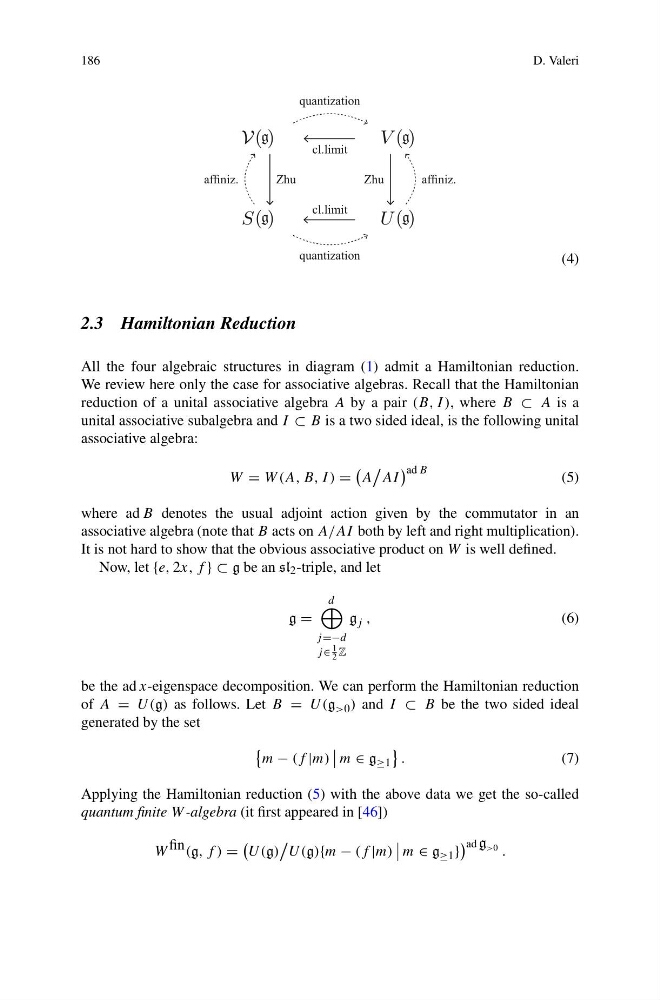
All the four algebraic structures in diagram (1) admit a Hamiltonian reduction.
We review here only the case for associative algebras. Recall that the Hamiltonian
reduction of a unital associative algebra A by a pair (B, I ), where B ⊂ A is a
unital associative subalgebra and I ⊂ B is a two sided ideal, is the following unital
associative algebra:
W = W (A, B, I ) =
A
AI
ad B
(5)
where ad B denotes the usual adjoint action given by the commutator in an
associative algebra (note that B acts on A/AI both by left and right multiplication).
It is not hard to show that the obvious associative product on W is well defined.
Now, let {e, 2x, f } ⊂ g be an sl 2 -triple, and let
g =
d
j =−d
j ∈
1
2 Z
g j ,
(6)
be the ad x-eigenspace decomposition. We can perform the Hamiltonian reduction
of A = U(g) as follows. Let B = U(g >0 ) and I ⊂ B be the two sided ideal
generated by the set
m − (f |m)
m ∈ g ≥1
.
(7)
Applying the Hamiltonian reduction (5) with the above data we get the so-called
quantum finite W -algebra (it first appeared in [46])
W fin (g, f ) =
U(g)
U(g){m − (f |m)
m ∈ g ≥1 }
ad g >0 .
D. Valeri
V( )
Zhu
quantization
V
cl.limit
Zhu
S
affiniz.
quantization
U
cl.limit
affiniz.
( )
( )
( )
(4)
2.3 Hamiltonian Reduction
All the four algebraic structures in diagram (1) admit a Hamiltonian reduction.
We review here only the case for associative algebras. Recall that the Hamiltonian
reduction of a unital associative algebra A by a pair (B, I ), where B ⊂ A is a
unital associative subalgebra and I ⊂ B is a two sided ideal, is the following unital
associative algebra:
W = W (A, B, I ) =
A
AI
ad B
(5)
where ad B denotes the usual adjoint action given by the commutator in an
associative algebra (note that B acts on A/AI both by left and right multiplication).
It is not hard to show that the obvious associative product on W is well defined.
Now, let {e, 2x, f } ⊂ g be an sl 2 -triple, and let
g =
d
j =−d
j ∈
1
2 Z
g j ,
(6)
be the ad x-eigenspace decomposition. We can perform the Hamiltonian reduction
of A = U(g) as follows. Let B = U(g >0 ) and I ⊂ B be the two sided ideal
generated by the set
m − (f |m)
m ∈ g ≥1
.
(7)
Applying the Hamiltonian reduction (5) with the above data we get the so-called
quantum finite W -algebra (it first appeared in [46])
W fin (g, f ) =
U(g)
U(g){m − (f |m)
m ∈ g ≥1 }
ad g >0 .