

172
K. B. Wolf et al.
3 Two Coordinate Systems for S
3
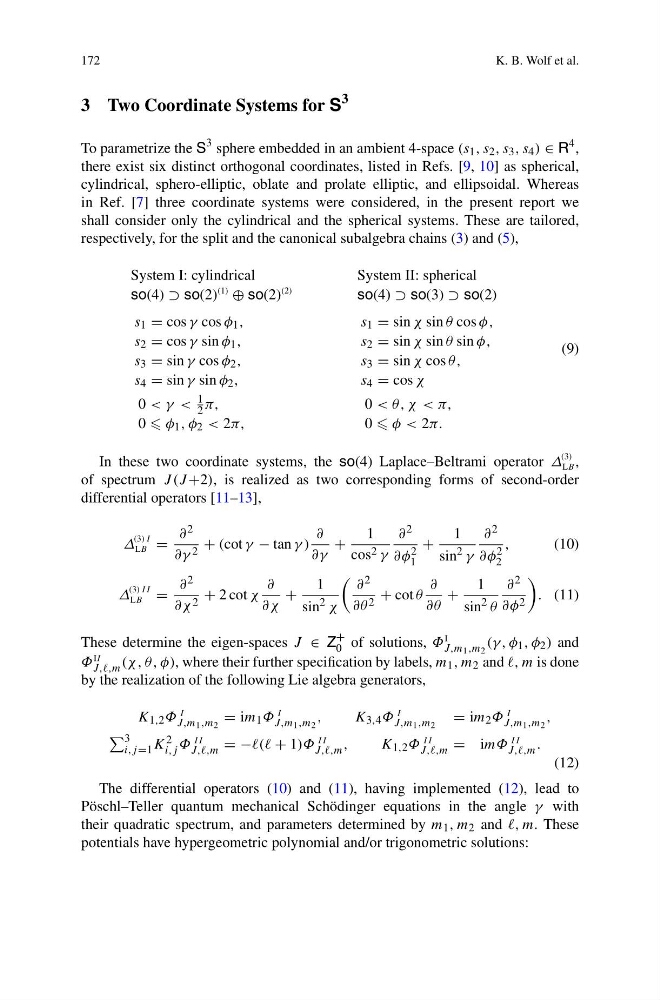
To parametrize the S
3 sphere embedded in an ambient 4-space (s 1 , s 2 , s 3 , s 4 ) ∈ R
4 ,
there exist six distinct orthogonal coordinates, listed in Refs. [9, 10] as spherical,
cylindrical, sphero-elliptic, oblate and prolate elliptic, and ellipsoidal. Whereas
in Ref. [7] three coordinate systems were considered, in the present report we
shall consider only the cylindrical and the spherical systems. These are tailored,
respectively, for the split and the canonical subalgebra chains (3) and (5),
System I: cylindrical
so(4) ⊃ so(2)
(1)
⊕ so(2)
(2)
s 1 = cos γ cos φ 1 ,
s 2 = cos γ sin φ 1 ,
s 3 = sin γ cos φ 2 ,
s 4 = sin γ sin φ 2 ,
0 < γ <
1
2 π,
0 φ 1 , φ 2 < 2π,
System II: spherical
so(4) ⊃ so(3) ⊃ so(2)
s 1 = sin χ sin θ cos φ,
s 2 = sin χ sin θ sin φ,
s 3 = sin χ cos θ,
s 4 = cos χ
0 < θ, χ < π,
0 φ < 2π.
(9)
In these two coordinate systems, the so(4) Laplace–Beltrami operator Δ
(3)
LB ,
of spectrum J (J +2), is realized as two corresponding forms of second-order
differential operators [11–13],
Δ
(3) I
LB =
∂ 2
∂γ 2 + (cot γ − tan γ )
∂
∂γ
+
1
cos 2 γ
∂ 2
∂φ 2
1
+
1
sin
2 γ
∂ 2
∂φ 2
2
,
(10)
Δ
(3) II
LB
=
∂ 2
∂χ 2 + 2 cot χ
∂
∂χ
+
1
sin
2 χ
∂ 2
∂θ 2 + cot θ
∂
∂θ
+
1
sin
2 θ
∂ 2
∂φ 2
. (11)
These determine the eigen-spaces J ∈ Z
+
0 of solutions, Φ
I
J,m 1 ,m 2
(γ , φ 1 , φ 2 ) and
Φ
II
J,,,m (χ, θ, φ), where their further specification by labels, m 1 , m 2 and , m is done
by the realization of the following Lie algebra generators,
K 1,2 Φ
I
J,m 1 ,m 2
= im 1 Φ
I
J,m 1 ,m 2
,
K 3,4 Φ
I
J,m 1 ,m 2
= im 2 Φ
I
J,m 1 ,m 2
,
3
i,j =1 K 2
i,j Φ
I I
J,,,m = − + 1)Φ
I I
J,,,m ,
K 1,2 Φ
I I
J,,,m = imΦ
I I
J,,,m .
(12)
The differential operators (10) and (11), having implemented (12), lead to
Pöschl–Teller quantum mechanical Schödinger equations in the angle γ with
their quadratic spectrum, and parameters determined by m 1 , m 2 and , m. These
potentials have hypergeometric polynomial and/or trigonometric solutions:
K. B. Wolf et al.
3 Two Coordinate Systems for S
3
To parametrize the S
3 sphere embedded in an ambient 4-space (s 1 , s 2 , s 3 , s 4 ) ∈ R
4 ,
there exist six distinct orthogonal coordinates, listed in Refs. [9, 10] as spherical,
cylindrical, sphero-elliptic, oblate and prolate elliptic, and ellipsoidal. Whereas
in Ref. [7] three coordinate systems were considered, in the present report we
shall consider only the cylindrical and the spherical systems. These are tailored,
respectively, for the split and the canonical subalgebra chains (3) and (5),
System I: cylindrical
so(4) ⊃ so(2)
(1)
⊕ so(2)
(2)
s 1 = cos γ cos φ 1 ,
s 2 = cos γ sin φ 1 ,
s 3 = sin γ cos φ 2 ,
s 4 = sin γ sin φ 2 ,
0 < γ <
1
2 π,
0 φ 1 , φ 2 < 2π,
System II: spherical
so(4) ⊃ so(3) ⊃ so(2)
s 1 = sin χ sin θ cos φ,
s 2 = sin χ sin θ sin φ,
s 3 = sin χ cos θ,
s 4 = cos χ
0 < θ, χ < π,
0 φ < 2π.
(9)
In these two coordinate systems, the so(4) Laplace–Beltrami operator Δ
(3)
LB ,
of spectrum J (J +2), is realized as two corresponding forms of second-order
differential operators [11–13],
Δ
(3) I
LB =
∂ 2
∂γ 2 + (cot γ − tan γ )
∂
∂γ
+
1
cos 2 γ
∂ 2
∂φ 2
1
+
1
sin
2 γ
∂ 2
∂φ 2
2
,
(10)
Δ
(3) II
LB
=
∂ 2
∂χ 2 + 2 cot χ
∂
∂χ
+
1
sin
2 χ
∂ 2
∂θ 2 + cot θ
∂
∂θ
+
1
sin
2 θ
∂ 2
∂φ 2
. (11)
These determine the eigen-spaces J ∈ Z
+
0 of solutions, Φ
I
J,m 1 ,m 2
(γ , φ 1 , φ 2 ) and
Φ
II
J,,,m (χ, θ, φ), where their further specification by labels, m 1 , m 2 and , m is done
by the realization of the following Lie algebra generators,
K 1,2 Φ
I
J,m 1 ,m 2
= im 1 Φ
I
J,m 1 ,m 2
,
K 3,4 Φ
I
J,m 1 ,m 2
= im 2 Φ
I
J,m 1 ,m 2
,
3
i,j =1 K 2
i,j Φ
I I
J,,,m = − + 1)Φ
I I
J,,,m ,
K 1,2 Φ
I I
J,,,m = imΦ
I I
J,,,m .
(12)
The differential operators (10) and (11), having implemented (12), lead to
Pöschl–Teller quantum mechanical Schödinger equations in the angle γ with
their quadratic spectrum, and parameters determined by m 1 , m 2 and , m. These
potentials have hypergeometric polynomial and/or trigonometric solutions: