

Discrete Curve Flows in Two-Dimensional Cayley–Klein Geometries
159
Definition 2 For 2 ∈ {−1, 0, 1}, the generalized imaginary number i 2 is a formal
symbol satisfying the equation
i
2
2
= − 2 .
Using generalized imaginary numbers, a point in S 2
[ 1 ],, 2
may be represented by
the complex number
z = x + i 2 y ∈ C 2 .
The induced action of the Cayley–Klein group SO 1 ,, 2 (3) on the point z ∈ C 2 is
then given by
Z =
αz + β
α − 1 βz
where
α, β ∈ C 2
with
αα + 1 ββ = 1,
(1)
and z = x−i 2 y denotes the complex conjugate of z. Geometrically, (1) corresponds
to the isometry group of the metric
g =
dzdz
(1 + 1 zz) 2 .
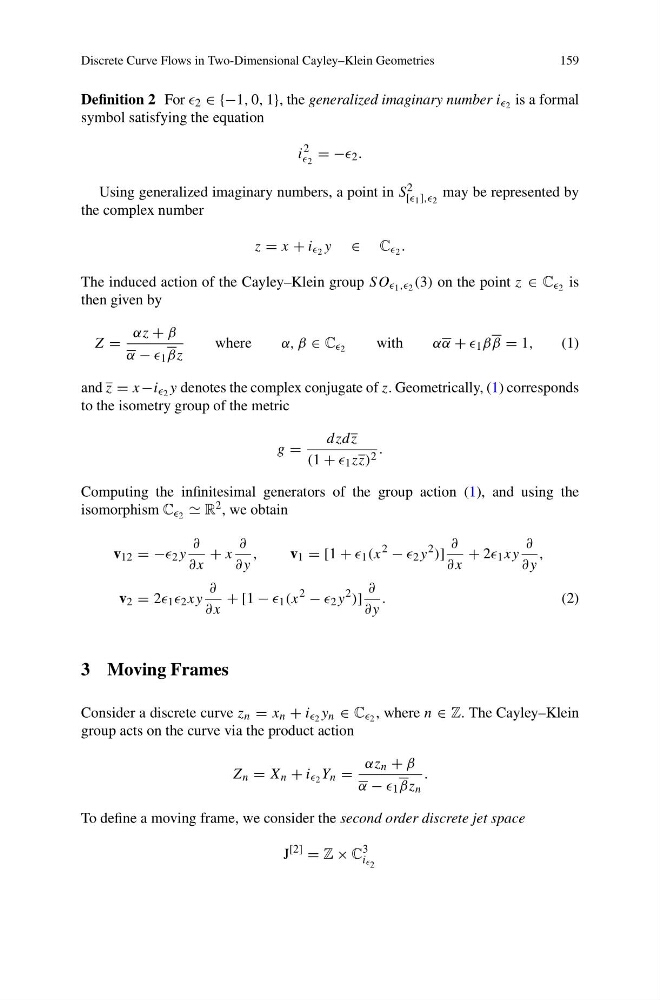
Computing the infinitesimal generators of the group action (1), and using the
isomorphism C 2 R 2 , we obtain
v 12 = − 2 y
∂
∂x
+ x
∂
∂y
,
v 1 = [1 + 1 (x
2
− 2 y
2 )]
∂
∂x
+ 2 1 xy
∂
∂y
,
v 2 = 2 1 2 xy
∂
∂x
+ [1 − 1 (x
2
− 2 y
2 )]
∂
∂y
.
(2)
3 Moving Frames
Consider a discrete curve z n = x n + i 2 y n ∈ C 2 , where n ∈ Z. The Cayley–Klein
group acts on the curve via the product action
Z n = X n + i 2 Y n =
αz n + β
α − 1 βz n
.
To define a moving frame, we consider the second order discrete jet space
J
[2]
= Z × C
3
i 2
159
Definition 2 For 2 ∈ {−1, 0, 1}, the generalized imaginary number i 2 is a formal
symbol satisfying the equation
i
2
2
= − 2 .
Using generalized imaginary numbers, a point in S 2
[ 1 ],, 2
may be represented by
the complex number
z = x + i 2 y ∈ C 2 .
The induced action of the Cayley–Klein group SO 1 ,, 2 (3) on the point z ∈ C 2 is
then given by
Z =
αz + β
α − 1 βz
where
α, β ∈ C 2
with
αα + 1 ββ = 1,
(1)
and z = x−i 2 y denotes the complex conjugate of z. Geometrically, (1) corresponds
to the isometry group of the metric
g =
dzdz
(1 + 1 zz) 2 .
Computing the infinitesimal generators of the group action (1), and using the
isomorphism C 2 R 2 , we obtain
v 12 = − 2 y
∂
∂x
+ x
∂
∂y
,
v 1 = [1 + 1 (x
2
− 2 y
2 )]
∂
∂x
+ 2 1 xy
∂
∂y
,
v 2 = 2 1 2 xy
∂
∂x
+ [1 − 1 (x
2
− 2 y
2 )]
∂
∂y
.
(2)
3 Moving Frames
Consider a discrete curve z n = x n + i 2 y n ∈ C 2 , where n ∈ Z. The Cayley–Klein
group acts on the curve via the product action
Z n = X n + i 2 Y n =
αz n + β
α − 1 βz n
.
To define a moving frame, we consider the second order discrete jet space
J
[2]
= Z × C
3
i 2