

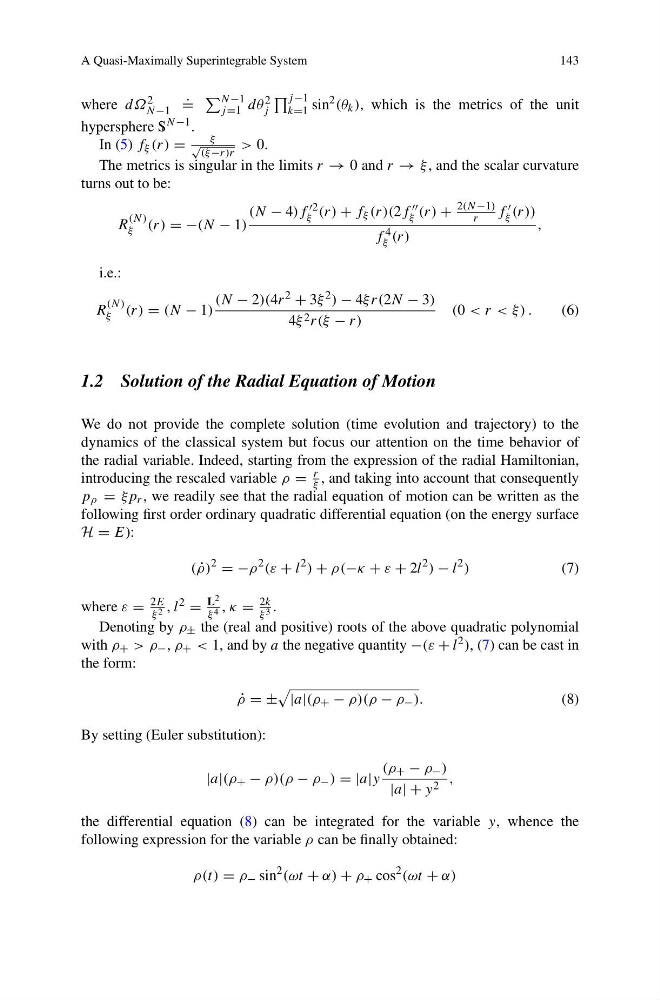
A Quasi-Maximally Superintegrable System
143
where dΩ 2
N −1
.
=
N −1
j =1 dθ 2
j
j −1
k=1 sin
2 (θ k ), which is the metrics of the unit
hypersphere S
N −1 .
In (5) f ξ (r) =
ξ
√
(ξ −r)r
> 0.
The metrics is singular in the limits r → 0 and r → ξ , and the scalar curvature
turns out to be:
R
(N )
ξ (r) = −(N − 1)
(N − 4)f
ξ (r) + f ξ (r)(2f
ξ (r) +
2(N −1)
r
f
ξ (r))
f 4
ξ (r)
,
i.e.:
R
(N )
ξ (r) = (N − 1)
(N − 2)(4r 2 + 3ξ 2 ) − 4ξr(2N − 3)
4ξ 2 r(ξ − r)
(0 < r < ξ) .
(6)
1.2 Solution of the Radial Equation of Motion
We do not provide the complete solution (time evolution and trajectory) to the
dynamics of the classical system but focus our attention on the time behavior of
the radial variable. Indeed, starting from the expression of the radial Hamiltonian,
introducing the rescaled variable ρ =
r
ξ , and taking into account that consequently
p ρ = ξp r , we readily see that the radial equation of motion can be written as the
following first order ordinary quadratic differential equation (on the energy surface
H = E):
( ˙
ρ)
2
= −ρ
2 (ε + l
2 ) + ρ(−κ + ε + 2l
2 ) − l
2 )
(7)
where ε =
2E
ξ 2 , l 2 =
L 2
ξ 4 , κ =
2k
ξ 3 .
Denoting by ρ ± the (real and positive) roots of the above quadratic polynomial
with ρ + > ρ − , ρ + < 1, and by a the negative quantity −(ε + l 2 ), (7) can be cast in
the form:
˙
ρ = ±
|a|(ρ + − ρ)(ρ − ρ − ).
(8)
By setting (Euler substitution):
|a|(ρ + − ρ)(ρ − ρ − ) = |a|y
(ρ + − ρ − )
|a| + y 2 ,
the differential equation (8) can be integrated for the variable y, whence the
following expression for the variable ρ can be finally obtained:
ρ(t) = ρ − sin
2 (ωt + α) + ρ + cos
2 (ωt + α)
143
where dΩ 2
N −1
.
=
N −1
j =1 dθ 2
j
j −1
k=1 sin
2 (θ k ), which is the metrics of the unit
hypersphere S
N −1 .
In (5) f ξ (r) =
ξ
√
(ξ −r)r
> 0.
The metrics is singular in the limits r → 0 and r → ξ , and the scalar curvature
turns out to be:
R
(N )
ξ (r) = −(N − 1)
(N − 4)f
ξ (r) + f ξ (r)(2f
ξ (r) +
2(N −1)
r
f
ξ (r))
f 4
ξ (r)
,
i.e.:
R
(N )
ξ (r) = (N − 1)
(N − 2)(4r 2 + 3ξ 2 ) − 4ξr(2N − 3)
4ξ 2 r(ξ − r)
(0 < r < ξ) .
(6)
1.2 Solution of the Radial Equation of Motion
We do not provide the complete solution (time evolution and trajectory) to the
dynamics of the classical system but focus our attention on the time behavior of
the radial variable. Indeed, starting from the expression of the radial Hamiltonian,
introducing the rescaled variable ρ =
r
ξ , and taking into account that consequently
p ρ = ξp r , we readily see that the radial equation of motion can be written as the
following first order ordinary quadratic differential equation (on the energy surface
H = E):
( ˙
ρ)
2
= −ρ
2 (ε + l
2 ) + ρ(−κ + ε + 2l
2 ) − l
2 )
(7)
where ε =
2E
ξ 2 , l 2 =
L 2
ξ 4 , κ =
2k
ξ 3 .
Denoting by ρ ± the (real and positive) roots of the above quadratic polynomial
with ρ + > ρ − , ρ + < 1, and by a the negative quantity −(ε + l 2 ), (7) can be cast in
the form:
˙
ρ = ±
|a|(ρ + − ρ)(ρ − ρ − ).
(8)
By setting (Euler substitution):
|a|(ρ + − ρ)(ρ − ρ − ) = |a|y
(ρ + − ρ − )
|a| + y 2 ,
the differential equation (8) can be integrated for the variable y, whence the
following expression for the variable ρ can be finally obtained:
ρ(t) = ρ − sin
2 (ωt + α) + ρ + cos
2 (ωt + α)