

142
O. Ragnisco
where ξ and k are positive real numbers, q, p ∈ IR
N are conjugate coordinates and
momenta with canonical Poisson bracket {q i , p j } = δ ij and
q
2
=
N
i=1
q
2
i ,
p
2
=
N
i=1
p
2
i ,
|q| = (q
2 )
1
2 .
To have a positive definite Hamiltonian, the position variables have to be
restricted to the (punctured) open ball (0 < |q| < ξ).
The Hamiltonian H can also be written in terms of hyperspherical coordinates
r, θ j , (and canonical momenta p r , p θ j ), (j = 1, . . . , N − 1) defined by
q j = r cos θ j
j −1
k=1
sin θ k , 1 ≤ j < N,
q N = r
N −1
k=1
sin θ k
(2)
so that
r = |q|,
p
2
= p
2
r + r
−2 L
2 ,
L
2
=
N −1
j =1
p
2
θ j
j −1
k=1
1
sin
2 θ k
.
Thus, for a given value of L, the Hamiltonian (1) becomes a 1D radial system:
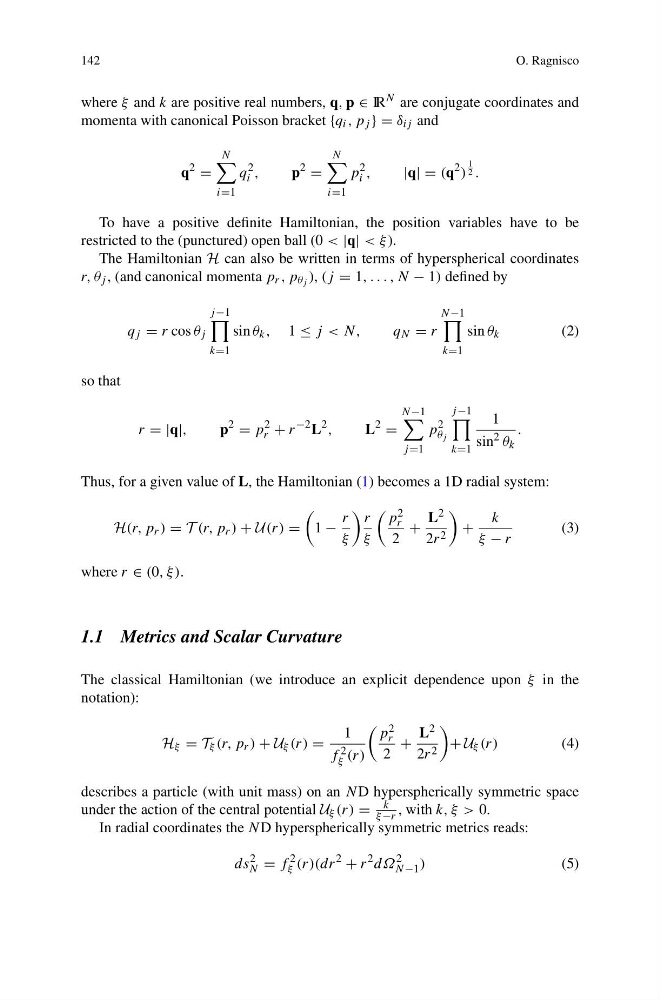
H(r, p r ) = T (r, p r ) + U (r) =
1 −
r
ξ
r
ξ
p 2
r
2
+
L 2
2r 2
+
k
ξ − r
(3)
where r ∈ (0, ξ).
1.1 Metrics and Scalar Curvature
The classical Hamiltonian (we introduce an explicit dependence upon ξ in the
notation):
H ξ = T ξ (r, p r ) + U ξ (r) =
1
f 2
ξ (r)
p 2
r
2
+
L 2
2r 2
+ U ξ (r)
(4)
describes a particle (with unit mass) on an ND hyperspherically symmetric space
under the action of the central potential U ξ (r) =
k
ξ −r , with k, ξ > 0.
In radial coordinates the N D hyperspherically symmetric metrics reads:
ds
2
N = f
2
ξ (r)(dr
2
+ r
2 dΩ
2
N −1 )
(5)
O. Ragnisco
where ξ and k are positive real numbers, q, p ∈ IR
N are conjugate coordinates and
momenta with canonical Poisson bracket {q i , p j } = δ ij and
q
2
=
N
i=1
q
2
i ,
p
2
=
N
i=1
p
2
i ,
|q| = (q
2 )
1
2 .
To have a positive definite Hamiltonian, the position variables have to be
restricted to the (punctured) open ball (0 < |q| < ξ).
The Hamiltonian H can also be written in terms of hyperspherical coordinates
r, θ j , (and canonical momenta p r , p θ j ), (j = 1, . . . , N − 1) defined by
q j = r cos θ j
j −1
k=1
sin θ k , 1 ≤ j < N,
q N = r
N −1
k=1
sin θ k
(2)
so that
r = |q|,
p
2
= p
2
r + r
−2 L
2 ,
L
2
=
N −1
j =1
p
2
θ j
j −1
k=1
1
sin
2 θ k
.
Thus, for a given value of L, the Hamiltonian (1) becomes a 1D radial system:
H(r, p r ) = T (r, p r ) + U (r) =
1 −
r
ξ
r
ξ
p 2
r
2
+
L 2
2r 2
+
k
ξ − r
(3)
where r ∈ (0, ξ).
1.1 Metrics and Scalar Curvature
The classical Hamiltonian (we introduce an explicit dependence upon ξ in the
notation):
H ξ = T ξ (r, p r ) + U ξ (r) =
1
f 2
ξ (r)
p 2
r
2
+
L 2
2r 2
+ U ξ (r)
(4)
describes a particle (with unit mass) on an ND hyperspherically symmetric space
under the action of the central potential U ξ (r) =
k
ξ −r , with k, ξ > 0.
In radial coordinates the N D hyperspherically symmetric metrics reads:
ds
2
N = f
2
ξ (r)(dr
2
+ r
2 dΩ
2
N −1 )
(5)