

Ladder Operators and Rational Extensions
125
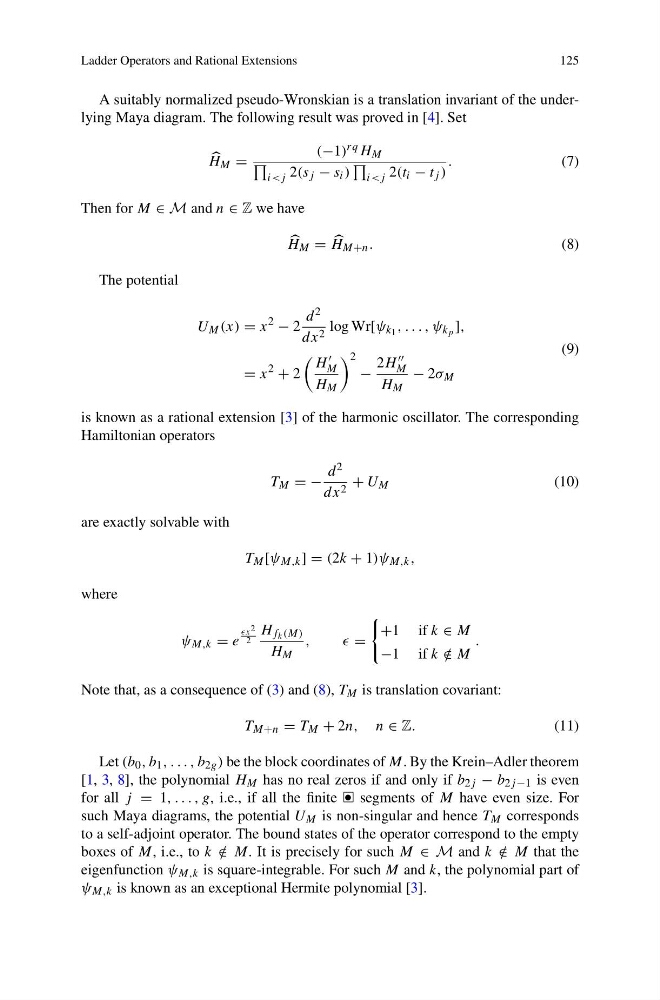
A suitably normalized pseudo-Wronskian is a translation invariant of the underlying Maya diagram. The following result was proved in [4]. Set
H M =
(−1) rq H M
i
(7)
Then for M ∈ M and n ∈ Z we have
H M =
H M+n .
(8)
The potential
U M (x) = x
2
− 2
d 2
dx 2 log Wr[ψ k 1 , . . . , ψ k p ],
= x
2
+ 2
H
M
H M
2
−
2H
M
H M
− 2σ M
(9)
is known as a rational extension [3] of the harmonic oscillator. The corresponding
Hamiltonian operators
T M = −
d 2
dx 2 + U M
(10)
are exactly solvable with
T M [ψ M,k ] = (2k + 1)ψ M,k ,
where
ψ M,k = e
2
2
H f k (M)
H M
,
, =
+1 if k ∈ M
−1 if k /
∈ M
.
Note that, as a consequence of (3) and (8), T M is translation covariant:
T M+n = T M + 2n, n ∈ Z.
(11)
Let (b 0 , b 1 , . . . , b 2g ) be the block coordinates of M. By the Krein–Adler theorem
[1, 3, 8], the polynomial H M has no real zeros if and only if b 2j − b 2j −1 is even
for all j = 1, . . . , g, i.e., if all the finite •
segments of M have even size. For
such Maya diagrams, the potential U M is non-singular and hence T M corresponds
to a self-adjoint operator. The bound states of the operator correspond to the empty
boxes of M, i.e., to k /
∈ M. It is precisely for such M ∈ M and k /
∈ M that the
eigenfunction ψ M,k is square-integrable. For such M and k, the polynomial part of
ψ M,k is known as an exceptional Hermite polynomial [3].
125
A suitably normalized pseudo-Wronskian is a translation invariant of the underlying Maya diagram. The following result was proved in [4]. Set
H M =
(−1) rq H M
i
(7)
Then for M ∈ M and n ∈ Z we have
H M =
H M+n .
(8)
The potential
U M (x) = x
2
− 2
d 2
dx 2 log Wr[ψ k 1 , . . . , ψ k p ],
= x
2
+ 2
H
M
H M
2
−
2H
M
H M
− 2σ M
(9)
is known as a rational extension [3] of the harmonic oscillator. The corresponding
Hamiltonian operators
T M = −
d 2
dx 2 + U M
(10)
are exactly solvable with
T M [ψ M,k ] = (2k + 1)ψ M,k ,
where
ψ M,k = e
2
2
H f k (M)
H M
,
, =
+1 if k ∈ M
−1 if k /
∈ M
.
Note that, as a consequence of (3) and (8), T M is translation covariant:
T M+n = T M + 2n, n ∈ Z.
(11)
Let (b 0 , b 1 , . . . , b 2g ) be the block coordinates of M. By the Krein–Adler theorem
[1, 3, 8], the polynomial H M has no real zeros if and only if b 2j − b 2j −1 is even
for all j = 1, . . . , g, i.e., if all the finite •
segments of M have even size. For
such Maya diagrams, the potential U M is non-singular and hence T M corresponds
to a self-adjoint operator. The bound states of the operator correspond to the empty
boxes of M, i.e., to k /
∈ M. It is precisely for such M ∈ M and k /
∈ M that the
eigenfunction ψ M,k is square-integrable. For such M and k, the polynomial part of
ψ M,k is known as an exceptional Hermite polynomial [3].