

124
D. Gómez-Ullate et al.
3 Rational Extensions
For n ∈ Z, set
ψ n (x) =
⎧
⎨
⎩
e
−
x 2
2 H n (x)
if n ≥ 0
e
x 2
2 ˜
H −n−1 (x) if n < 0
where
H n (x) = (−1)
n e
x 2 d n
dx n e
−x 2 , n = 0, 1, 2, . . .
are the Hermite polynomials, and
˜
H n (x) = (−i)
n H n (ix)
are the conjugate Hermite polynomials. We then have
−ψ
n (x) + x
2 ψ n (x) = (2n + 1)ψ n (x), n ∈ Z.
For n ≥ 0, the above solutions correspond to the bound states of the quantum
harmonic oscillator. The solutions for n < 0 do not satisfy the boundary conditions
at ±∞ and therefore represent virtual states.
For M ∈ M with index set K ∈ Z p , let s 1 > · · · > s r ≥ 0 and t 1 > · · · > t q ≥ 0
be the uniquely specified lists of natural numbers such that
K = {−1 − s 1 , . . . , −1 − s r , t q , . . . , t 1 }, p = q + r.
We will refer to (s 1 , . . . , s r | t q , . . . , t 1 ) as the Frobenius symbol of M. It is easy to
check that the index of M is given by σ = q − r.
Let us now define
H M (x) = e
σ M
x 2
2 Wr[ψ k 1 , . . . , ψ k p ],
(5)
where k 1 < · · · < k p is an increasing enumeration of K, where σ M ∈ Z is the
index, and Wr is the usual Wronskian determinant. The polynomial nature of H M (x)
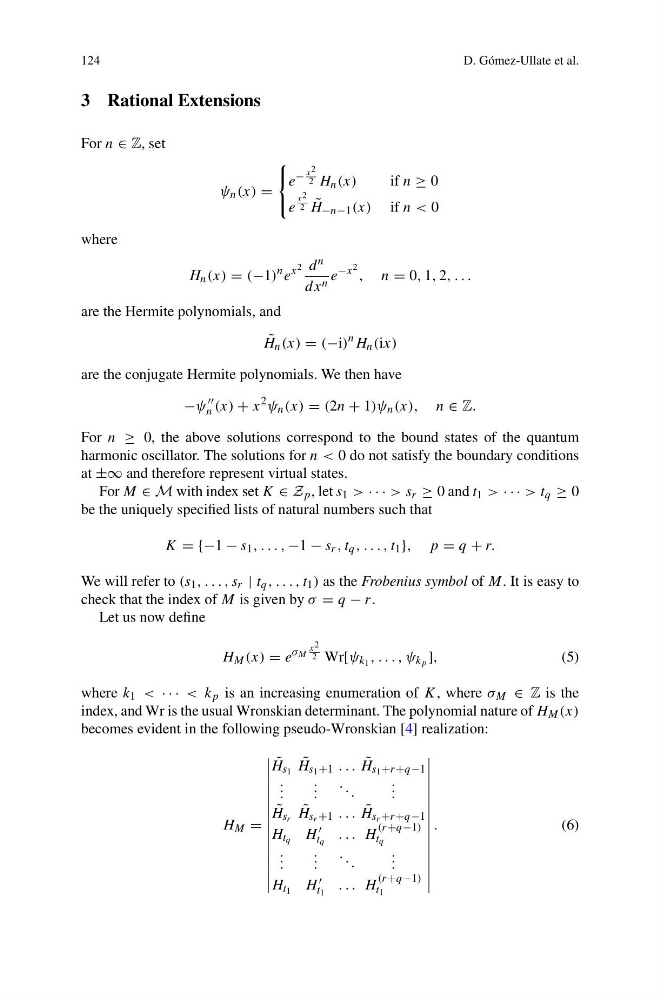
becomes evident in the following pseudo-Wronskian [4] realization:
H M =
˜
H s 1 ˜
H s 1 +1 . . . ˜
H s 1 +r+q−1
. . .
. . .
. . .
. . .
˜
H s r ˜
H s r +1 . . . ˜
H s r +r+q−1
H t q H
t q
. . . H
(r+q−1)
t q
. . .
. . .
. . .
. . .
H t 1 H
t 1
. . . H
(r+q−1)
t 1
.
(6)
D. Gómez-Ullate et al.
3 Rational Extensions
For n ∈ Z, set
ψ n (x) =
⎧
⎨
⎩
e
−
x 2
2 H n (x)
if n ≥ 0
e
x 2
2 ˜
H −n−1 (x) if n < 0
where
H n (x) = (−1)
n e
x 2 d n
dx n e
−x 2 , n = 0, 1, 2, . . .
are the Hermite polynomials, and
˜
H n (x) = (−i)
n H n (ix)
are the conjugate Hermite polynomials. We then have
−ψ
n (x) + x
2 ψ n (x) = (2n + 1)ψ n (x), n ∈ Z.
For n ≥ 0, the above solutions correspond to the bound states of the quantum
harmonic oscillator. The solutions for n < 0 do not satisfy the boundary conditions
at ±∞ and therefore represent virtual states.
For M ∈ M with index set K ∈ Z p , let s 1 > · · · > s r ≥ 0 and t 1 > · · · > t q ≥ 0
be the uniquely specified lists of natural numbers such that
K = {−1 − s 1 , . . . , −1 − s r , t q , . . . , t 1 }, p = q + r.
We will refer to (s 1 , . . . , s r | t q , . . . , t 1 ) as the Frobenius symbol of M. It is easy to
check that the index of M is given by σ = q − r.
Let us now define
H M (x) = e
σ M
x 2
2 Wr[ψ k 1 , . . . , ψ k p ],
(5)
where k 1 < · · · < k p is an increasing enumeration of K, where σ M ∈ Z is the
index, and Wr is the usual Wronskian determinant. The polynomial nature of H M (x)
becomes evident in the following pseudo-Wronskian [4] realization:
H M =
˜
H s 1 ˜
H s 1 +1 . . . ˜
H s 1 +r+q−1
. . .
. . .
. . .
. . .
˜
H s r ˜
H s r +1 . . . ˜
H s r +r+q−1
H t q H
t q
. . . H
(r+q−1)
t q
. . .
. . .
. . .
. . .
H t 1 H
t 1
. . . H
(r+q−1)
t 1
.
(6)