

Quantum Superintegrable Systems
117
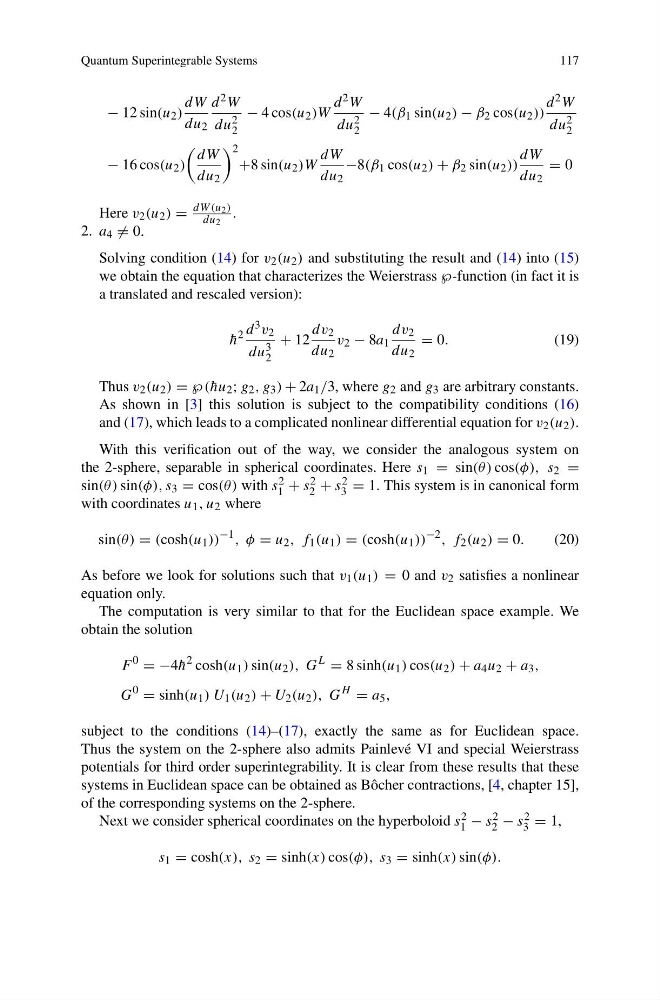
− 12 sin(u 2 )
dW
du 2
d 2 W
du 2
2
− 4 cos(u 2 )W
d 2 W
du 2
2
− 4(β 1 sin(u 2 ) − β 2 cos(u 2 ))
d 2 W
du 2
2
− 16 cos(u 2 )
dW
du 2
2
+8 sin(u 2 )W
dW
du 2
−8(β 1 cos(u 2 ) + β 2 sin(u 2 ))
dW
du 2
= 0
Here v 2 (u 2 ) =
dW (u 2 )
du 2
.
2. a 4 = 0.
Solving condition (14) for v 2 (u 2 ) and substituting the result and (14) into (15)
we obtain the equation that characterizes the Weierstrass ℘-function (in fact it is
a translated and rescaled version):
¯
h
2 d 3 v 2
du 3
2
+ 12
dv 2
du 2
v 2 − 8a 1
dv 2
du 2
= 0.
(19)
Thus v 2 (u 2 ) = ℘ ( ¯
hu 2 ; g 2 , g 3 ) + 2a 1 /3, where g 2 and g 3 are arbitrary constants.
As shown in [3] this solution is subject to the compatibility conditions (16)
and (17), which leads to a complicated nonlinear differential equation for v 2 (u 2 ).
With this verification out of the way, we consider the analogous system on
the 2-sphere, separable in spherical coordinates. Here s 1 = sin(θ ) cos(φ), s 2 =
sin(θ ) sin(φ), s 3 = cos(θ ) with s 2
1 + s 2
2 + s 2
3 = 1. This system is in canonical form
with coordinates u 1 , u 2 where
sin(θ ) = (cosh(u 1 ))
−1 , φ = u 2 , f 1 (u 1 ) = (cosh(u 1 ))
−2 , f 2 (u 2 ) = 0.
(20)
As before we look for solutions such that v 1 (u 1 ) = 0 and v 2 satisfies a nonlinear
equation only.
The computation is very similar to that for the Euclidean space example. We
obtain the solution
F
0
= −4 ¯
h
2 cosh(u 1 ) sin(u 2 ), G
L
= 8 sinh(u 1 ) cos(u 2 ) + a 4 u 2 + a 3 ,
G
0
= sinh(u 1 ) U 1 (u 2 ) + U 2 (u 2 ), G
H
= a 5 ,
subject to the conditions (14)–(17), exactly the same as for Euclidean space.
Thus the system on the 2-sphere also admits Painlevé VI and special Weierstrass
potentials for third order superintegrability. It is clear from these results that these
systems in Euclidean space can be obtained as Bôcher contractions, [4, chapter 15],
of the corresponding systems on the 2-sphere.
Next we consider spherical coordinates on the hyperboloid s 2
1 − s 2
2 − s 2
3 = 1,
s 1 = cosh(x), s 2 = sinh(x) cos(φ), s 3 = sinh(x) sin(φ).
117
− 12 sin(u 2 )
dW
du 2
d 2 W
du 2
2
− 4 cos(u 2 )W
d 2 W
du 2
2
− 4(β 1 sin(u 2 ) − β 2 cos(u 2 ))
d 2 W
du 2
2
− 16 cos(u 2 )
dW
du 2
2
+8 sin(u 2 )W
dW
du 2
−8(β 1 cos(u 2 ) + β 2 sin(u 2 ))
dW
du 2
= 0
Here v 2 (u 2 ) =
dW (u 2 )
du 2
.
2. a 4 = 0.
Solving condition (14) for v 2 (u 2 ) and substituting the result and (14) into (15)
we obtain the equation that characterizes the Weierstrass ℘-function (in fact it is
a translated and rescaled version):
¯
h
2 d 3 v 2
du 3
2
+ 12
dv 2
du 2
v 2 − 8a 1
dv 2
du 2
= 0.
(19)
Thus v 2 (u 2 ) = ℘ ( ¯
hu 2 ; g 2 , g 3 ) + 2a 1 /3, where g 2 and g 3 are arbitrary constants.
As shown in [3] this solution is subject to the compatibility conditions (16)
and (17), which leads to a complicated nonlinear differential equation for v 2 (u 2 ).
With this verification out of the way, we consider the analogous system on
the 2-sphere, separable in spherical coordinates. Here s 1 = sin(θ ) cos(φ), s 2 =
sin(θ ) sin(φ), s 3 = cos(θ ) with s 2
1 + s 2
2 + s 2
3 = 1. This system is in canonical form
with coordinates u 1 , u 2 where
sin(θ ) = (cosh(u 1 ))
−1 , φ = u 2 , f 1 (u 1 ) = (cosh(u 1 ))
−2 , f 2 (u 2 ) = 0.
(20)
As before we look for solutions such that v 1 (u 1 ) = 0 and v 2 satisfies a nonlinear
equation only.
The computation is very similar to that for the Euclidean space example. We
obtain the solution
F
0
= −4 ¯
h
2 cosh(u 1 ) sin(u 2 ), G
L
= 8 sinh(u 1 ) cos(u 2 ) + a 4 u 2 + a 3 ,
G
0
= sinh(u 1 ) U 1 (u 2 ) + U 2 (u 2 ), G
H
= a 5 ,
subject to the conditions (14)–(17), exactly the same as for Euclidean space.
Thus the system on the 2-sphere also admits Painlevé VI and special Weierstrass
potentials for third order superintegrability. It is clear from these results that these
systems in Euclidean space can be obtained as Bôcher contractions, [4, chapter 15],
of the corresponding systems on the 2-sphere.
Next we consider spherical coordinates on the hyperboloid s 2
1 − s 2
2 − s 2
3 = 1,
s 1 = cosh(x), s 2 = sinh(x) cos(φ), s 3 = sinh(x) sin(φ).