

The Salpeter Equation: Nonlocality and Pseudodifferential Operators
107
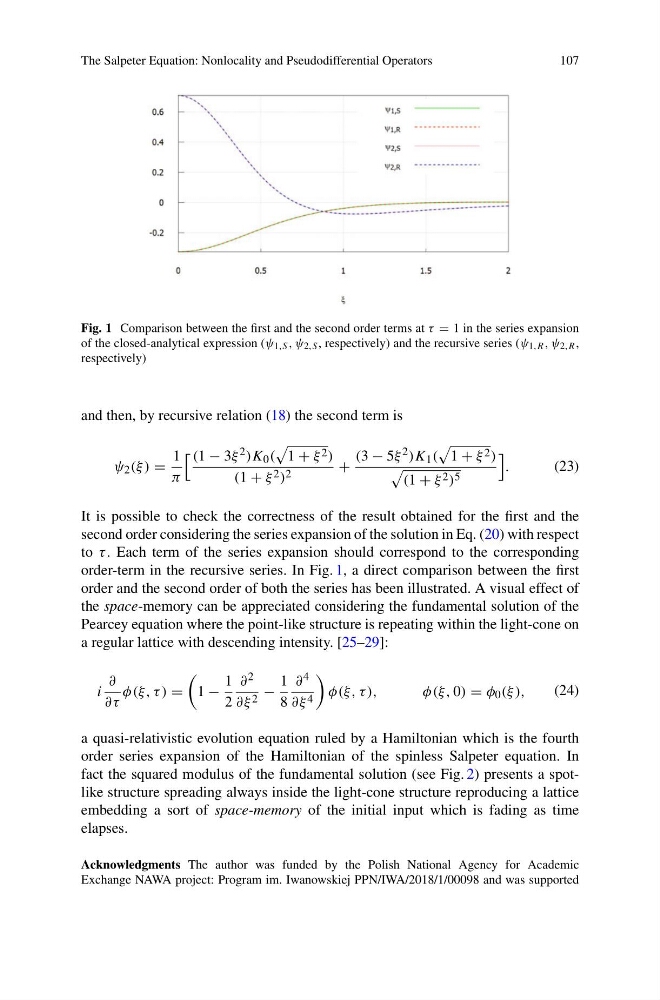
Fig. 1 Comparison between the first and the second order terms at τ = 1 in the series expansion
of the closed-analytical expression (ψ 1,S , ψ 2,S , respectively) and the recursive series (ψ 1,R , ψ 2,R ,
respectively)
and then, by recursive relation (18) the second term is
ψ 2 (ξ ) =
1
π
(1 − 3ξ 2 )K 0 (
1 + ξ 2 )
(1 + ξ 2 ) 2
+
(3 − 5ξ 2 )K 1 (
1 + ξ 2 )
(1 + ξ 2 ) 5
.
(23)
It is possible to check the correctness of the result obtained for the first and the
second order considering the series expansion of the solution in Eq. (20) with respect
to τ . Each term of the series expansion should correspond to the corresponding
order-term in the recursive series. In Fig. 1, a direct comparison between the first
order and the second order of both the series has been illustrated. A visual effect of
the space-memory can be appreciated considering the fundamental solution of the
Pearcey equation where the point-like structure is repeating within the light-cone on
a regular lattice with descending intensity. [25–29]:
i
∂
∂τ
φ(ξ, τ ) =
1 −
1
2
∂ 2
∂ξ 2 −
1
8
∂ 4
∂ξ 4
φ(ξ, τ ),
φ(ξ, 0) = φ 0 (ξ ),
(24)
a quasi-relativistic evolution equation ruled by a Hamiltonian which is the fourth
order series expansion of the Hamiltonian of the spinless Salpeter equation. In
fact the squared modulus of the fundamental solution (see Fig. 2) presents a spotlike structure spreading always inside the light-cone structure reproducing a lattice
embedding a sort of space-memory of the initial input which is fading as time
elapses.
Acknowledgments The author was funded by the Polish National Agency for Academic
Exchange NAWA project: Program im. Iwanowskiej PPN/IWA/2018/1/00098 and was supported
107
Fig. 1 Comparison between the first and the second order terms at τ = 1 in the series expansion
of the closed-analytical expression (ψ 1,S , ψ 2,S , respectively) and the recursive series (ψ 1,R , ψ 2,R ,
respectively)
and then, by recursive relation (18) the second term is
ψ 2 (ξ ) =
1
π
(1 − 3ξ 2 )K 0 (
1 + ξ 2 )
(1 + ξ 2 ) 2
+
(3 − 5ξ 2 )K 1 (
1 + ξ 2 )
(1 + ξ 2 ) 5
.
(23)
It is possible to check the correctness of the result obtained for the first and the
second order considering the series expansion of the solution in Eq. (20) with respect
to τ . Each term of the series expansion should correspond to the corresponding
order-term in the recursive series. In Fig. 1, a direct comparison between the first
order and the second order of both the series has been illustrated. A visual effect of
the space-memory can be appreciated considering the fundamental solution of the
Pearcey equation where the point-like structure is repeating within the light-cone on
a regular lattice with descending intensity. [25–29]:
i
∂
∂τ
φ(ξ, τ ) =
1 −
1
2
∂ 2
∂ξ 2 −
1
8
∂ 4
∂ξ 4
φ(ξ, τ ),
φ(ξ, 0) = φ 0 (ξ ),
(24)
a quasi-relativistic evolution equation ruled by a Hamiltonian which is the fourth
order series expansion of the Hamiltonian of the spinless Salpeter equation. In
fact the squared modulus of the fundamental solution (see Fig. 2) presents a spotlike structure spreading always inside the light-cone structure reproducing a lattice
embedding a sort of space-memory of the initial input which is fading as time
elapses.
Acknowledgments The author was funded by the Polish National Agency for Academic
Exchange NAWA project: Program im. Iwanowskiej PPN/IWA/2018/1/00098 and was supported