

96
V. Hussin et al.
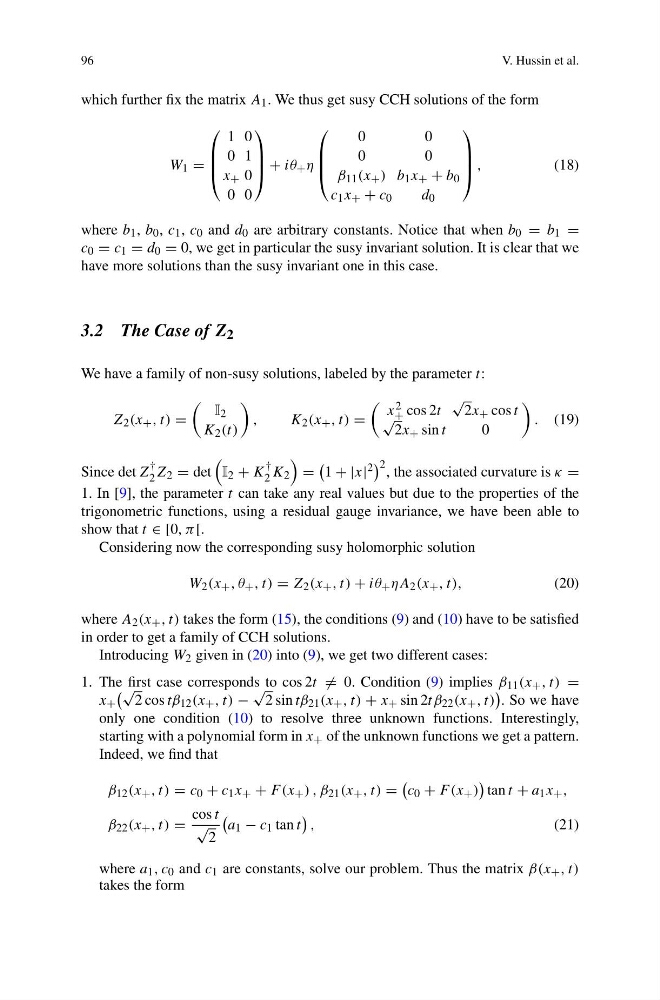
which further fix the matrix A 1 . We thus get susy CCH solutions of the form
W 1 =
⎛
⎜
⎜
⎝
1 0
0 1
x + 0
0 0
⎞
⎟
⎟
⎠ + iθ + η
⎛
⎜
⎜
⎝
0
0
0
0
β 11 (x + ) b 1 x + + b 0
c 1 x + + c 0
d 0
⎞
⎟
⎟
⎠ ,
(18)
where b 1 , b 0 , c 1 , c 0 and d 0 are arbitrary constants. Notice that when b 0 = b 1 =
c 0 = c 1 = d 0 = 0, we get in particular the susy invariant solution. It is clear that we
have more solutions than the susy invariant one in this case.
3.2 The Case of Z 2
We have a family of non-susy solutions, labeled by the parameter t:
Z 2 (x + , t) =
I 2
K 2 (t)
,
K 2 (x + , t) =
x 2
+ cos 2t
√
2x + cos t
√
2x + sin t
0
. (19)
Since det Z
†
2 Z 2 = det
I 2 + K
†
2 K 2
=
1 + |x| 2 2 , the associated curvature is κ =
1. In [9], the parameter t can take any real values but due to the properties of the
trigonometric functions, using a residual gauge invariance, we have been able to
show that t ∈ [0, π[.
Considering now the corresponding susy holomorphic solution
W 2 (x + , θ + , t) = Z 2 (x + , t) + iθ + ηA 2 (x + , t),
(20)
where A 2 (x + , t) takes the form (15), the conditions (9) and (10) have to be satisfied
in order to get a family of CCH solutions.
Introducing W 2 given in (20) into (9), we get two different cases:
1. The first case corresponds to cos 2t = 0. Condition (9) implies β 11 (x + , t) =
x +
√
2 cos tβ 12 (x + , t) −
√
2 sin tβ 21 (x + , t) + x + sin 2tβ 22 (x + , t)
. So we have
only one condition (10) to resolve three unknown functions. Interestingly,
starting with a polynomial form in x + of the unknown functions we get a pattern.
Indeed, we find that
β 12 (x + , t) = c 0 + c 1 x + + F (x + ) , β 21 (x + , t) =
c 0 + F (x + )
tan t + a 1 x + ,
β 22 (x + , t) =
cos t
√
2
a 1 − c 1 tan t
,
(21)
where a 1 , c 0 and c 1 are constants, solve our problem. Thus the matrix β(x + , t)
takes the form
V. Hussin et al.
which further fix the matrix A 1 . We thus get susy CCH solutions of the form
W 1 =
⎛
⎜
⎜
⎝
1 0
0 1
x + 0
0 0
⎞
⎟
⎟
⎠ + iθ + η
⎛
⎜
⎜
⎝
0
0
0
0
β 11 (x + ) b 1 x + + b 0
c 1 x + + c 0
d 0
⎞
⎟
⎟
⎠ ,
(18)
where b 1 , b 0 , c 1 , c 0 and d 0 are arbitrary constants. Notice that when b 0 = b 1 =
c 0 = c 1 = d 0 = 0, we get in particular the susy invariant solution. It is clear that we
have more solutions than the susy invariant one in this case.
3.2 The Case of Z 2
We have a family of non-susy solutions, labeled by the parameter t:
Z 2 (x + , t) =
I 2
K 2 (t)
,
K 2 (x + , t) =
x 2
+ cos 2t
√
2x + cos t
√
2x + sin t
0
. (19)
Since det Z
†
2 Z 2 = det
I 2 + K
†
2 K 2
=
1 + |x| 2 2 , the associated curvature is κ =
1. In [9], the parameter t can take any real values but due to the properties of the
trigonometric functions, using a residual gauge invariance, we have been able to
show that t ∈ [0, π[.
Considering now the corresponding susy holomorphic solution
W 2 (x + , θ + , t) = Z 2 (x + , t) + iθ + ηA 2 (x + , t),
(20)
where A 2 (x + , t) takes the form (15), the conditions (9) and (10) have to be satisfied
in order to get a family of CCH solutions.
Introducing W 2 given in (20) into (9), we get two different cases:
1. The first case corresponds to cos 2t = 0. Condition (9) implies β 11 (x + , t) =
x +
√
2 cos tβ 12 (x + , t) −
√
2 sin tβ 21 (x + , t) + x + sin 2tβ 22 (x + , t)
. So we have
only one condition (10) to resolve three unknown functions. Interestingly,
starting with a polynomial form in x + of the unknown functions we get a pattern.
Indeed, we find that
β 12 (x + , t) = c 0 + c 1 x + + F (x + ) , β 21 (x + , t) =
c 0 + F (x + )
tan t + a 1 x + ,
β 22 (x + , t) =
cos t
√
2
a 1 − c 1 tan t
,
(21)
where a 1 , c 0 and c 1 are constants, solve our problem. Thus the matrix β(x + , t)
takes the form