

Supersymmetric Grassmannian Sigma Model
95
Z 1 =
⎛
⎜
⎜
⎝
1 0
0 1
x + 0
0 0
⎞
⎟
⎟
⎠ , Z 2 =
⎛
⎜
⎜
⎝
1
0
0
1
x 2
+ cos 2t
√
2x + cos t
√
2x + sin t
0
⎞
⎟
⎟
⎠ , t ∈ R
Z 3 =
⎛
⎜
⎜
⎝
1
0
0
1
√
3x 2
+
√
8/3x +
0
√
1/3x +
⎞
⎟
⎟
⎠ , Z 4 =
⎛
⎜
⎜
⎝
1
0
0
1
2x 3
+
√
3x 2
+
√
3x 2
+ 2x +
⎞
⎟
⎟
⎠ .
(13)
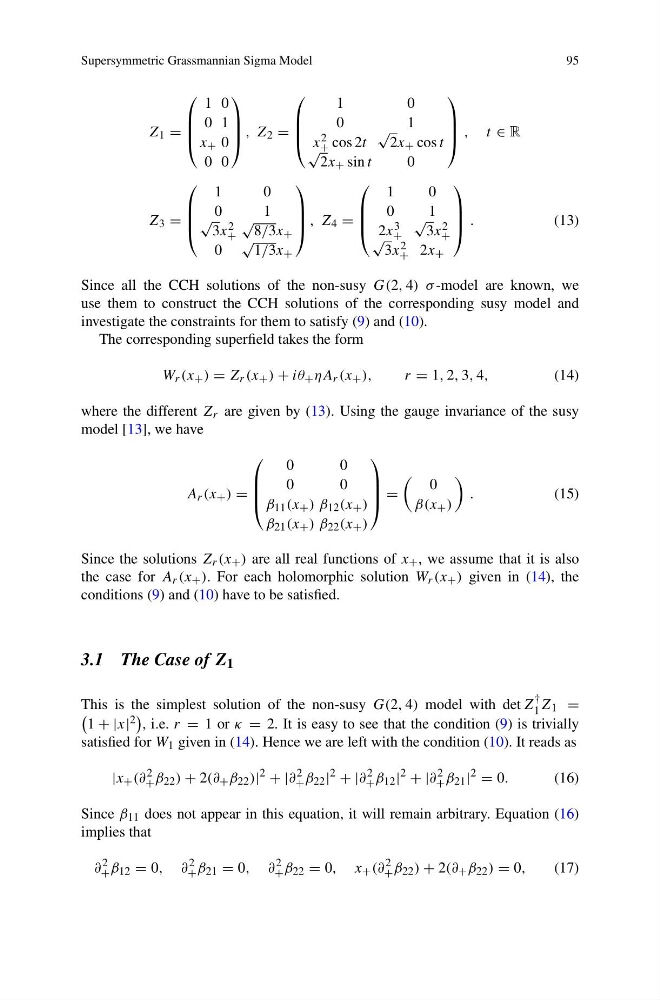
Since all the CCH solutions of the non-susy G(2, 4) σ-model are known, we
use them to construct the CCH solutions of the corresponding susy model and
investigate the constraints for them to satisfy (9) and (10).
The corresponding superfield takes the form
W r (x + ) = Z r (x + ) + iθ + ηA r (x + ),
r = 1, 2, 3, 4,
(14)
where the different Z r are given by (13). Using the gauge invariance of the susy
model [13], we have
A r (x + ) =
⎛
⎜
⎜
⎝
0
0
0
0
β 11 (x + ) β 12 (x + )
β 21 (x + ) β 22 (x + )
⎞
⎟
⎟
⎠ =
0
β(x + )
.
(15)
Since the solutions Z r (x + ) are all real functions of x + , we assume that it is also
the case for A r (x + ). For each holomorphic solution W r (x + ) given in (14), the
conditions (9) and (10) have to be satisfied.
3.1 The Case of Z 1
This is the simplest solution of the non-susy G(2, 4) model with det Z
†
1 Z 1 =
1 + |x| 2
, i.e. r = 1 or κ = 2. It is easy to see that the condition (9) is trivially
satisfied for W 1 given in (14). Hence we are left with the condition (10). It reads as
|x + (∂
2
+ β 22 ) + 2(∂ + β 22 )|
2
+ |∂
2
+ β 22 |
2
+ |∂
2
+ β 12 |
2
+ |∂
2
+ β 21 |
2
= 0.
(16)
Since β 11 does not appear in this equation, it will remain arbitrary. Equation (16)
implies that
∂
2
+ β 12 = 0, ∂
2
+ β 21 = 0, ∂
2
+ β 22 = 0, x + (∂
2
+ β 22 ) + 2(∂ + β 22 ) = 0,
(17)
95
Z 1 =
⎛
⎜
⎜
⎝
1 0
0 1
x + 0
0 0
⎞
⎟
⎟
⎠ , Z 2 =
⎛
⎜
⎜
⎝
1
0
0
1
x 2
+ cos 2t
√
2x + cos t
√
2x + sin t
0
⎞
⎟
⎟
⎠ , t ∈ R
Z 3 =
⎛
⎜
⎜
⎝
1
0
0
1
√
3x 2
+
√
8/3x +
0
√
1/3x +
⎞
⎟
⎟
⎠ , Z 4 =
⎛
⎜
⎜
⎝
1
0
0
1
2x 3
+
√
3x 2
+
√
3x 2
+ 2x +
⎞
⎟
⎟
⎠ .
(13)
Since all the CCH solutions of the non-susy G(2, 4) σ-model are known, we
use them to construct the CCH solutions of the corresponding susy model and
investigate the constraints for them to satisfy (9) and (10).
The corresponding superfield takes the form
W r (x + ) = Z r (x + ) + iθ + ηA r (x + ),
r = 1, 2, 3, 4,
(14)
where the different Z r are given by (13). Using the gauge invariance of the susy
model [13], we have
A r (x + ) =
⎛
⎜
⎜
⎝
0
0
0
0
β 11 (x + ) β 12 (x + )
β 21 (x + ) β 22 (x + )
⎞
⎟
⎟
⎠ =
0
β(x + )
.
(15)
Since the solutions Z r (x + ) are all real functions of x + , we assume that it is also
the case for A r (x + ). For each holomorphic solution W r (x + ) given in (14), the
conditions (9) and (10) have to be satisfied.
3.1 The Case of Z 1
This is the simplest solution of the non-susy G(2, 4) model with det Z
†
1 Z 1 =
1 + |x| 2
, i.e. r = 1 or κ = 2. It is easy to see that the condition (9) is trivially
satisfied for W 1 given in (14). Hence we are left with the condition (10). It reads as
|x + (∂
2
+ β 22 ) + 2(∂ + β 22 )|
2
+ |∂
2
+ β 22 |
2
+ |∂
2
+ β 12 |
2
+ |∂
2
+ β 21 |
2
= 0.
(16)
Since β 11 does not appear in this equation, it will remain arbitrary. Equation (16)
implies that
∂
2
+ β 12 = 0, ∂
2
+ β 21 = 0, ∂
2
+ β 22 = 0, x + (∂
2
+ β 22 ) + 2(∂ + β 22 ) = 0,
(17)