

91
8.3 EGS Case Studies
The case studies presented in this chapter were developed through key informant
interviews with a small, local seed company based in Kenya, correspondence with
a university bean breeder, and a review of documents provided by the company and
found in online searches. Names of some individuals and entities have been omitted
to maintain the anonymity of those consulted. The case studies involve the same
seed company interacting with two different universities. The examples are contrasting: one is a successful example of EGS sharing, and the other is an example of
how the lack of EGS access can hinder commercialization of a new variety.
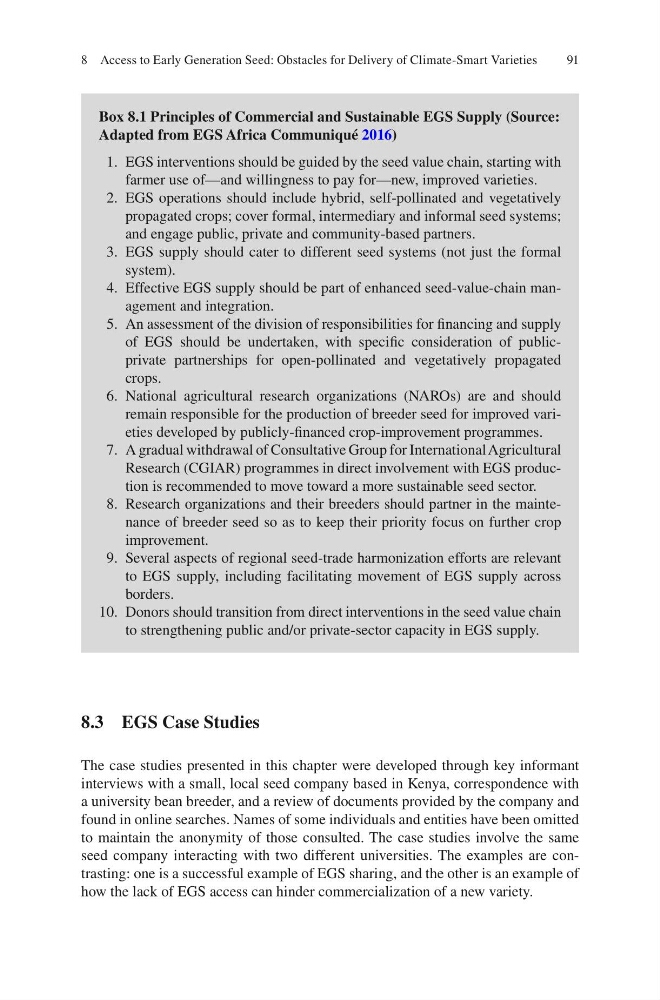
Box 8.1 Principles of Commercial and Sustainable EGS Supply (Source:
Adapted from EGS Africa Communiqué 2016)
1. EGS interventions should be guided by the seed value chain, starting with
farmer use of—and willingness to pay for—new, improved varieties.
2. EGS operations should include hybrid, self-pollinated and vegetatively
propagated crops; cover formal, intermediary and informal seed systems;
and engage public, private and community-based partners.
3. EGS supply should cater to different seed systems (not just the formal
system).
4. Effective EGS supply should be part of enhanced seed-value-chain management and integration.
5. An assessment of the division of responsibilities for financing and supply
of EGS should be undertaken, with specific consideration of publicprivate partnerships for open-pollinated and vegetatively propagated
crops.
6. National agricultural research organizations (NAROs) are and should
remain responsible for the production of breeder seed for improved varieties developed by publicly-financed crop-improvement programmes.
7. A gradual withdrawal of Consultative Group for International Agricultural
Research (CGIAR) programmes in direct involvement with EGS production is recommended to move toward a more sustainable seed sector.
8. Research organizations and their breeders should partner in the maintenance of breeder seed so as to keep their priority focus on further crop
improvement.
9. Several aspects of regional seed-trade harmonization efforts are relevant
to EGS supply, including facilitating movement of EGS supply across
borders.
10. Donors should transition from direct interventions in the seed value chain
to strengthening public and/or private-sector capacity in EGS supply.
8 Access to Early Generation Seed: Obstacles for Delivery of Climate-Smart Varieties
8.3 EGS Case Studies
The case studies presented in this chapter were developed through key informant
interviews with a small, local seed company based in Kenya, correspondence with
a university bean breeder, and a review of documents provided by the company and
found in online searches. Names of some individuals and entities have been omitted
to maintain the anonymity of those consulted. The case studies involve the same
seed company interacting with two different universities. The examples are contrasting: one is a successful example of EGS sharing, and the other is an example of
how the lack of EGS access can hinder commercialization of a new variety.
Box 8.1 Principles of Commercial and Sustainable EGS Supply (Source:
Adapted from EGS Africa Communiqué 2016)
1. EGS interventions should be guided by the seed value chain, starting with
farmer use of—and willingness to pay for—new, improved varieties.
2. EGS operations should include hybrid, self-pollinated and vegetatively
propagated crops; cover formal, intermediary and informal seed systems;
and engage public, private and community-based partners.
3. EGS supply should cater to different seed systems (not just the formal
system).
4. Effective EGS supply should be part of enhanced seed-value-chain management and integration.
5. An assessment of the division of responsibilities for financing and supply
of EGS should be undertaken, with specific consideration of publicprivate partnerships for open-pollinated and vegetatively propagated
crops.
6. National agricultural research organizations (NAROs) are and should
remain responsible for the production of breeder seed for improved varieties developed by publicly-financed crop-improvement programmes.
7. A gradual withdrawal of Consultative Group for International Agricultural
Research (CGIAR) programmes in direct involvement with EGS production is recommended to move toward a more sustainable seed sector.
8. Research organizations and their breeders should partner in the maintenance of breeder seed so as to keep their priority focus on further crop
improvement.
9. Several aspects of regional seed-trade harmonization efforts are relevant
to EGS supply, including facilitating movement of EGS supply across
borders.
10. Donors should transition from direct interventions in the seed value chain
to strengthening public and/or private-sector capacity in EGS supply.
8 Access to Early Generation Seed: Obstacles for Delivery of Climate-Smart Varieties