

90
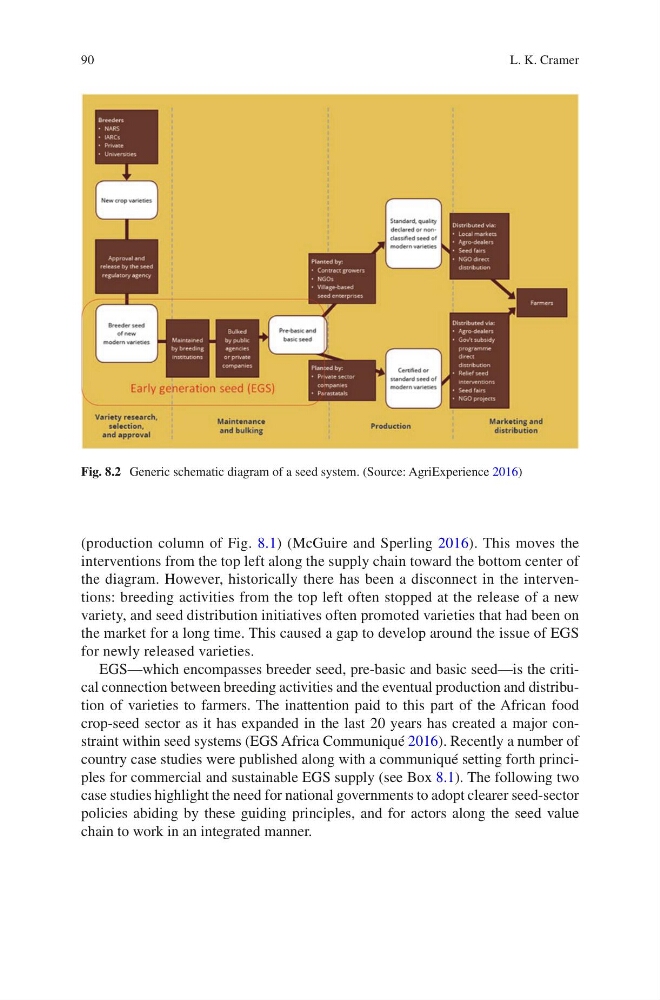
(production column of Fig. 8.1) (McGuire and Sperling 2016). This moves the
interventions from the top left along the supply chain toward the bottom center of
the diagram. However, historically there has been a disconnect in the interventions: breeding activities from the top left often stopped at the release of a new
variety, and seed distribution initiatives often promoted varieties that had been on
the market for a long time. This caused a gap to develop around the issue of EGS
for newly released varieties.
EGS—which encompasses breeder seed, pre-basic and basic seed—is the critical connection between breeding activities and the eventual production and distribution of varieties to farmers. The inattention paid to this part of the African food
crop-seed sector as it has expanded in the last 20 years has created a major constraint within seed systems (EGS Africa Communiqué 2016). Recently a number of
country case studies were published along with a communiqué setting forth principles for commercial and sustainable EGS supply (see Box 8.1). The following two
case studies highlight the need for national governments to adopt clearer seed-sector
policies abiding by these guiding principles, and for actors along the seed value
chain to work in an integrated manner.
Fig. 8.2 Generic schematic diagram of a seed system. (Source: AgriExperience 2016)
L. K. Cramer
(production column of Fig. 8.1) (McGuire and Sperling 2016). This moves the
interventions from the top left along the supply chain toward the bottom center of
the diagram. However, historically there has been a disconnect in the interventions: breeding activities from the top left often stopped at the release of a new
variety, and seed distribution initiatives often promoted varieties that had been on
the market for a long time. This caused a gap to develop around the issue of EGS
for newly released varieties.
EGS—which encompasses breeder seed, pre-basic and basic seed—is the critical connection between breeding activities and the eventual production and distribution of varieties to farmers. The inattention paid to this part of the African food
crop-seed sector as it has expanded in the last 20 years has created a major constraint within seed systems (EGS Africa Communiqué 2016). Recently a number of
country case studies were published along with a communiqué setting forth principles for commercial and sustainable EGS supply (see Box 8.1). The following two
case studies highlight the need for national governments to adopt clearer seed-sector
policies abiding by these guiding principles, and for actors along the seed value
chain to work in an integrated manner.
Fig. 8.2 Generic schematic diagram of a seed system. (Source: AgriExperience 2016)
L. K. Cramer