

74
6.5 Enhancing the Delivery of CS Maize Varieties:
Harmonising Seed Laws and Promoting Adoption
In addition to increasing the rate of genetic gain for CS varieties, regional bottlenecks in releasing, disseminating and adopting new varieties in ESA must be
addressed in order to incentivise the private sector to invest in crop improvement, to
reduce product life cycles, and to ensure certified seed of CS varieties reach smallholder farmers. ESA presents an attractive maize seed market (currently 20% that of
North America) and many countries share common agro-ecologies which eases
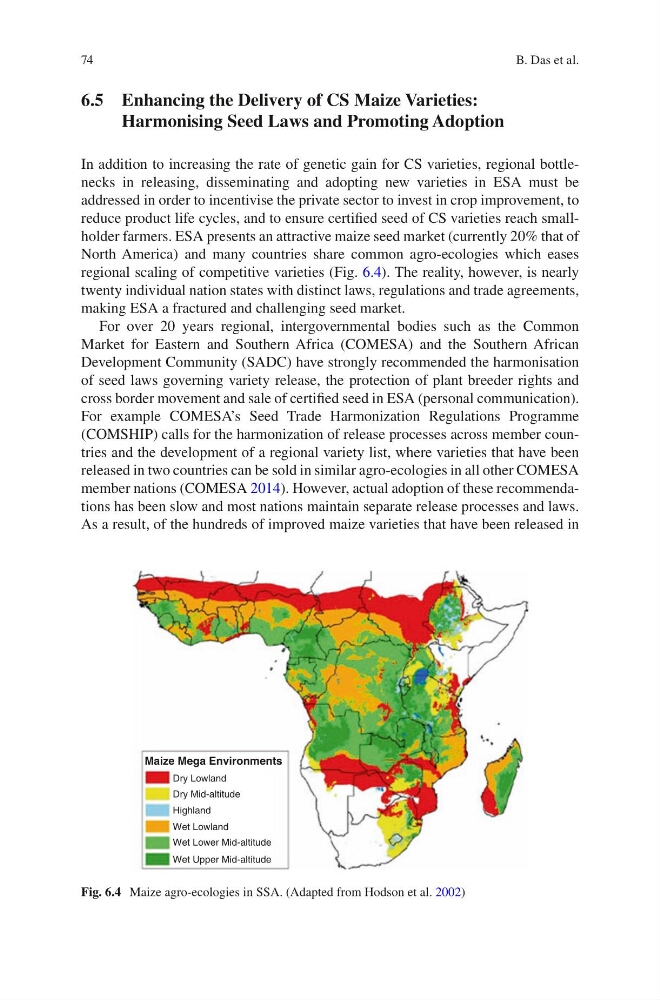
regional scaling of competitive varieties (Fig. 6.4). The reality, however, is nearly
twenty individual nation states with distinct laws, regulations and trade agreements,
making ESA a fractured and challenging seed market.
For over 20 years regional, intergovernmental bodies such as the Common
Market for Eastern and Southern Africa (COMESA) and the Southern African
Development Community (SADC) have strongly recommended the harmonisation
of seed laws governing variety release, the protection of plant breeder rights and
cross border movement and sale of certified seed in ESA (personal communication).
For example COMESA’s Seed Trade Harmonization Regulations Programme
(COMSHIP) calls for the harmonization of release processes across member countries and the development of a regional variety list, where varieties that have been
released in two countries can be sold in similar agro-ecologies in all other COMESA
member nations (COMESA 2014). However, actual adoption of these recommendations has been slow and most nations maintain separate release processes and laws.
As a result, of the hundreds of improved maize varieties that have been released in
Maize Mega Environments
Dry Lowland
Dry Mid-altitude
Highland
Wet Lowland
Wet Lower Mid-altitude
Wet Upper Mid-altitude
Fig. 6.4 Maize agro-ecologies in SSA. (Adapted from Hodson et al. 2002)
B. Das et al.
6.5 Enhancing the Delivery of CS Maize Varieties:
Harmonising Seed Laws and Promoting Adoption
In addition to increasing the rate of genetic gain for CS varieties, regional bottlenecks in releasing, disseminating and adopting new varieties in ESA must be
addressed in order to incentivise the private sector to invest in crop improvement, to
reduce product life cycles, and to ensure certified seed of CS varieties reach smallholder farmers. ESA presents an attractive maize seed market (currently 20% that of
North America) and many countries share common agro-ecologies which eases
regional scaling of competitive varieties (Fig. 6.4). The reality, however, is nearly
twenty individual nation states with distinct laws, regulations and trade agreements,
making ESA a fractured and challenging seed market.
For over 20 years regional, intergovernmental bodies such as the Common
Market for Eastern and Southern Africa (COMESA) and the Southern African
Development Community (SADC) have strongly recommended the harmonisation
of seed laws governing variety release, the protection of plant breeder rights and
cross border movement and sale of certified seed in ESA (personal communication).
For example COMESA’s Seed Trade Harmonization Regulations Programme
(COMSHIP) calls for the harmonization of release processes across member countries and the development of a regional variety list, where varieties that have been
released in two countries can be sold in similar agro-ecologies in all other COMESA
member nations (COMESA 2014). However, actual adoption of these recommendations has been slow and most nations maintain separate release processes and laws.
As a result, of the hundreds of improved maize varieties that have been released in
Maize Mega Environments
Dry Lowland
Dry Mid-altitude
Highland
Wet Lowland
Wet Lower Mid-altitude
Wet Upper Mid-altitude
Fig. 6.4 Maize agro-ecologies in SSA. (Adapted from Hodson et al. 2002)
B. Das et al.